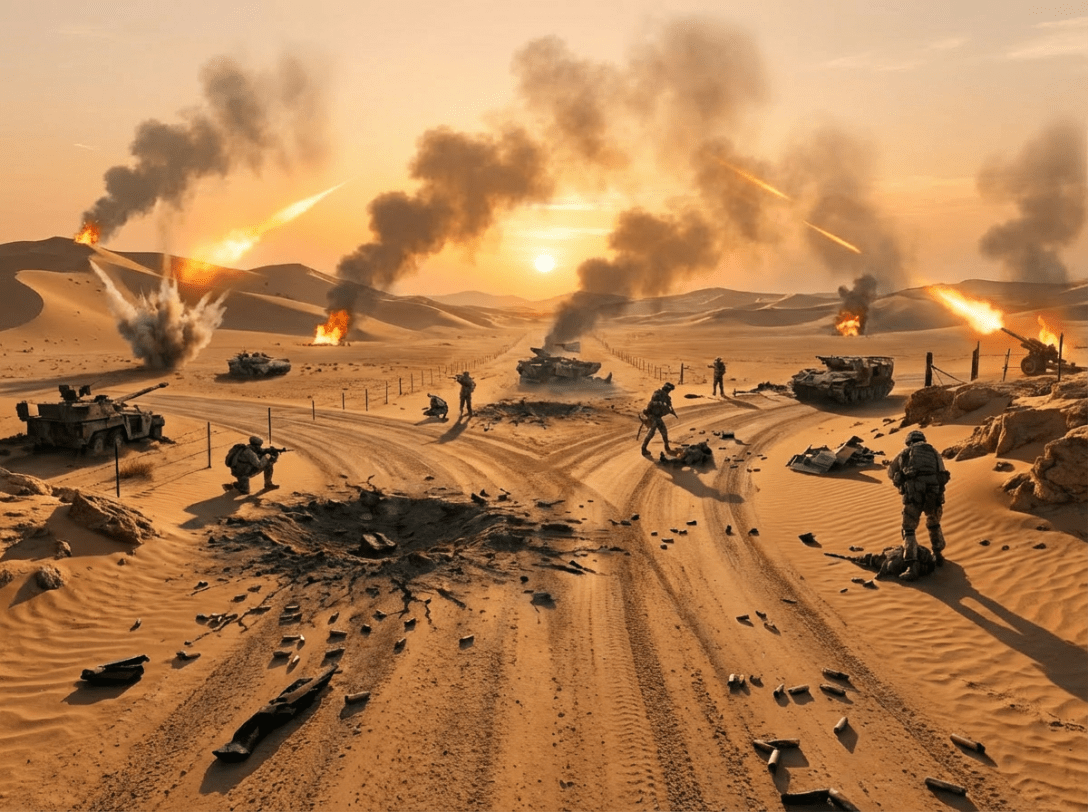
To hear detractors tell it, we are badly losing a miscalculated enterprise from the start, facing incredibly limited options with no plan to speak of. Needless to say, supporters disagree and the truth is likely in between.
As the world reels from a now unprecedented spike in oil prices (March was the largest single month increase on record) and other supply chain disruptions prompted by President Donald Trump’s equally unprecedented decision to take military action against Iran, it’s worth considering the questions that remain unanswered and the reality there are likely far more options to end the conflict than are regularly reported.
To hear President Trump’s detractors tell it, the US is badly losing a badly miscalculated enterprise from the start, facing incredibly limited options with no plan to speak of. According to The Nation, for example, “there is no avoiding the truth: The United States is, in fact, losing this war.” In their view, despite some 11,000 strikes and counting, “as anyone with eyes can plainly see, the Iranian military continues to fight, not just in a flailing and minuscule way as the president implies, but with consistent levels of ballistic missile fire towards both Israel and American bases in the Gulf,” remains capable of “additional waves of attacks and shows no sign of stopping or even dropping the number of missiles and drones it fires,” and despite “claims of the destruction of the Iranian Navy, the Strait of Hormuz remains closed to all shipping from nations the Iranian state deems to be hostile.” As a result, seemingly “all other objectives of the war, be they degrading the Iranian military’s capabilities or overthrowing the Islamic Republic, have fallen by the wayside as the American government desperately attempts to control the price of oil, and reopen the Strait that was previously completely open before the war.” From there, they make a comparison to Vietnam to better illustrate their position, claiming there is an “apt historical comparison for this over-emphasis on sorties flown, strikes conducted, and commanders killed, over all other obvious, abundantly clear indicators of victory: Vietnam. General William Westmoreland, the American military chief of staff whom Iranian Foreign Minister Abbas Araghchi has compared to Trump officials, regularly boasted of weapon loss statistics and kill ratios as evidence that the tide was turning against Ho Chi Minh. Defense Secretary Robert McNamara told the Senate in 1965 that the US was flying 13,000 sorties a month against the North Vietnamese, that 1,900 ‘fixed targets’ had been hit, and that the US had been ‘hurting North Vietnam’s war-making capability.’ Westmoreland would declare in 1967 that ‘we have reached an important point when the end begins to come into view.’ The war would rage on for another 8 years, ending with the fall of Saigon to the communists.”
Of course, Vietnam was an effort that ultimately saw around 550,000 troops deployed in the country, resulting in over 58,200 fatalities compared to zero troops deployed in Iran and 13 casualties, seven from an accident. To square that proverbial circle, The Nation assumes we are on the verge of deploying some unspecified number of troops and that many of them will die, “there is a growing consensus among the Trump administration that ground troops are, in fact, needed to impose the control that the US has supposedly already taken. As of this writing, thousands of US troops are heading to the Persian Gulf region, as reports swirl about a potential landing on Kharg Island, or perhaps any number of other Iranian islands in the Gulf and in the Strait, where thousands, if not tens of thousands of Iranians, could soon come under direct American military occupation. The Iranian military, for its part, has been increasing its previously bombarded defenses on Kharg, anticipating the kind of invasion its military strategists have been anticipating for most of the Islamic Republic’s history.” Though The Nation readily admits they have no idea what happens next, saying outright, “Whatever happens next, this is not what a won war looks like. Instead, the mission creep of the war against Iran continues to lurch forward. The question of a potential new forever war that will cost many more thousands of Iranian lives, to say nothing of the American soldiers who would be in the line of direct Iranian fire, has been treated with a completely cavalier attitude,” they are convinced we are on a clear, near inevitable path to defeat.
Not surprisingly, President Trump’s supporters – myself included to a large extent – would use some of these same facts to tell a completely different story. While the Iranian military “continues to fight,” there is no doubt they have been significantly degraded. The Nation cited “consistent” levels of ballistic missile and drone attacks,” but that’s only true if you ignore the much higher volume of attacks when the conflict began on February 28. Initially, Iran was able to fire hundreds of both per day – 194 missiles and 232 drones on day one, followed by 34 missiles and 343 drones on day two – yet, as the war has progressed, these numbers have plummeted. According to NBC News, by day 14 drone launches dropped by 95% and it was estimated that 70% of their launchers and stockpiles have been destroyed. Over the past week or so, they are continuing to launch between 9 and 48 attacks per day, and those attacks have increasingly relied on drones as opposed to the more serious ballistic missile fire power, indicating a dramatic decline. The Nation has also conveniently glossed over the damage we have done to their manufacturing capabilities, and of course, their leadership including killing the Supreme Leader of the entire country on day one, the Ayatollah Ali Khamenei who has ruled since 1989, along with over 40 of his top officials. In addition, they completely failed to mention that the current Supreme Leader has not been seen since he was selected, and could well be dead or in a coma, which would not generally be seen as a sign of strength. Nor do they say anything about the damage we have done to their technical infrastructure, cutting off most of the internet and disabling their banking systems, or that our allies have also targeted them financially, with the United Arab Emirates freezing $530 billion in assets this week alone leading some to suggest they are close to bankruptcy. Further, while The Nation acknowledged the pain we have inflicted on the Iranian Navy, they seem to forget that we have also destroyed their air force and proceeded to mischaracterize the situation in the Strait of Hormuz, suggesting that there is a physical blockade like the great chain that blocked the Blackwater Rush in the book version of Game of Thrones, trapping Stannis Baratheon’s fleet. Instead, Iran has merely been able to threaten and harass ship traffic, instilling fear that prevents people from passing for obvious reasons, a distinction with a dramatic difference in terms of their overall military capability if not the current impact on shipping and resulting prices. Lastly, they make no mention whatsoever about a potential cease fire or permanent truce deal in the near future.
As the old saying about there being three sides to every story, the husband’s, the wife’s, and the truth has it, the reality is likely somewhere in the middle with several key questions completely unanswered and to outside observers or even the President himself, unanswerable at this time. While Iran’s ability to project force via missiles and drones has been seriously degraded, they remain a threat and it’s unclear what capacity they still have. How long can they continue at this volume and what damage can they do to critical assets like oil infrastructure in neighboring countries, enough to threaten the world’s oil supply? Do they have a reserve that would enable them to increase their volume in a more devastating attack than we’ve seen so far? Do they truly have the ability to prevent passage of ships through the Strait, especially if they were escorted by the US or another country’s military, and do we just need to test them to reveal that most of their so-called control is psychological? While Iran’s leadership has been damaged, has it succeeded in fracturing those that remain, creating competing factions that can be exploited and putting the regime in a more precarious position than they are projecting beyond the complete absence of their Supreme Leader? Below the top level of leadership, have there been defections and desertions, and are they desperate for basic manpower as some reports suggest? Is there any truth to the notion that Iran is seeking a deal if it contains certain guarantees and that most of their public statements are pure propaganda? What is really the likelihood of the US committing ground troops beyond conducting targeted, special operator driven strikes? Are we really inching closer to a classic quagmire like Vietnam or more recently Iraq?
While I wish I had answers to these questions, all I can offer are opinions with varying degrees of confidence like everyone else. There are two things, however, that I can offer with a high degree of confidence. First, as has frequently been the case, President Trump has been his own worst enemy particularly regarding the messaging aspects of a war fought in the media as well as the battlefield. While it might be possible for me to defend most of his statements in isolation, adjusting for the usual bombast and braggadocio, taken together over the course of the last month, they are, to put it politely, all over the place. He has veered from proclaiming victory multiple times to providing different versions of what victory even means. This culminated in a sense yesterday, when President Trump declared that reopening the Strait of Hormuz is no longer a requirement to ending the war. According to The Wall Street Journal, “President Trump told aides he’s willing to end the U.S. military campaign against Iran even if the Strait of Hormuz remains largely closed, administration officials said, likely extending Tehran’s firm grip on the waterway and leaving a complex operation to reopen it for a later date.” Even normally Trump-friendly commentators, such as HotAir.com’s Ed Morrissey were unimpressed. Rightly in my opinion, he claimed “this is more easily said than done. There are several reasons why Trump can’t afford to leave the Strait to Europe or anyone else.” From there, he went on to cite several reasons including “Europe can’t do it,” “If we don’t keep control, China will take it,” “Our Gulf allies are finally aligned on Iran,” “A closed Strait of Hormuz is our problem too,” “Sustained high prices benefit the wrong players,” and “TACO,” meaning the President would be undercutting the strength of his own position. Later, Mr. Morrisey expanded on this inconsistency on X, opining that “Trump sounds like he wants to abruptly leave; Hegseth wants to go the full Curtis LeMay; Rubio wants to talk with rational alternatives. Either this is the most incoherent winning side of a war in human history, or there’s a strategy in place.”
Obviously, I cannot speak on behalf of President Trump, but Mr. Morrissey’s quip transitions nicely to the second point I can make with high confidence: Strategic ambiguity in general is one of the most under-appreciated aspects of the conflict. Much of the doom, gloom, and naysaying implicitly assumes that the war continues much longer than President Trump has publicly stated. Whether you call it a quagmire or something else, The Nation’s notion that we are losing is at least partially predicated on our inability to extricate ourselves in an advantageous position in the near future. Likewise, the predictions of a global economic collapse, massive inflation, oil shortages, fertilizer shortages, and the other worst case scenarios all assume that the Strait remains essentially closed for an extended period. While they rarely say how long that period may be, figure it is at least a few months if not more. The challenge with that position and the reason I remain confident despite the currently unanswerable questions I’ve raised here, playing devil’s advocate with myself, is that it has always been within our power to end the conflict any time. Contrary to conventional wisdom, unless you believe Iran would be unwilling to make a simple exchange to end our hundreds of strikes per day, forget what else we might do, and stop targeting their leaders to open the Straits, there has been an admittedly unsatisfactory deal to be had the entire time. Personally, I think we will get a better one that achieves the great majority of our objectives if not full on regime change, and not surprisingly, there will indications of it yesterday when Iran’s President, Masoud Pezeshkian announced, “We possess the necessary will to end this conflict, provided that essential conditions are met, especially the guarantees required to prevent repetition of the aggression,” and followed up on X claiming specifically that the Strait should open again. “To de-escalate the situation, I urged Iran to stop the unacceptable attacks on countries in the region and to engage positively on the diplomatic track, notably with the UN to ensure the freedom of navigation in the Strait of Hormuz.” To be sure, it’s war, anything can still happen. It’s possible the President doesn’t have the power to make a deal, but we’re negotiating with others in the country as well. Either way, whether we are looking at a truly decisive victory or a smaller one, it seems clear to me at least that the war will end long before the predicted disasters and it will do so with a significantly chastened Iran. In fact, we might know more this evening when President Trump addresses the country.

 Confessions of a Conservative Atheist