Confining the Oscar-winning film to a story of grief undervalues a far more wide ranging work that can be said to include the totality of the human experience in around 4,000 lines, but does so in a way both powerful and accessible.
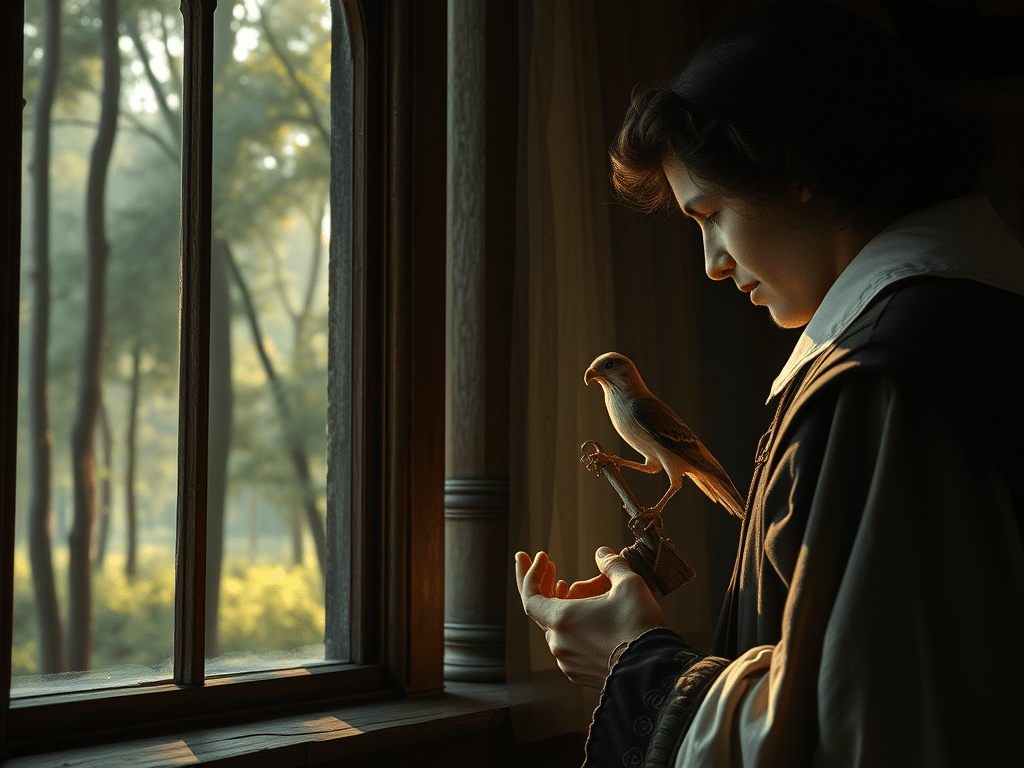
Hamnet, the Oscar-winning film, inspired by real events in the life of William Shakespeare begins with an intriguing premise. Rather than consider Shakespeare the writer, artist, thinker, theater producer, or actor, Hamnet focuses almost exclusively on Shakespeare the man and his relationship with his wife and family. Indeed, the film begins before the pair have even met, imagining Shakespeare working as a Latin tutor and seeing Agnes through a window as she approaches the house after feeding her falcon in the forest. The two are depicted as outsiders from the very start, hovering on the fringes of a proper life in late 15th century England. Shakespeare struggles against a domineering father who believes his obsession with learning is frivolous, and who wishes to see him spend his life as a leatherworker in a shop. Agnes’ mother passed away during childbirth and while she has a loving relationship with her brother, she lives with his family and his wife, who find her behavior and obsession with the woods near their home unsettling. At some point, she describes her mother as “coming out of the woods” the way all of the women in the family do, introducing a mystical element to the proceedings. Despite their differences, the two develop a bond and Agnes ultimately gets pregnant, prompting them to make their handfast marriage official even in the face of opposition from their families. Throughout this portion of the film, there is little to no mention made of Shakespeare’s desire to be an author or of his possessing any kind of vast ambition to change the entire world of literature. We understand that he is educated and doesn’t fit in at a regular job in the Elizabethan Era, especially after he confronts his father and walks out of the shop, but of his artistic aspirations, we only know what we brought with us before we started watching.
Even after their first baby is born – Agnes takes to the wood by herself for the birth – we know only what we can glean from a conversation between her and her brother. She tells him that Shakespeare cannot spend his life in the country and needs to be in London, but even at that point, we see nothing of his life there, knowing only that he travels back and forth between the city and the country. After Shakespeare departs, Agnes gets pregnant again and rather than being free to birth in the woods as for her first child, she is restrained in her house by the maid and a family member before ultimately having twins, a boy, Hamnet and a girl, Judith. Shakespeare himself isn’t present for their arrival to this world, but through a series of rapid time shifts as all three children age, we understand him to be a devoted father despite his business in London. We also come to understand that Agnes has no interest in living in a city – something about the forest calls for her too deeply – and though Shakespeare tries to lure her to a luxurious house in the equivalent of a suburb at Stratton, she has no desire to go there either. The purchase of the largest house in the area also provides a clue that Shakespeare’s career has taken off and he is earning significant money, but it’s positioned as an impediment to familial happiness rather than an improvement in their lives, at least at first. We get the sense as well that Shakespeare himself is torn between both worlds. While we cannot say precisely what he’s up to in London, he clearly misses his family deeply, enjoys spending time with them, even has them perform a little bit of Macbeth as the witches, and in a touching moment, gives his son, Hamnet, something of a pep talk to be brave and look after their mother when he is away. To those who are aware of what’s coming next, the moment is also foreboding. The younger twins are around eleven years old at this point, when the plague sweeps through England killing more than 15,000 in London alone. At first, the twin sister is struck, but ultimately the cruel disease takes young Hamnet after he wishes he could switch places with her. Agnes wakes up to discover that her daughter lives, but her son is in dire shape before dying in agony in her arms even as she attempts to save him.
Shakespeare himself has rushed from London, believing his daughter is sick, but he doesn’t arrive in time. At first, he sees his Judith alive and on the mend, believing for a moment that his family has been spared, only to discover that Hamnet is dead under a sheet in the back of the room, devastating him. For her part, Agnes takes out her grief on her husband, blaming him for not being there when the family needed him most and though she had encouraged him to pursue a career in London, she now views his absence as a frivolous escape. Shakespeare is equally devastated, but rather than deal with his grief directly, he heads back to London where he is rehearsing the play, Hamlet, and we begin to see some of his life there. Consumed by grief, Shakespeare only half-heartedly attempts to provide direction during one of Hamlet’s pivotal scenes, when the titular prince informs Ophelia that he never loved her, questions why she would want to be a mother of sinners, and tells her to get to a nunnery instead, a moment that begins her descent into madness. The actor playing Hamlet struggles with his lines, however, prompting Shakespeare to tear into him that he’s merely reading words, rather than living him. Shakespeare himself steps into the role and delivers some of the most biting lines in the play which also serve as a double meaning, more on that in a moment:
Get thee to a nunnery. Why wouldst thou be
a breeder of sinners? I am myself indifferent honest,
but yet I could accuse me of such things that it
were better my mother had not borne me: I am
very proud, revengeful, ambitious, with more offenses
at my beck than I have thoughts to put them
in, imagination to give them shape, or time to act
them in. What should such fellows as I do crawling
between earth and heaven? We are arrant knaves
all; believe none of us. Go thy ways to a nunnery.
At this point, it seems clear that Shakespeare is confusing his own feelings with the character, something made more plain in the next sequence where he comes close to committing suicide in the Thames while delivering the infamous “to be or not to be speech” in sparse, tortured, pained language. While these events are occurring, Agnes is struggling alone at home, only to discover that her husband is producing a new play, Hamlet, obviously inspired by Hamnet to some extent (a note that opening explains that the names were interchangeable at the time). She proceeds with her brother to the legendary Globe Theatre to find out for herself and almost has a breakdown over what she immediately considers a poor copy of her son on stage, only to realize that Shakespeare is playing the father’s ghost. She begins to become moved when he describes his own death at the hands of his uncle, how he forgives his wife for her own adultery, saying “Taint not thy mind, nor let thy soul contrive Against thy mother aught. Leave her to heaven And to those thorns that in her bosom lodge To prick and sting her,” and becomes enraptured with how Shakespeare used his own grief at the loss of his son to fuel and inform the play. By Hamlet’s fateful death in the end, she reaches out to hold the hands of the actor during his final lines, “the rest is silence,” and the rest of the audience extends their hands as well, sharing in communal grief. Agnes spies her husband gazing at her from backstage, the two exchange a moment suggesting she finally understands that he has been as wounded as she, and his method of dealing with it was creating one of the world’s foremost literary masterpieces, if not the foremost.
In this sense, Hamnet works on one level and fails on another. Hamlet certainly experiences his fair share of grief at the death of his father, the betrayal of his mother, the usurpation of his crown, and the potential dissolution of his kingdom controlled by his drunken, carousing uncle. The film wisely in my opinion focuses the story on the personal rather than the literal instead, allowing Hamlet to be seen as a vehicle for recovery and renewal on a thematic level. Visually and narratively, the film subtly leans into this as well by making it unclear whether the mysticism of the forest is real or imagined, whether Hamnet truly did change places with his sister somehow, and generally rendering the world a little more wild and untamed than it is naturally, a place where like Hamlet’s Denmark, ghosts still exist. Also like Hamlet, this is is juxtaposed with a more mechanical view – mundane jobs, diseases, etc., the drudgery of life – as Hamlet himself lives in a world with ghosts, and yet insists on believing he is rational and there is no special providence in the fall of a sparrow. At the same time, confining Hamlet to a story merely of grief and renewal, positioning it as being driven by the loss of Shakespeare’s son, fundamentally undervalues a far more wide ranging work that can be said to include the totality of the human experience in around 4,000 lines.
The late, great literary critic Harold Bloom referred to it as a “poem unlimited” for a reason. In a book of the same title, he argued that the play is a “kaleidoscope” that defies genre conventions as both a “revenge upon revenge tragedy” popular in Elizabethan England and a “cosmological drama” where the play’s true subject is “Hamlet’s consciousness of his own consciousness” as it is “at war with itself.” Interestingly, Bloom too saw it as deeply personal to Shakespeare and deeply influenced by the deaths of Hamnet and his father, only rather than grief, he concluded that Shakepeare needed to confront every aspect of the human experience at once. As he put it in an interview in 2003 where he also noted that the names were interchangeable, Shakespeare was “searching for something in himself, something that will suffice perhaps and what he comes up with does not altogether make him happy. His protagonist, his hero as it were, is an amazingly mixed being. I cannot think of anyone in the entire history of literature, just as you know one who knows a great many people, when has been teaching for 50 years, I calculated the other day when I was lying in a hospital bed, from which I have fortunately been resurrected, that I had now taught some 35,000 separate individuals, which is you know almost crushing in a way when worries can one really know so many people. I have never met a person and never encountered a literary figure who is able to combine absolute contraries, really contradictions as Hamlet does. He is at once more given to theatricality than any other figure and yet also given to a sign of terrifying inwardness which keeps growing and growing further and further into the deeps and that’s an amazing combination.” In that regard, it seems to me to be purposeful that Hamnet contains the Hamlet quote that encapsulates this idea, albeit in an aggressive, negative way. Hamlet is seething at Ophelia when he claims, I have “more offenses at my beck than I have thoughts to put them in, imagination to give them shape, or time to act them in,” but read on a higher plane than a personal attack, it suggests a depth that cannot be easily divined. While Hamnet the film only hints at this, perhaps it’s for the best in making inaccessible depths easily accessible, using a grief we can all understand as an entry point. Either way, it’s an intriguing, powerful take on a nearly unlimited poem.

 Confessions of a Conservative Atheist