At this point, if anyone truly believes either Denmark or the broader European Union can be trusted to safeguard Greenland against Russia and China, there’s an old expression about a bridge for sale.
In season two of Netflix’ of The Diplomat, the potential for Russia to launch a sneak attack against the United States by sending nuclear submarines across the Arctic and North Atlantic Oceans, north of Scotland and then south of Greenland is so great that the Vice President, the fictional Grace Penn, conspires with an equally fictional British politician to launch a false-flag attack against Britain itself. Her fear is simple: The only high–tech base the US operates in that corridor, a real world location known as Creegan, that can support our own advanced nuclear submarines and the other sophisticated technology required to detect potential incursions is in Scotland and in the world of the show, Scotland is considered seceding from the United Kingdom. If they become an independent country, they could eject the United States from the base and open us, the British Isles, and the rest of Europe up to potential attack. The need to continue operating Creegan as a deterrent to Russia was so compelling, that the Vice President initiated an attack on a British vessel, the Courageous, and framed Russia itself for the act of war, believing it would inspire nationalism in the United Kingdom that would prevent Scotland from voting for independence. As the Vice President puts it, “The Scots hate nukes, and they hate English overreach, but they really hate having a bullseye on their heads.” Though the false flag attack resulted in the death of 43 British sailors, she claimed that was the cost of protecting up to “40 million” from nuclear war. While the scenario is certainly far-fetched, it is based on a strategic reality: The corridor the Vice President feared could be used for a sneak attack on America exists. There is essentially a straight shot over the top of Scotland and below Greenland, known as the GUIK gap for Greenland itself, Iceland and the United Kingdom, that would deposit nuclear submarines not far from New York City. The VP sought to limit that risk by ensuring the base remained in Scotland, but in a case of life imitating art, President Donald Trump seeks to control Greenland as an additional deterrent, at times claiming he would use force if necessary, to limit the risk in the real world.
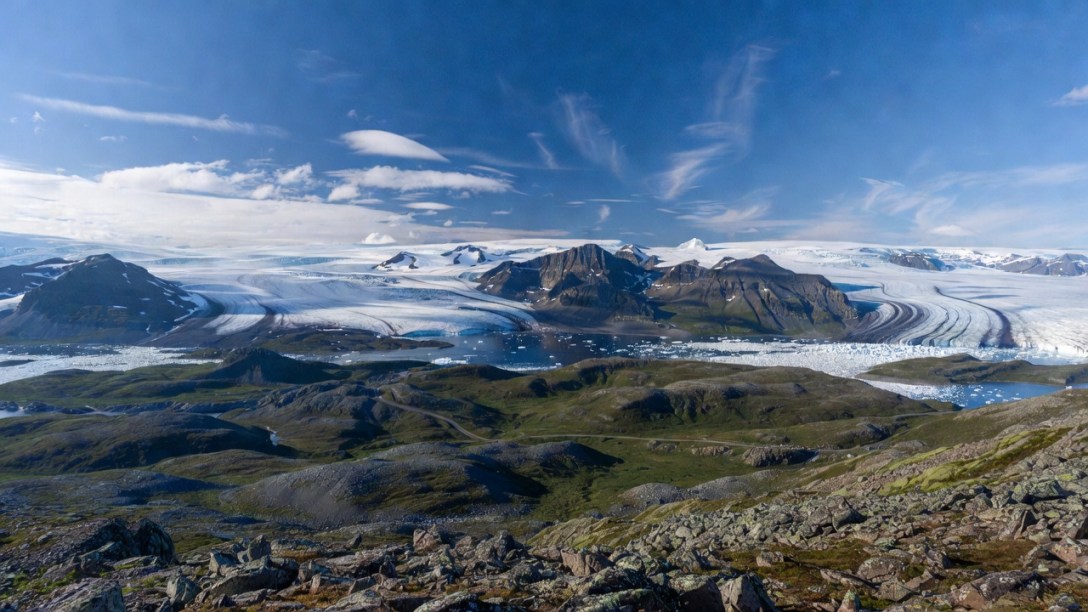
Despite the surprise of Democrats, progressives, and their affiliated media allies, Greenland has long been considered of strategic importance to the United States and the entire world both in fiction such as The Diplomat and reality itself. The reason is simple: The GUIK gap is the only direct path from Russia to North America to the east of the continent, is relatively small in ocean terms and can be far more easily patrolled and controlled than the broader Atlantic, making it a vital choke point. As early as World War II, the gap was exploited by the Nazis as a way to attack cross-Atlantic shipping until the Allies took control with Britain occupying Iceland in April 1940, situated almost directly in the middle of the gap, and the United States, rather ironically occupying Greenland in May 1940. During the Cold War, the United States and the UK continued partnering to protect the gap, installing an underground chain of listening points to detect submarines while the Soviet Union itself conducted drills to ensure they could make it through if the Cold War suddenly turned hot. Since then, Russia has not abandoned that route. They conducted a massive military simulation as recently as 2019, using ten submarines for two months, to ensure they could still penetrate the gap and make it through undetected. A year earlier, another United States adversary, China declared itself a “near-Arctic state” with a desire to have more influence in the region, announcing plans to build a “Polar Silk Road” as part of its plans to remake the world order. As Mike Pompeo, then Secretary of State, put it at the time, “Do we want the Arctic Ocean to transform into a new South China Sea, fraught with militarization and competing territorial claims?” Even as it stands right now, Greenland hosts the Pituffik Space Base that provides distant early warning and missile defense. As Spenser A. Warren recently described it for the military website War on the Rocks, “Greenland is strategic.” “As sea temperatures and geopolitical tensions simultaneously heat up, Greenland’s strategic importance increases. Against this backdrop, the specter of American territorial expansion has emerged as a new factor that is complicating Arctic security. The evolving security environment in the Arctic necessitates deeper American involvement in the region. Specifically, the United States needs to enhance its military presence in Greenland by improving regional air and missile defenses. Future developments could call for other actions, such as reopening closed bases and deploying more troops to Greenland.”
Mr. Warren is not alone in this assessment, nor is Greenland only of military importance. Danica Kirka and Stefanie Dazio of the Associatee Press both concurred with that and added the importance of rare earth minerals to the equation, writing earlier this month “Location, location, location: Greenland’s position above the Arctic Circle makes the world’s largest island a key part of security strategy. Increasing international tensions, global warming and the changing world economy have put Greenland at the heart of the debate over global trade and security, and U.S. President Donald Trump wants to make sure his country controls the mineral-rich island that guards the Arctic and North Atlantic approaches to North America.” They continued to expound that “Greenland is also a rich source of the so-called rare earth minerals that are a key component of cellphones, computers, batteries and other high-tech gadgets that are expected to power the world’s economy in the coming decades. That has attracted the interest of the U.S. and other Western powers as they try to ease China’s dominance of the market for these critical minerals. Development of Greenland’s mineral resources is challenging because of the island’s harsh climate, while strict environmental controls have proved an additional hurdle for potential investors.” As it currently stands, claiming China dominates this market is an understatement. They account for up to 70% of mining and about 90% of processing and refining, nor are they afraid to use that fact to their advantage in world affairs. In 2023, the Heritage Foundation reported that they have “essentially pushed Western companies out of the rare earth mining and processing business” and “Experts have repeatedly urged Washington to address this critical national security vulnerability.” As early as 2010, China intentionally reduced supplies to Japan over a dispute about a group of uninhabited Islands. Last year, they further restricted exports on rare earth minerals and even more common minerals like silver. In October, BBC reported on “Why the US needs China’s rare earths.” “The trade war between China and the US has reignited after a truce lasting months – this time over rare earths. China has a chokehold on the minerals which are used in the making of electric cars, electronics and military weapons. It has tightened its grip over rare earth exports in recent months, and now requires companies in China to get government approval before shipping the minerals abroad. These curbs have dealt a major blow to the US, whose industries are heavily dependent on imports of the precious metal. Analysts say China is using its dominance as a key bargaining chip in trade talks with Washington.”
Given Greenland’s obvious and well established strategic and economic importance, the question becomes what is the best means to ensure the largely ice-covered, sparsely inhabited island remains well protected from incursion by our adversaries, well-equipped with surveillance equipment and military assets should the need to act arise, and properly invested in to maximize the output of rare earths? Currently, Greenland is a self-governing territory of Denmark, not exactly a confidence-inspiring world superpower. While I am sure the setting for Hamlet has its charms, it remains a tiny country of about 6 million people, almost 40% of which live in New Zealand rather than Denmark proper. While citizens enjoy a high standard of living, its GDP of about $450 billion ranks a paltry 52nd in the world and its military is essentially non-existent with a budget of $21 billion, less than a fortieth of what the US spends, and 21,000 active duty members, barely one sixtieth of US strength. Further, the country has no experience mining rare earths and little mining industry to speak of, employing only around 4,000 people and focused primarily on basics such as oil, gas, sand, gravel, and stone. By any reasonable standard, they are far from equipped to handle a situation of Greenland’s importance. Sadly, the entire European Union doesn’t fare much better as either a producer of rare earths or a bulwark against Russia and China. Forget that they were unable to prevent Russia from invading Ukraine in their own backward so to speak, but prior to the invasion they allowed Russia to be their largest supplier of crude and refined oil, essentially funding the aggressor in the conflict. Though imports of crude have dropped dramatically, they still import diesel, jet fuel, and natural gas, and do not plan to stop doing so until 2028 – six years after Russia invaded a European country. They are also actively courting investments from China. After a decline in Chinese investment in 2023, the numbers rebounded in 2024 and show no signs of slowing down. In fact, French President Emmanuel Macron called for even more investment just this week. “China is welcome, but what we need is more Chinese foreign direct investments in Europe, in some key sectors, to contribute to our growth, to transfer some technologies, and not just to export towards Europe, some devices or products which sometimes don’t have the same standards, or are much more subsidized, than the ones being produced in Europe,” he said. While some have attributed this to President Trump’s desire to control Greenland directly, Jian Junbo, director of the Center for China-Europe Relations at Fudan University’s Institute of International Studies, told the Global Times that “this stance on China is not something new, or an immediate action responding to US’ recent tariff threat over Greenland. It in fact shows that the EU – as a whole – has been trying to rebalance its China approach in face of rising protectionism as well as the US’ hegemonic moves.”
At this point, if anyone truly believes either Denmark or the broader European Union can be trusted to safeguard Greenland’s future, there’s an old expression about a bridge for sale. As President Trump put it at the World Economic Forum earlier this week, “no nation or group of nations is in any position to be able to secure Greenland, other than the United States.” Of course, everyone knows this, but because President Trump has been pushing Greenland’s importance and making it clear he feels the island needs to be under US control, the usual suspects are equal parts opposed to and outraged at the mere suggestion, pretending that all of this is somehow under control already and there’s nothing to be concerned about while fully knowing that’s not the case. Admittedly, the President has been rather bellicose on the issue – threatening potential use of force and sanctions until just yesterday – but to anyone that’s even casually observed him for more than a decade in the political arena, that’s simply his way and you have either come to terms with it or you haven’t. That doesn’t change the reality that Greenland needs to be secured one way oor another and anyone with a fair mind should hope that the “framework” for a deal President Trump announced yesterday is the real thing.

 Confessions of a Conservative Atheist