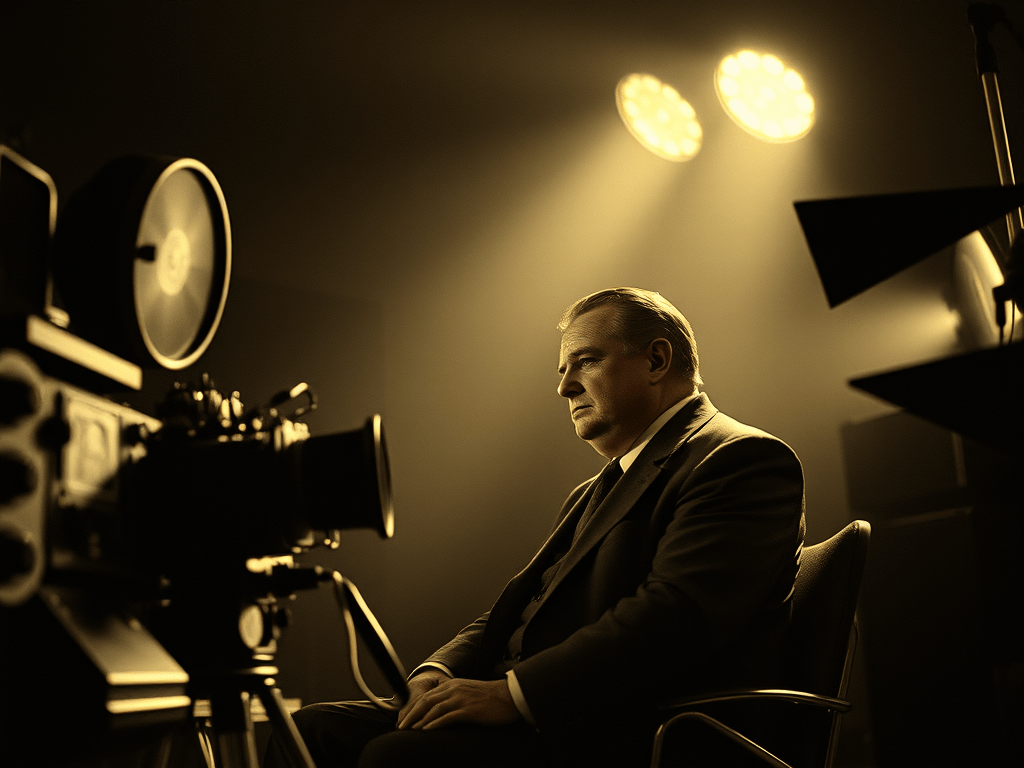
Released in 1941, Citizen Kane is widely regarded as the greatest film ever made despite my falling asleep twice during it in film school, ranked so by the British Film Institute’s poll of critics while also topping the American Film Institute’s 100 Years…100 Movie’s list, but what does that really mean?
I’ll confess: I fell asleep not once but twice while watching Citizen Kane for the first time and I was in freaking film school when I did so. I’m not sure if it was my tender age, my roommate, who was also in film school and had the same problem, or the alcohol consumed before and after, maybe even during, but something about the film simply didn’t do it for me. In class, we studied the myriad ways Orson Welles had taken filmmaking to a new level, inventing techniques both technical and narrative that continue to be utilized over a century later. The layered audio and equally layered, out of order story telling; the use of deep focus and the focus of each character on Kane’s life; the contrast between light and dark in the cinematography juxtaposed against the character study in the film; the tracking shots that move through the scene as we move through a life, and more. All were apparent to me, all were significant in a sort of theoretical fashion, and yet none of it was enough to get through it despite two attempts. Released in 1941, Citizen Kane is widely regarded as the greatest film ever made despite my challenges with it until a rewatch less than two weeks ago, ranked by the British Film Institute’s poll of critics, it finished first in 1962, 1972, 1982, 1992, and 2002 while also topping the American Film Institute’s 100 Years…100 Movie’s list in 1998 and the updated version in 2007. The brainchild of legendary director and actor Orson Welles, its very production was a bet by RKO Pictures. Welles had never made a movie before. He rose to prominence based on Broadway’s Mercury Theatre and a 1938 radio broadcast of War of the Worlds that was said to have been so realistic, many believed we were truly being invaded by aliens. Unusual at the time for a newbie director, RKO gave Welles both the freedom to develop his own story and power over the final cut. Welles proposed two projects that didn’t make it into production, prompting The Hollywood Reporter to quip “They are laying bets over on the RKO lot that the Orson Welles deal will end up without Orson ever doing a picture there,” but the third time proved the charm when he partnered with Herman J. Mankiewicz on one of those rare scripts that is both timeless and topical, highly individual and universal, engaging and distancing at once. Conceived as the real-life biography of a fictional character, Charles Foster Kane, the story combined fact and fiction in ways that are hard to separate. Kane himself was said to be a composite of media barons that were prominent at the time including William Randolph Hearst and Joseph Pulitzer, plus other industrial tycoons like Samuel Insull and Harold McCormick with perhaps a sprinkling of robber barons turned do-gooders such as John D. Rockefeller and Andrew Carnegie mixed in.
At the same time, aspects of it are believed to have been autobiographical. Mankiewicz knew Hearst personally, but grew to hate him after he was exiled from his inner circle. He had also been a drama critic and served as at least part of the inspiration for one of the main characters, Kane’s confidant Jedediah Leland. Mankiewicz is credited with the “Rosebud” mystery that opens and closes the film as well, taking the name from a famous racehorse, Old Rosebud, who had won the Kentucky Derby in 1914, but this has been disputed by Mankiewicz himself who claimed, that “I had undergone psycho-analysis, and Rosebud, under circumstances slightly resembling the circumstances in [Citizen Kane], played a prominent part” while Gore Vidal argued “Rosebud was what Hearst called his friend Marion Davies’s clitoris.” Nor was this the only controversy surrounding the movie’s authorship or release. As best we can tell, Welles and Mankiewicz wrote separately instead of collaboratively. From what we know, Welles provided 300 pages of notes to Mankiewicz in February 1940 and contracted him to write a script under the supervision of John Houseman while he worked on his own independent version. As he put it, “I left him on his own finally, because we’d started to waste too much time haggling. So, after mutual agreements on storyline and character, Mank went off with Houseman and did his version, while I stayed in Hollywood and wrote mine.” Welles received the draft from Mankewiecz and combined it with his own, taking pieces from each, cutting out quite a bit, and adding some new material. Interestingly, Mankewiecz’ contract did not entitle him to be listed as a screenwriter in the credits, prompting some to accuse Welles of underplaying his role in the final product. Mankewiecz himself certainly felt he deserved the credit, even threatening to take out ads in trade papers declaring himself a co-writer, asking the Screen Writer’s Guild to declare him the sole writer, and recruiting his friend Ben Hecht to write about the emerging scandal in The Saturday Evening Post. He eventually did lodge the complaint with the Guild only to withdraw it after the studio relented and added his name to the credits. Welles commented on the matter later, saying “At the end, naturally, I was the one making the picture, after all—who had to make the decisions. I used what I wanted of Mank’s and, rightly or wrongly, kept what I liked of my own.”
Production began on June 29, 1940 and proved as interesting as the script. In addition to a first time director, much of the cast had never acted in a film before including Welles himself, who was far from an icon at that point. William Alland, Ray Collins, Joseph Cotten, Agnes Moorehead, Erskine Sanford, Everett Sloane, and Paul Stewart would all make their debut in the movie. After his previous projects had been cancelled, Welles tricked the studio into committing to this one by beginning production on a Sunday and claiming they were only doing screen tests, “because we wanted to get started and be already into it before anybody knew about it.” RKO would only officially greenlight the picture a month later, prompting Welles to continue the subterfuge by claiming the tests were so stellar, there was no need to reshoot them and he would use everything in the final product. A born promoter, Welles frequently engaged the press throughout the production, inviting them to watch scenes being filmed only to have finished for the day and hosting a cocktail party instead. Given the film covers decades of the character’s lives, the make up required to age the actors was arduous by the standards of the day, leading to long days and even some injuries. Welles himself wore thick contact lenses that made it hard to see, resulting in him cutting his wrist in a scene and falling down the stairs. After, he directed parts of the movie from a wheel chair for two weeks after chipping bones in his ankle. Though Welles had his supporters at the studio including John D. Rockefeller’s son, Nelson, many were uncomfortable with the level of control he was given and the secrecy in which he operated, prompting them to make unannounced visits to the set and even send spies. On more than one occasion, studio executives visiting the production were treated to the cast and crew playing softball rather than shooting scenes, but regardless filming wrapped on October 24, a brisk five months especially by modern standards. If anything, editing was even brisker. Welles had planned everything out meticulously and shot little outside his vision (interestingly, one of the editors was a young Robert Wise, would become a legendary director in his own right, making movies for decades including Start Trek: The Motion Picture), leading to only a couple of scenes requiring extensive work before the film was ultimately released on May 1, 1941 after Hearst himself tried to sue the studio to prevent it ever being seen – to some critical acclaim, but poor box office results.
Incredibly, critics couldn’t agree if Welles had crafted something genuinely new and interesting, or merely copied others, cobbling them together like he was making shoes with different uppers, laces, and soles. French historian Georges Sadoul wrote, “The film is an encyclopedia of old techniques” to which another French Critic responded, “In this respect, the accusation of plagiarism could very well be extended to the film’s use of panchromatic film or its exploitation of the properties of gelatinous silver halide” before pointing out what I believe is the most astute observation of Kane and great art in general, “even if Welles did not invent the cinematic devices employed in Citizen Kane, one should nevertheless credit him with the invention of their meaning.” Welles himself claimed a certain amount of ignorance. While he acknowledged that he’d taken a crash course on filmmaking prior to shooting, consuming everything from the dark, expressionist work of early German directors including Fritz Lang to the more modern at the time and upbeat sensibilities of Frank Capra and John Ford (he was said to have watched Stagecoach 40 times), he protested that the secret was “Ignorance, ignorance, sheer ignorance—you know there’s no confidence to equal it. It’s only when you know something about a profession, I think, that you’re timid or careful.” In that case, ignorance must be bliss because no matter what sources he pulled from, there is no doubt that Citizen Kane as a whole was something somehow new and unseen before. In the grand tradition of artists over the centuries, Welles turned his various influences into a statement that is at once of the time and also immortal, what the late, great literary critic Harold Bloom calls the anxiety of influence. Technically, the film was among the first to use new lenses that enabled a sharp focus across objects in the foreground and the background, known as deep focus or rack focus. The cinematographer, Gregg Toland, one of the few people working on the movie who was well experienced, described it this way in one of those impossible to believe understatements given the advances that would come, “New developments in the science of motion picture photography are not abundant at this advanced stage of the game but periodically one is perfected to make this a greater art. Of these I am in an excellent position to discuss what is termed ‘Pan-focus,’ as I have been active for two years in its development and used it for the first time in Citizen Kane. Through its use, it is possible to photograph action from a range of eighteen inches from the camera lens to over two hundred feet away, with extreme foreground and background figures and action both recorded in sharp relief. Hitherto, the camera had to be focused either for a close or a distant shot, all efforts to encompass both at the same time resulting in one or the other being out of focus. This handicap necessitated the breaking up of a scene into long and short angles, with much consequent loss of realism. With pan-focus, the camera, like the human eye, sees an entire panorama at once, with everything clear and lifelike.”
Narratively, Welles broke new ground by adopting the “unreliable narrator” from literature and relying on multiple points of view, each with their own perspective to tell Kane’s life story as they saw it, a technique that had never been done before in a Hollywood movie. While telling the story out of order and relying on flashbacks wasn’t entirely new, framing the story with Kane’s final words, “Rosebud,” and the use of a newsreel to set out the objective facts before transitioning to more subjective perspectives integrated and elevated the techniques to become fundamental to almost every aspect of the film. At times, Citizen Kane feels like a detective thriller. A reporter assigned to investigate what “Rosebud” meant to Kane questions key people in his life, his mentor, his ex-wives, and other associates, but rather than revealing anything about the fundamental mystery, it serves to reveal different aspects of Kane, both biographical and as a character study. The sense is both of coming closer to the truth as the story unfolds while also getting further away as no one can say what Rosebud means, much less why Kane would choose it as his dying words, a sense amplified by the lighting and the focus as though we will never quite see the meaning the way we would like. This sense is even further compounded by the reality that we have no real reason to doubt the veracity of the various interviews, but human nature being what it is, we innately understand that each character is only sharing their own point of view on a complex man with many potentially competing motives. There are moments when he seeks the truth and the path of righteousness, and others when he strays, growing conflicted between his self-appointed crusade as a tough talking newspaper owner, his own desire for power and influence, and his personal relationships. Though he appears to have principles, he frequently betrays them and others in his life, making decisions that are driven by emotion more than logic, then rationalizing them so he remains the hero in his own story. Kane is at once the archetype of a megalomaniac who believes his wealth and privilege is enough to make him President and each and every one of us. Beyond the sad reality that all of us make compromises and rationalizations, he dies having lived an incomplete life with his work unfinished despite all he has achieved. Welles makes this real at the end when the film returns to the more objective mode in which it began. Xanadu, Kane’s fabled estate where the world’s greatest architecture would be stuffed with its greatest art, is a shambles of boxes. A life reduced to crates and containers, packaged up to be either sold off or discarded. Among the boxes is an old sleigh inscribed with Rosebud, making his final words a memory of perhaps the last time he was truly happy, before he was plucked from obscurity and transformed into the wealthy elite. Cleverly, Welles hinted that was the case early in the film. When his new, rich guardian arrives to take him away from a simple life with his parents, a young Kane plays in the snow in the background, happily sleighing up and down a hill.
The film ends with what can only be seen as a bold, near nihilistic statement about the futility of human existence when the subject of the film’s mystery, the answer the reporter has sought the entire time, the secret that was supposed to unlock this life, is unceremoniously heaved into a furnace and burned, meaning no one will ever know what made Charles Foster Kane tick – except the audience, who has been returned to an omniscient perspective looking down upon a man likely far more successful and influential than they were. Of the story he wanted to tell, Welles himself claimed, “I wished to make a motion picture which was not a narrative of action so much as an examination of character. For this, I desired a man of many sides and many aspects. It was my idea to show that six or more people could have as many widely divergent opinions concerning the nature of a single personality…There have been many motion pictures and novels rigorously obeying the formula of the ‘success story.’ I wished to do something quite different. I wished to make a picture which might be called a ‘failure story.’” He certainly did so and managed to craft one of the most successful and influential movies in the history of the artform. Though the box office was less than stellar upon its release, the film began acquiring its modern reputation when it was back in the theaters in 1956. By 1958, it was voted number nine on the Brussel’s 12 list at the 1958 World Expo. Whether or not Citizen Kane is indeed the greatest film ever made, is a more difficult question to answer, subject to personal taste and the reality that as groundbreaking as it was in 1941, technology has changed dramatically since then, allowing filmmakers to more fully realize their vision. If the tortured nature of artistic production bringing out greatness is your standard, you can look no further than the wild ride to bring the picture to theaters. If influence is your standard, then it’s certainly on a short list. If combining all influence into a single, complete picture as opposed to an Alfred Hitchcock who appeared to choose each picture as its own unique test, raises that standard, the case gets stronger. If immortality is your standard, it is on that one as well. In one sense, the movie is clearly a product of its time down to the idea of focusing on a media tycoon obsessed with newspapers. In another, the same script with minor changes could be filmed with modern equipment and released today as a period piece likely to receive positive reviews. Whether that makes it the best is up to the viewer to decide – the same as we sit in judgement of Kane’s life story.

 Confessions of a Conservative Atheist
Amazingly (or perhaps not b/c it is so often the case that I haven’t tuned into the acclaimed item), I’ve never seen the film. However, it’s on my list. Trump has said, when asked, that it was his favorite film.
It seems to me from your account – that Kane’s story could well be Trump’s. Which is SO intriguing.
Thanks!
LikeLiked by 1 person
Excellent point, the movie is as good as they claim, even by modern standards. Beyond the brilliant way it is put together, there are so many parallels between Kane and everyone else, it’s astounding.
LikeLike