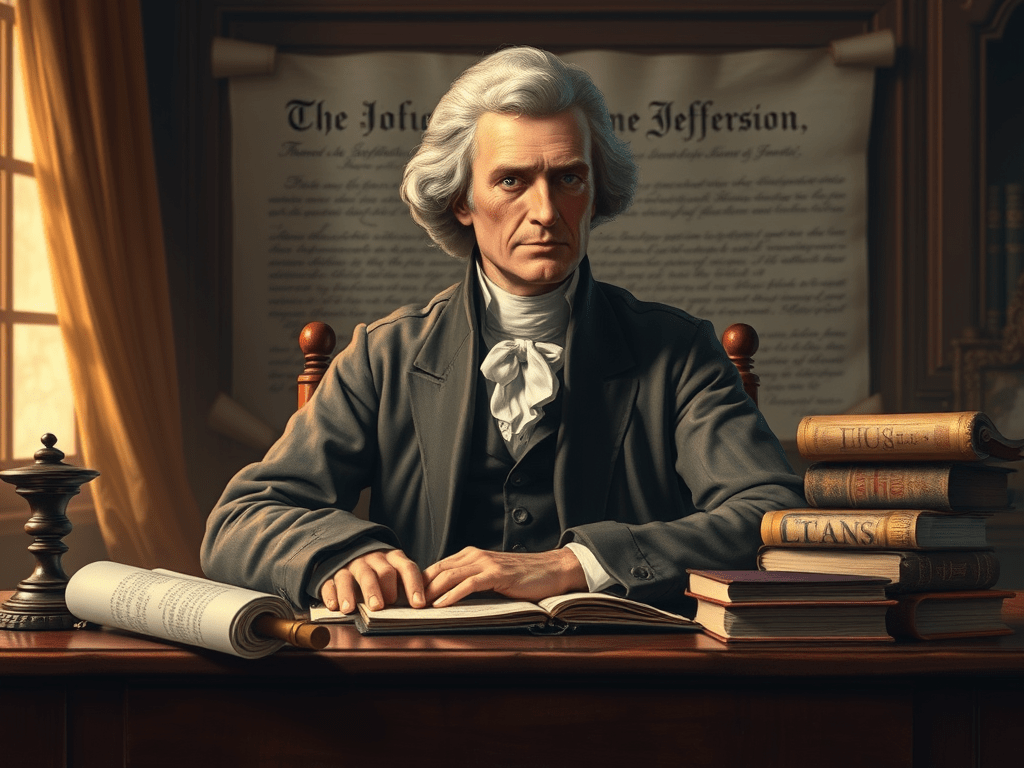
For a man who prided himself on principle, communicating our Founding ethos those better than anyone else, Jefferson had a habit of discarding them when convenient. Was he a liar, a hypocrite, a fraud, or simply a political genius?
Thomas Jefferson has long been acknowledged as one of the most eloquent communicators of our Founding principles to ever walk the planet. Credited as the primary drafter of the Declaration of Independence, he changed history itself with the immortal words, “We hold these truths to be self-evident, that all men are created equal, that they are endowed by their Creator with certain unalienable Rights, that among these are Life, Liberty and the pursuit of Happiness.–That to secure these rights, Governments are instituted among Men, deriving their just powers from the consent of the governed, –That whenever any Form of Government becomes destructive of these ends, it is the Right of the People to alter or to abolish it, and to institute new Government, laying its foundation on such principles and organizing its powers in such form, as to them shall seem most likely to effect their Safety and Happiness.” If those were the only phrases he’d ever penned, Jefferson would rightly be considered a master communicator, but his letters and other writings are littered with rhetorical gems tossed about like mere pieces of candy. “I would rather be exposed to the inconveniences attending too much liberty than to those attending too small a degree of it,” “Our civil rights have no dependence on our religious opinions any more than our opinions in physics or geometry,” “The legitimate powers of government extend to such acts only as are injurious to others. It does me no injury for my neighbor to say there are twenty gods or no god. It neither picks my pocket nor breaks my leg,” “The equal rights of man, and the happiness of every individual, are now acknowledged to be the only legitimate objects of government,” “It is an axiom in my mind, that our liberty can never be safe but in the hands of the people themselves, and that too of the people with a certain degree of instruction. This it is the business of the State to effect, and on a general plan,” “If a nation expects to be ignorant and free, in a state of civilization, it expects what never was and never will be,” “There is nothing more unequal than the equal treatment of unequal people,” “The whole art of government consists in the art of being honest,” “On matters of style, swim with the current, on matters of principle, stand like a rock,” to sample just a few.
Ironically, Jefferson was also a man who understood the nature of political power as astutely as anyone and at times, he was certainly not averse to sacrificing his principles to achieve his goals despite the last quote. In fact, two rather grievous instances come to mind followed by his successful two term Presidency. First, he betrayed rival Alexander Hamilton after learning of his affair with Maria Reynolds with the express purpose of destroying his political career. Jefferson became aware of the affair itself through his ally and future President James Monroe, using the relationship and knowledge gleaned from it for purely partisan purposes, staging a sneak attack on a rival at just the right moment. After Reynold’s husband James was arrested for his participation in a corrupt scheme to steal back wages for Revolutionary War Veterans, he used his knowledge of the affair as a bargaining chip to escape punishment. Monroe, accompanied by Abraham Venable and Frederick Mulhenberg learned of this indiscretion and feared that Hamilton might have been involved in the corruption beyond his marital infidelity because of payments made to Reynolds to maintain his silence about his wife’s conduct. The three confronted Hamilton at his home on December 15, 1792, arriving unexpectedly on his door step with a terrible accusation. A mortified Hamilton admitted the affair, but denied any financial impropriety and turned over all of the correspondence between him and Reynolds to prove his innocence. Though Monroe and his colleagues were satisfied that Hamilton was guilty only of infidelity, a not uncommon trespass in that era, and agreed to keep the matter private to protect Hamilton’s family, they subsequently provided the letters to Jefferson, who was surely aware that they were given in the strictest confidence. Jefferson, however, seeing this as an opportunity to destroy the potentially meteoric career of a political adversary, didn’t feel bound by any honorable commitment to privacy. Instead, he sat on the information until an opportune moment five years later and then provided the letters to muckraking journalist James Thomson Callender, who began printing them for the public after Hamilton had left the Washington Administration and was planning his next political move. Hamilton was outraged, believing at first that he had been betrayed by Monroe and even challenging him to a duel. Ultimately, he attempted to clear his name by releasing all of the letters in what has come to be known as the Reynolds Pamphlet where he admitted the affair but denied the corruption.
The Reynolds Pamphlet itself begins with a full throated denunciation of Jefferson’s tactics and his principles in violating his trust, “The spirit of jacobinism, if not entirely a new spirit, has at least been cloathed with a more gigantic body and armed with more powerful weapons than it ever before possessed. It is perhaps not too much to say, that it threatens more extensive and complicated mischiefs to the world than have hitherto flowed from the three great scourges of mankind, War, Pestilence and Famine. To what point it will ultimately lead society, it is impossible for human foresight to pronounce; but there is just ground to apprehend that its progress may be marked with calamities of which the dreadful incidents of the French revolution afford a very faint image. Incessantly busied in undermining all the props of public security and private happiness, it seems to threaten the political and moral world with a complete overthrow. A principal engine, by which this spirit endeavours to accomplish its purposes is that of calumny. It is essential to its success that the influence of men of upright principles, disposed and able to resist its enterprises, shall be at all events destroyed. Not content with traducing their best efforts for the public good, with misrepresenting their purest motives, with inferring criminality from actions innocent or laudable, the most direct falshoods are invented and propagated, with undaunted effrontery and unrelenting perseverance. Lies often detected and refuted are still revived and repeated, in the hope that the refutation may have been forgotten or that the frequency and boldness of accusation may supply the place of truth and proof.” Ironically once again, Jefferson managed to derail Hamilton by exposing details of his private life even as his own private life was rather suspect to begin with. After Jefferson’s wife Martha passed in 1782, he vowed never to marry again to protect the inheritance of her children. Instead of choosing another wife, it is widely believed that he had a long-running romance with a slave, Sally Hemings and that this affair started when she was between fourteen and sixteen years old – when he was in his forties. The relationship began when they were in France and Hemings had an opportunity to emancipate herself because slavery was already illegal there, but they struck what many may see as a corrupt bargain especially by modern standards: She would return to the fledgling United States if Jefferson would free their children together when they came of age. Historians think they had four children that survived into adulthood and were freed upon Jefferson’s death. Visitors to Monticello at the time reported being waited on by slaves that looked exactly like Jefferson himself and DNA evidence generations later suggested they had at least five children together, but this reality notwithstanding, Jefferson had no problem whatsoever using Hamilton’s private life against him.
The second instance of Jefferson choosing power over principle occurred when he failed to secure the Presidency in the election of 1796 and found himself in the uncomfortable position of being Vice President to John Adams, who was a personal friend but another political rival that had to be disposed of in the quest for power. Though Adams had hoped the administration of two rivals would help bridge sectional and emerging partisan divides, offering Jefferson allies key roles in the administration including appointing James Madison as a French diplomat, Jefferson, realizing that helping his friend might well impede his own chances of securing the Presidency in 1800, rejected the offer – and proceeded to undermine Adams while he was VP in his own government. On the domestic front, he encouraged opposition to Adams’ legislation, anonymously writing resolutions for Kentucky and Virginia to counteract the administration with help from Madison. Rather than supporting the role of the federal government in domestic affairs, he introduced the idea that states could shield their citizens from federal laws they deemed unconstitutional, what was known as “interposition” at the time, but ultimately became nullification which went on to become the rallying cry of slave holding states in the lead up to the Civil War. Of the Alien and Sedition Acts in particular, he said that if they were not “arrested at the threshold,” they would “drive these states into revolution and blood.” Jefferson was so radical in these matters that he received a rare rebuke from George Washington who told Patrick Henry if they were “systematically and pertinaciously pursued,” they could “dissolve the union or produce coercion.” By that point, Jefferson had broken so far from Washington, he refused to attend his funeral in 1799. In the spring of 1797, he took his campaign against Adams international by attacking his boss to French consul Joseph Letombe, telling him he was convinced Adams would only serve one term. He encouraged him to stall Adams’ envoys in Paris and to consider an invasion of England. When this happened and Adams’ diplomats were rebuffed, he lobbied for the release of the private papers describing the incident, known as the XYZ Affair.
In a final irony, when Jefferson assumed the Presidency himself after winning the election of 1801, at least partly because of the discord he sowed as Vice President, he went on to abandon the literal interpretation of the Constitution that he’d advocated just a year earlier. Though Adams had signed the Judiciary Act of 1801 that expanded the courts before leaving office, Jefferson withheld the judge’s commissions and started a constitutional stand off that resulted in the concept of judicial review. Starting in 1801, he waged war against the Barbary pirates, though it was never declared by Congress. While he told Congress itself, “I communicate [to you] all material information on this subject, that in the exercise of this important function confided by the constitution to the legislature exclusively their judgment may form itself on a knowledge and consideration of every circumstance of weight,” he greatly exceeded his authority when Commodore Edward Preble attacked Tripoli itself despite having a limited mandate for “for protecting effectually the commerce and seamen thereof on the Atlantic Ocean, the Mediterranean and adjoining seas.” Also in international affairs, he negotiated the Louisiana Purchase from France in 1803 despite no mechanism in the Constitution to acquire land from a foreign power. Finally, in 1807 he signed the Embargo Act which banned all American ships to foreign ports to “encourage” France and Britain from respecting our neutrality while they were at war and attempted to enforce it aggressively. This prompted the New England states that relied heavily on trade to circumvent it however they could, believing the power to regulate commerce did not equate to the power to destroy it, either refusing to implement it or turning a blind eye to smuggling. At the Supreme Court, two of Jefferson’s own appointees, Justices William Johnson and Brockholst Livingston ruled against the act and his enforcement, declaring it unconstitutional.
For a man who prided himself on principle, only to violate them over and over again, was Jefferson a liar, a hypocrite, a fraud, or even some kind of monster who would say whatever was necessary in the pursuit of power or more optimistically, was he simply a political genius who instinctively understood the nature of his profession and was a supreme practitioner of the art? Personally, I would argue that latter. Jefferson knew better than most who have ever lived that politics was a zero sum game; you win or you die, in most cases figuratively, but in some literally. By signing the Declaration of Independence, he was keenly aware that he could’ve been signing his death warrant if the colonies lost the war and indeed, during the conflict, he had to flee the Virginia’s governor’s mansion for his life when the British came marching through. The lesson was a simple one: Without power, your principles are meaningless because those with power will advance their own, frequently at your expense. He betrayed Hamilton and Adams because both men had different views on the nature of government than he did, and had either Hamilton continued his political ascent or Adams had a successful Presidency, Jefferson’s own principles would have been undermined. However high minded he sounded about the nature of government at times, he was willing to sacrifice one set of principles – trust in a friend and the confidence of a comrade – for another – steering the fledgling government as he felt best. Once he was behind the tiller, he made the same decision again, sacrificing some of what he said about the Constitution, to pursue what he felt was best for the country as a whole. While you might say his only principle was power and that is not strictly false, it is better to say that his only principle was power wielded by him to achieve the goals he sought for America. Of course, his detractors would say otherwise. Adams and Jefferson reconciled after Jefferson left the Presidency, but at the time, Adams wrote, “There is nothing which I dread so much as a division of the republic into two great parties, each arranged under its leader, and concerting measures in opposition to each other. This, in my humble apprehension, is to be dreaded as the greatest political evil under our Constitution.” For better or worse, history has proven Jefferson right.
Final note: If you think I am picking on Jefferson too harshly, Adams had his own struggles between power and principles.

 Confessions of a Conservative Atheist