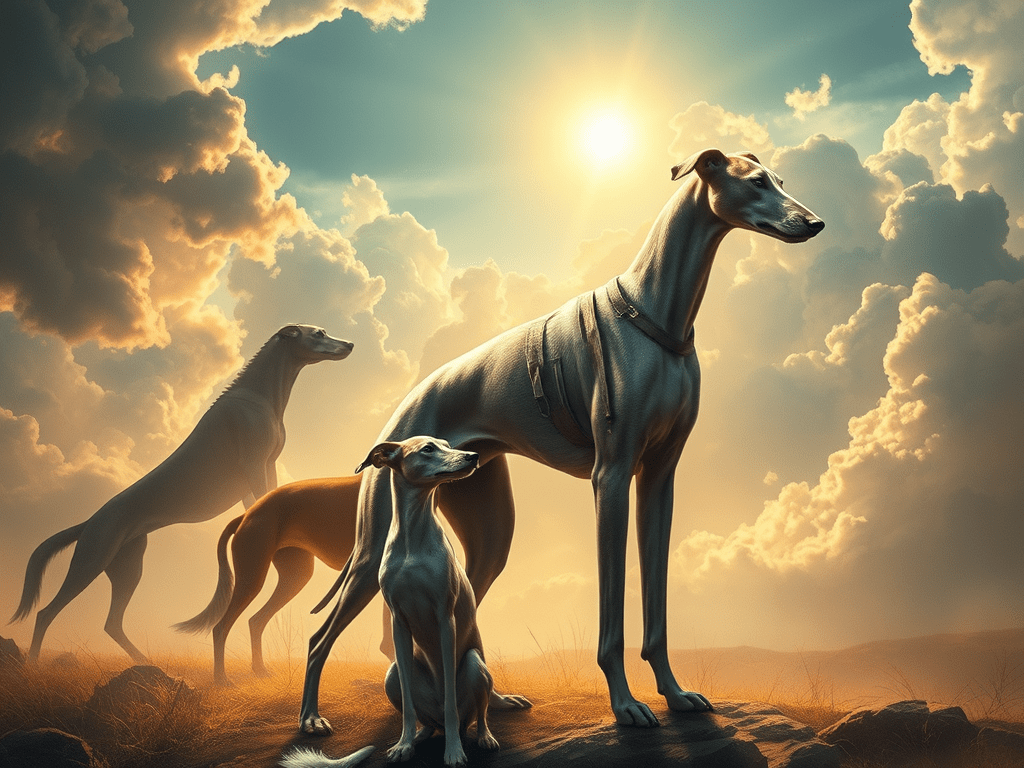
As my lovely wife is fond of saying, we and our beloved doggies are thrown together by fate, but I want to go much further back in time than she’s normally thinking to consider what fate had in store up to a hundred million years ago when humans and canines were one species.
Since every animal has parents, grandparents, great grandparents, and so on in unbroken line unless you believe in spontaneous generation, my ancestors and the ancestors of both our greyhound, Rosie, and our whippet, Carlitos, have been walking this Earth for hundreds of millions of years, billions if you go back to more primitive life before the Cambrian Explosion. As my lovely wife is fond of saying, we and our beloved doggies are thrown together by fate, but I want to go much further back in time than she’s normally thinking to consider what fate had in store up to a hundred million years ago. Starting from my house today and working backwards, whippets are a much younger breed than greyhounds in addition to being smaller physically. The modern version first emerged in mid 1800s England when greyhounds were mixed with terriers, resulting in something around two thirds the size with much the same lithe shape and barrel chest. Initially prized by the working class because they were cheaper and easier to care for than their larger cousins, they were used for hunting rabbits and racing, which had become popular in the era. Later in the 19th century, they arrived in America and were officially recognized by the American Kennel Club as a breed in 1888 with the English Kennel Club following in 1891, around the time my great grandparents were born, meaning they would have entered a world with both greyhounds and whippets already existing in their current forms. On my father’s side, both sets of grandparents would’ve been born in America, likely in the Northeast, somewhere not far from where I was born in Staten Island, but mother’s father was a first generation Italian American, and his parents would’ve been born in Europe before emigrating sometime around the turn of the 20th century. They would have left a continent with both whippets and greyhounds, and came to another where both were already present, but Carlitos, our own little whippet, was born in China, making it impossible to say where his ancestors would have been during this period, or even when whippets arrived in China in the first place. Terriers, which contributed to Carlitos’ line, date back to at least 1410, when the word appears in the writings of Edward of Norwich, Second Duke of York, coming from the Latin “terra” or literally, “earth dog.” This was around the time Henry IV took the throne from Richard II in medieval England, dislodging the Plantagenets and kicking off the War of Roses. Among his pets, Richard was said to have a large, aggressive male greyhound that was adopted by Henry’s son, Prince Hal, the future Henry V. In other words, I might not know where my own ancestors were at the time, but Rosie’s were there to witness the power struggle that would define Britain for more than a hundred years even as Carlitos’ breed hadn’t yet emerged. Greyhounds, presumably, looked and acted then as they do today, though their roots go back even further – and extend much further away.
In fact, historians believe greyhounds are the oldest purebred dog, dating back some 8,000 years to ancient Egypt, where they were revered, considered sacred, and even worshiped, long before anyone had ever heard of a terrier – or any of the countries my ancestors hailed from in Europe even existed, meaning what they were doing at this time, likely living in small settlements scattered across the continent, impossible to say. Putting this another way, the Egyptians put the face of a greyhound on the head of a god, while my own ancestors remained faceless. Going back even further, dogs as a species are believed to have emerged from grey wolves around 15,000 years ago, somewhere in southern East Asia. If an alien were to have arrived before then, neither Rosie and Carlitos would be the same species they are today; instead they would likely find two competitors, one human and slowly begin to mature into a civilized society, one much more wild, perhaps warily observing each other beside a bonfire at night and mildly disputing for territory. This was the first age of farming, protecting flocks, fences and the like, much of which was in place to defend from wolves. Lest we get an over inflated sense of ourselves, humans aren’t all that much older than dogs in the grand scheme of things, emerging as modern Homo sapiens somewhere around 300,000 years ago, when our hypothetical alien would recognize something very much like me, if not what would ultimately come to be known as man’s best friend. Humanity back then was a primitive affair, however, roaming the scrubland between pockets of trees in Northern Africa, part hunter and gather, yet still relying on whatever carrion we could find, scavenging off of dead animals after chasing the other scavengers away. Wolves weren’t likely to hunt humans in groups at that point, but surely more than a few who wandered off would have been taken as an easy meal, and neither group, to the extent that either could be said to dream, would have imagined the relationship that would develop over the next couple of hundred thousand years, when natural competitors slowly, and likely uneasily, evolved into animals that shared the same territory and then the same fire. Even further back in time, our ancestors were known as Home erectus, the first human species to wield fire, and Homo habilis, the first to use tools, both of which evolved somewhere around 2 million years ago (erectus) or 2.4 million years ago (habilis), also in Africa. It is believed these early human species co-existed for hundreds of thousands of years, and ultimately migrated out of Africa into Europe and Asia. Both would appear similar enough to our hypothetical alien that they would be recognized as the ancestors of modern humans. They walked upright, used tools, probably had some primitive clothing, and likely had some sense of social rituals.
At the same time, they would have been noticeably different in terms of appearance. The Dutch biologist Eugene Dubois described Homo habilis as having a “skullcap” because of the lower and thicker cranial vault and a continuous bar of bone forming the brow ridge. The overall brain size was also smaller than modern humans, and the bones were generally thicker and tougher, though also shorter and squatter, rarely measuring more than five feet six inches in height. Whether they possessed rich language and shared stories around the fire at night is unknown. What they might have thought of wolves is equally unclear, whether they viewed them as fierce competitors, whether they feared them as potential enemies, what sort of chill ran down their spine when they heard them howling in the night right beyond the small circle of light they huddled around regardless of whether the fear was rational, but wolves at this time also numbered many other species, making for a panoply of predators lurking in the darkness. The grey wolf that ultimately gave birth to dogs didn’t arise until around a million years ago, perhaps as late as 400,000. Some of its predecessors were much larger and more vicious, from the dire wolf that was recently reintroduced to the world to the even more impressive Epicyon haydeni, also known as Hayden’s bone-crushing dog that roamed North America between 12 and 6 million years ago. These monsters weighed between 220 and 276 pounds, close to double a regular wolf and more than five times the size of a mere whippet. One fossil weighed a ridiculous 370 pounds, roughly the size of a grizzly bear or an African lion. We can only imagine what our ancestors without fire or tools would have thought at the sight (technically, they were not yet in the Americas and would only have seen the largest version present in Africa), but if we had any language or culture at all, it would be easy to believe the presence of these and other fierce carnivores and voracious hunters would have left an indelible mark on our mythologies, even millennia later, giving birth to legends that might last to this day for the wolf in general is present in most cultures. In fact, one of the earliest written references to black wolves occurs in the Babylonian epic Gilgamesh. The hero and titular character rejects the advances of the goddess Ishtar because she had transformed a previous lover who was a shepherd into a wolf, making him the predator he once protected his flock from. Is it possible that some of these legends go back further than history itself, further than humanity itself?
Whether or not the species that would become human some three or more million years ago, up to about six, known as variations of Australopithecus afarensis, made most famous by the “Lucy fossil,” had the intelligence to appreciate such a beast as Epicyon haydeni, we can be sure they would have feared it. Australopithecus was much smaller than a modern human; it stood upright, albeit with a more stooped, less purposeful gait, but was covered with hair like our primate cousins. It is believed to be the first of our ancestors that left the trees and took to the open savannah, despite the monsters that were out there, megafauna that like Epicyon were much larger and fiercer than the great majority of species alive today, from monstrous mammoths with an average shoulder height for males better than ten feet and a weight of up to 13,200 pounds to Simbakubwa, a lion the size of a polar bear. The hypothetical alien observer isn’t likely to have been impressed with Aferensis in such company, possibly believing the wolf, with its social structure and skills hunting as a pack, would ultimately become more prosperous as the years turned, but as we go even further back, beyond periods that humans can truly conceive, both sets of our ancestors become less and less recognizable and some would say less and less impressive compared to the dominant creatures of the day. Primates as a group split off from extinct mammal species known as Plesiadapiformes somewhere between 65 million and 45 million years ago. Unlike humans, powerful chimpanzees, or earth-shaking silver backed gorillas, they were small, tree-dwelling creatures, something like a cross between a squirrel and a miniature monkey, but are said to be distinct from other mammals at the time as the first group to have fingernails rather than claws. Interestingly, Plesiadapiformes were descended from a branch that gave birth to tree shrews, rodents, rabbits, hares, and pikas, meaning we have more in common with a mice in a field than most other creatures on this planet and with precious few exceptions like our silverback gorilla cousins, many of our kind are diminutive, not exactly terrifying herbivores that live their lives in fear of become someone else’s prey. Of course, no one would mistake Plesiadapiformes for a human, yet as they gave way to Prosimians somewhere around 20 million years ago, we begin to see features of proper primates like lemurs and lorises. It wasn’t, however, until much more recently, ten million to five million years ago, that our closest cousins, the apes and chimpanzees mentioned earlier emerged. To some extent, the ancestors of wolves and hence dogs would be more recognizable at this time. Around 40 million years ago, close to when primates broke away from other mammals, wolves began their long march to the present from a fox-like creature, Hespeocyon, which lived in North America, roaming from Canada to Colorado for somewhere over 10 million years. If you consider that Plesiadapiformes was also native to North America, though it could be found in Europe and even Asia as well, both of our ancestors might not have looked a thing like we do today, but they roamed the same primeval, pristine, untouched, and undoubtedly wild landscape, little knowing how their distant, distant futures would become so intertwined.
Of course, if you go even further back, somewhere between 100 million and 90 million years ago, dogs and humans were one, sharing a common ancestor in the final days of the dinosaurs. Known as Boreoeutheria, this shrew-like creature ultimately gave birth to the lineages that lead to humans and dogs as we know and love them today. While the exact species is unknown, it is presumed to have weighed only about 20 pounds, roaming trees in the night, feeding on insects, and looking next to nothing like a primate or a canine save for being furry, having warm blood, and giving live birth using a placenta. We can also assume it was rather skittish and more than a little sneaky, eking out an existence in the presence of true giants, some of the largest and most fearsome predators to ever stalk the Earth, creatures that make polar bear sized lions and giant wolves seem like mere house pets in comparison. Tyrannosaurus rex, the most famous and among the most terrifying of the dinosaurs, would have been stalking the plains in North America, rattling the ground with its stride as it hunted everything in sight and scavenged the rest. Argentinosaurus and Patagotitan, both sauropods similar to the more popularly known Brontosaurus, were two of the largest land animals that ever lived, measuring more than a hundred feet long and weighing in at around 100 tons. Can you imagine being caught in a tree one of these monstrous herbivores was busy eating? If our hypothetical alien observer arrived during this period, it would have been almost impossible for them to predict that little Boreutheria, living in the shadow of literal titans walking the Earth, would over the next 100 million years branch out into different species, then reunite as codependent species, and ultimately rule the world together, conquering every habitable continent and exploring the inhabitable ones as a team. We – as in us and our canine companions – got extremely lucky, subject to the mad twists and turns of genetic fate, that made us first different and then more the same than perhaps two such divergent species should ever be. This is the path we have walked together, thrown together by fate indeed. Our dogs, nestled on the couch somewhere as I type this, sleeping as they do during the day, undoubtedly waiting for their next meal, can’t possibly know this, but what does it matter? We’re in this together and who knows what the future might hold for such survivors?

 Confessions of a Conservative Atheist