
When people ask what’s different about India, the sheer number of people is astounding. Boasting a population of over 1.4 billion and still undergoing massive economic development, hotels, restaurants, and service businesses tend to feature at least twice if not three times the number of employees as in the United States and automation is barely a thing.
I’ve never been described as the strongest guy, the fastest guy, the most agile guy, or the most athletic guy. At barely 150 pounds soaking wet as they say and not possessed of any innate speed, dexterity, or strength, I’m far more brains than brawn, or so I hope, but if there’s one thing I’ve never been short on, it’s energy and endurance, especially when traveling. At home, I might prefer seven hours of sleep and obsessively keeping to a schedule that has included intermittent fasting long before it was fashionable, but away, all bets are off and all routines are out the window to pile on the old expressions. Something awakens within me, something at least partially fueled by alcohol to be completely honest, and as a result, I simply cannot stop moving, exploring, doing, however senseless or nonsensical. India, even on what was technically a business trip, is no exception. If anything, it’s even worse considering the jet lag induced by a 9.5 hour time difference frequently means that you can’t sleep even if you wanted to and have no choice except to keep on going. If I were to miss a meeting or an important event, I’d be able to get away with a lot less fooling around either before or after, giving me little choice in the matter but to suck it up and count the hours until the next beer. Jet lag, in particular, is a strange thing. When I arrived in India on Friday evening, I got to sleep at a decent hour and slept later than usual, waking up at almost 10:00 AM the following day and feeling surprisingly well rested on day one. There was the glimmer of hope that somehow the jet lag wouldn’t hit me this time, but the following evening, I was wide awake after less than three hours of sleep. The next night it was four, then when I finally started approaching five I could see the proverbial light at the end of the tunnel. At the same time, the mind continues to play strange tricks. For the rest of the week, whenever I got up to go to the bathroom, I found myself convinced the jet lag was back, even though it wasn’t. Either way, there was nothing to do except press onward, but what does that mean almost 10,000 miles from home, a stranger in a strange land if ever there was one?

Not for the first time, I was struck by how India is so remarkably the same and bizarrely different from the United States. I’ve already covered the mad jumble of wealth and poverty, where beachfront mansions sit right beside shacks, but people tend to be people wherever you may travel, and wherever you grew up. Thus, if you are on the beach anywhere in the world, chances are you will not be alone. Some of my colleagues chose to walk in the morning, before the sun came up, others gathered between strategy meetings and dinner, watching the waves come in and enjoying the afternoon breeze, perhaps with an adult beverage. Of course, boys will undoubtedly be boys, and not surprisingly, the hotel pool hosted some friendly, if rather childish competitions. Who could hold their breath longest? Who could throw their colleague furthest? Who could stand on someone’s shoulders and dive the longest? What other stupid thing could we come up with while some of our less adventurous colleagues watched and why could this scene have played out anywhere in the world over the last half-century? Though this might have been the same, when people ask me what’s different about India in general, one of the things I will most frequently mention is the sheer number of people. As the largest country in the world, boasting a population of over 1.4 billion and as a region still undergoing massive economic development, hotels, restaurants, and service businesses tend to feature at least twice if not three times the number of employees as in the United States and automation is barely a thing. For example, at a Tim Horton’s at the New Delhi airport, there were three people responsible for making coffees. One took the order, the other filled the cup, and the third placed the lid and the sleeve on. As an awkward result, there tends to be an inordinate amount of delegation between employees. If you ask one person for something, chances are they will refer you to another, who might refer you to a third. At breakfast in the morning, you don’t ask the chef directly to make you a dosa (a delicious crepe made from fermented rice) or an omelette, though they are right behind the counter. Instead, a young lady stands right there and takes your order. Someone else brings it, and someone else attends to your coffee and drinks.
It can be dizzying and confusing, sometimes even a little frustrating. It can also be funny. While having a team dinner beside the beach, a colleague who has become a friend mentioned that he wanted to walk a little, even though the beach was technically closed. I mentioned that was a little strange in America – they might not have any lifeguards on the beach after hours and a hotel might not want you to go swimming, but it’s rarely if ever behind a locked gate either, at least that I have seen. The general thinking here seems to be if you are dumb or crazy enough, and certainly I have been dumb and crazy enough, to take a late night swim, do it at your own risk, we are not responsible for your stupidity. At this resort, however, the gate to the beach was locked tight, except the wall to the beach wasn’t more than a couple of feet high, so low you could sit on it and fall right over, especially with the amount of alcohol being consumed. Like in much of the United States, the beaches are public, not owned by the resort, meaning the resort itself cannot tell you not to take a walk, even as they think they can. In this case, no sooner were we over the wall, when a staff member sprung into action, following us a few yards onto the beach and demanding we return. Given the cultural dynamics, I felt it was better to leave this one to my Indian colleague, who informed the gentleman that the beach is public and we can take a walk if we like. There was nothing he could do about it. The gentleman wasn’t impressed, however, demanding our room number and when told we were just there for a party, becoming quite confused. What recourse did he have to deal with a recalcitrant beach walker who wasn’t staying at the resort? So, he did the only thing he could do in India, used his walkie talkie to call someone else. This time it was “lobby guard,” “lobby guard,” “lobby guard,” repeated several times – only the lobby guard never came. Apparently, he informed someone else, who informed a member of our party about the incident, who then became responsible for reigning the two of us in. Of course, we were already back over the wall by that point, so the result was a lot of noise and no actual action. More generally speaking, a creative application of this need to delegate can push certain boundaries. For example, if they are closing the pool, ask someone to get you a towel before you get out and there’s a good chance you’ll have a solid half hour of extra swimming time, albeit one interrupted several times by multiple staff members telling you the pool is closed without bringing you the towel you requested.

Boundary pushing in India might be a more subtle, below the radar thing than in the United States, but there remains a quiet rebellious streak, particularly in regards to traffic laws. Last week, I covered how they appear to follow no laws. This week, I’ll note that this applies to open containers and perhaps even drinking and driving. From what I could tell, the country is in the middle of a large push to reduce drunk driving, though they lack the police presence to hold checkpoints. Instead, they put up signs and place barriers in the road one would have to be extremely drunk to crash into, almost like they were setting up nets to catch fish, but I guess that’s something. Between the opening of our new office and a reception at a nearby hotel, my colleague asked me if I wanted to pick up a beer or two for the ride. Who was I to refuse, especially as I’d never been to an Indian liquor store? Much like tobacco shops, they tend not be as common as in the United States and my colleague had already warned me that most are counter-style with a gate. Like a fast food restaurant, you tell the person what you want and they bring out your order. This, I was prepared for as the practice isn’t unknown in America, especially in urban or poverty stricken areas like an Indian reservation in Montana. The one we walked into thanks to Google Maps I was far from prepared for, however, and nor was my colleague. From the outside, it was more like a dungeon or torture chamber than any place selling distilled spirits. On the inside, it was even worse. The interior was barely lit, a few seemingly unwashed derelicts were hanging about, and the place stank like multiple people were pissing or worse in the corner. I’m not sure how anyone worked there for a full shift, or why any of the few people would gather there, and I wasn’t alone. My colleague stepped up to the counter, covered his face in disgust, and marched right out, remaining inside for no more than 15 seconds. I followed suit and though I suspected the problem, asked him what was wrong. He said he couldn’t handle the smell, so he sent another colleague in, that delegation trend again. I followed for back up, only to learn that they don’t even sell any drinkable beer, and so we had to find another place, which was good because about 20 seconds inside was more than enough. The second place, fortunately, was something closer to what you would find in New York or another urban area: An actual store, with actual refrigerators, albeit a little small. It was, of course, on a rather crazy street requiring more dexterity than I usually have to get from the parking location to the actual store, dodging motorcycles, potholes, and some refuse, but to me at least, that’s part of the adventure.
In recent years, my family and I have opted increasingly or AirBnB’s over hotels. One of the reasons why is that you feel like you’re living in a place like a local. Anyone with the means can organize a grand, curated tour of India or another exotic location, the equivalent of glamping through the country with a well-mannered guide, protected from the riff-raff, but what’s the fun in that? Traveling with colleagues, navigating the inner city the way they would, doing the sort of things they do, is an entirely different and to me at least, more meaningful experience. Of course, I wasn’t there simply to play, fortunately or unfortunately. There was real work to be done amid the mayhem – three full days of meetings, an office opening, a reception where I had to speak about the future of the company after the beers in the car, one where I chose to use Bruce Springsteen as an inspiration to fire people up, and a press conference of sorts, something I’ve never done before, not even in the United States. Imagine your humble author, seated next to the company’s President and CEO in a hotel conference room, facing five Indian journalists and a PR person, attempting to convince them that our efforts were worth covering in sources as prestigious as the Times of India. I did, however, have two things going for me. First, I was a former used car salesman and born bullshit artist. Crafting reasonable sounding answers to unexpected questions like what differentiates our little tech firm from either the huge multinational conglomerates like Accenture or the hundreds of smaller providers has never been difficult for me, nor has speaking in public, off the cuff. Second, as the proverbial stranger in a strange land, the one white guy at the table, I had the edge of being a curiosity. Why would this random dude, who isn’t exactly a tech titan, travel all the way from New Jersey to meet this particular collection of journalists that particular afternoon? Whatever we said, it appeared to have worked because three of the five publications covered us the next day and my picture was featured in an Indian newspaper of all places.
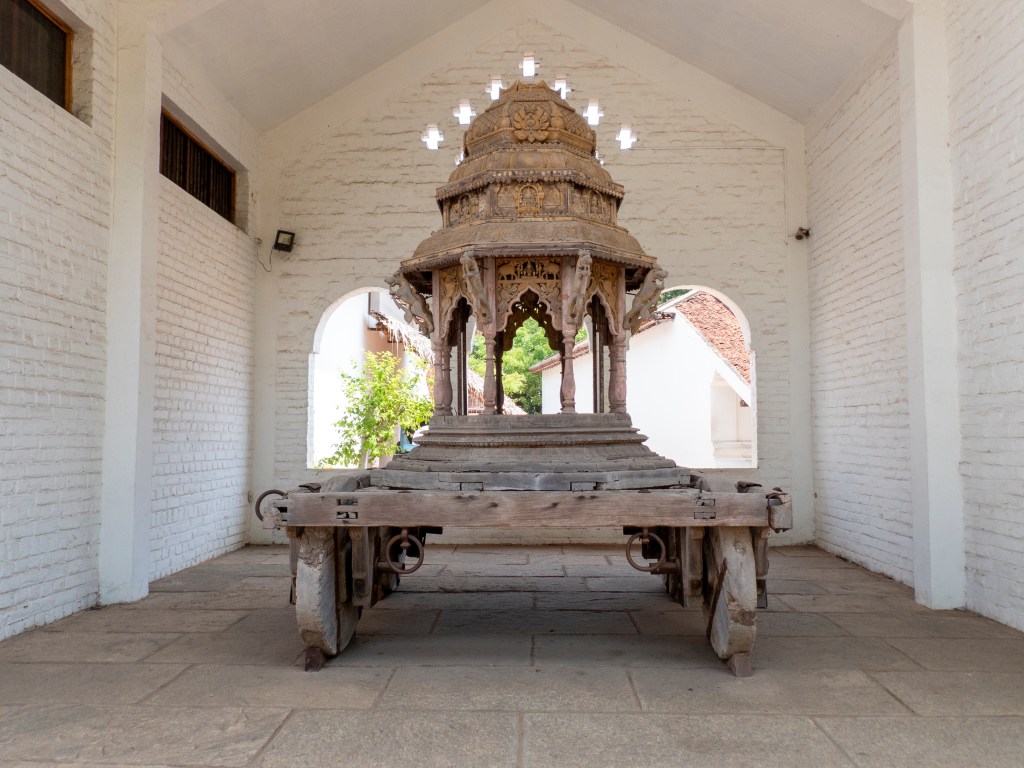
From there, I finally had a day to check out some of the local sights. It was my third trip to India, but as I joked to my friends on Facebook, I had yet to see anything other than the inside of a conference room and the bottom of a bottle. With a day to spare, I had the chance to experience two historical and cultural locations, the Dakshina Chitra Heritage Museum and St. Thomas Mount, representing two very different traditions. Dakshina Chitra celebrates the history of the Chennai region and India in general, showing how people lived hundreds of years ago. Once again, I was struck by how we are different and the same. India is essentially a different kind of melting pot than the United States. While many point to English colonialism followed by independence as the driving force of the country’s current events, there are many more cultures to be found, ranging from the Middle East to the French and the Portuguese. In fact, about 70 miles south of Chennai, there is a town where the street names are still French. Across the country in Goa, on the West Coast, there are areas where they still speak Portuguese, the names are somewhat Spanish, and a recent influx of Russians is further changing the cultural mix. Also like the United States, there have historically been some rather odd laws, including the average person not being able to walk in the street in certain regions until 1929. St. Thomas Mount, on the other hand, celebrates India’s Christian heritage. Today, around 7% of the population is Christian, a massive number. Locals date the arrival of Christianity to Jesus’ apostle, St. Thomas, who was said to venture all the way to Chennai in 52 A.D. to spend the last years of his life living in a cave on the hillside. Tradition has it that he was martyred in 72 A.D., either with a bow and arrow or struck by a spear. In 1523, the Portuguese built a church there that is still honored to this day. The Portuguese may have gone from that part of India, and indeed none of my colleagues even mentioned their presence in the region, but at least some of what they left behind lives on, an enduring part of the history and the landscape even if few truly know it, but can’t you say the same about us?

I’ll end with two, unconnected items. First, war broke out while I was there. I woke up Wednesday morning to the news that India had launched airstrikes on Pakistan. My family in the United States was flipping out, but my Indian colleagues didn’t say a thing until I asked them. From what I can tell, the American media was more hysterical than the Indian. Second, at the risk of a little bragging, I mentioned how I like to try to live like a local. I joked about that to a colleague on Facebook when I noted that you can’t leave India without riding in one of the rickshaws and I was doing my best to live like a local. He responded by noting that he and two other colleagues discussed exactly that, and decided that no white guy they’ve ever seen has done it better. What higher praise could you ask for?

 Confessions of a Conservative Atheist