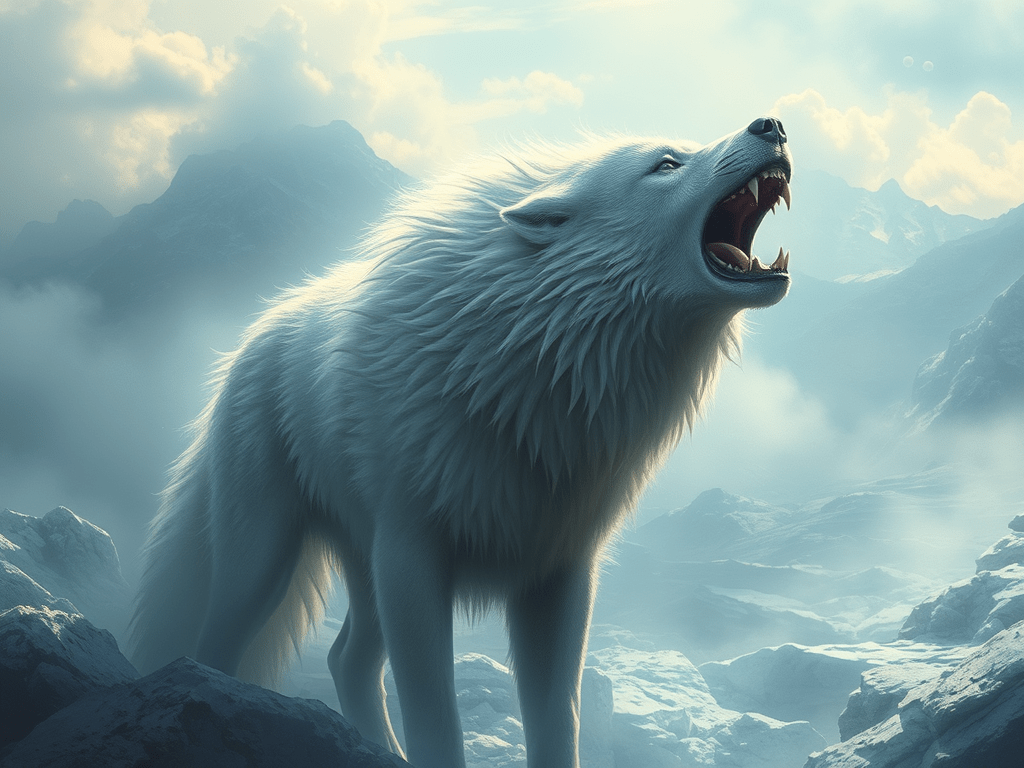
I am part creation of modern science, part living legend, having not walked the Earth for more than 10,000 years. I also pose an interesting biological question, one scientists have been debating for years and one which has no clear answer…
I am a dire wolf, newly born into this world. I am part creation of modern science, part living legend, having not walked the Earth for more than 10,000 years, back when humans were hiding from super predators and shivering through the end of an ice age. While I have lived on in myths and modern fantasy stories, featured prominently in HBO’s breakthrough series, Game of Thrones, for example, it required the latest technology to save me from extinction. Scientists at Colossal Biosciences, a company based in Dallas, TX devoted to bringing lost species back to life effectively conjured me into existence in a lab by combining ancient DNA found in fossils of my actual ancestors (technically Aenocyon dirus, as there were two dire wolf species) and DNA from one of my modern cousins, the grey wolf. “This massive milestone is the first of many coming examples demonstrating that our end-to-end de-extinction technology stack works,” explained Ben Lamm, Colossal’s cofounder and CEO. “Our team took DNA from a 13,000 year old tooth and a 72,000 year old skull and made healthy dire wolf puppies.” By comparing the ancient DNA to modern day canines including wolves, jackals, and foxes, the Colossal team was able to identify the genes that made a dire wolf unique, finding that my species is 99.5% similar to the grey wolf and giving them an optimal starting point. “We aren’t trying to bring something back that’s 100% genetically identical to another species. Our goal with de-extinction is always create functional copies of these extinct species. We were focusing on identifying variants that we knew would lead to one of these key traits,” Beth Shapiro, Colossal’s chief science officer told CNN. This included 20 edits to some 14 genes that were then cloned and transferred into donor eggs from domestic dogs. “So we can take these eggs and we remove the nucleus, and then you insert the nucleus that we’ve edited from that gray wolf cell, and that is what we clone,” Ms. Shapiro explained. The fact that they edited a current species’ genes rather than beginning with dire wolf DNA in the first place has led some to claim I am not a dire wolf at all, but some strange, never-before-seen hybrid instead. “So what Colossal has produced is a grey wolf, but it has some dire wolf-like characteristics, like a larger skull and white fur,” explained Otago University’s Dr. Nic Rawlence. “It’s a hybrid.” “It’s in a completely different genus to grey wolves,” he continued. “Colossal compared the genomes of the dire wolf and the grey wolf, and from about 19,000 genes, they determined that 20 changes in 14 genes gave them a dire wolf.”
In this sense, I pose an interesting biological question, one scientists have been debating for years and one which has no clear answer, though I certainly wouldn’t phrase it that way, not knowing or caring about any of this. If you believe that genes are binary entities, a sort of computer code to build life, where the different letters, A, T, G, and C are completely fixed in each gene and each gene is independent of others, selected separately down the line, it should make no difference whether my creators edited an existing grey wolf DNA strange to match the ancient dire wolf sample, or the other way around, the same as it makes no difference when you copy and paste between different documents on your computer. The only thing that mattered would be whether or not Colossal edited the correct genes to make me a true dire wolf. If, however, you believe evolution is a far more fluid affair, one where differences in functional genes are only a single piece of the puzzle that makes a specific species, then I am something else entirely, something never seen before that has no current classification. Of course, I cannot speak for him, but the famed evolutionary biologist, Richard Dawkins might well take this approach. In his most recent book, The Genetic Book of the Dead, he describes how collections of genes including regular DNA, mitochondrial DNA, and even bacterial DNA embedded in our digestive tracts and other systems, appear to have evolved to work closely together even beyond the function of any specific gene. As he put it, “The way this works is that each gene is selected for its compatibility with other genes in the same pool, and vice versa. So cartels of mutually compatible, cooperating genes build up…Within any one species, genes work together in embryological harmony to produce bodies of the species’ own type. Other cartels in other species’ gene pools self-assemble, and work together to produce different bodies. There will be carnivore cartels, herbivore cartels, burrowing insectivore cartels, river-fishing cartels, tree-climbing, nut-loving cartels, and so on. My main point…is that by far the most important environment that a gene has to master is the collection of other genes in its own gene pool, the collection of other genes that it is likely to meet in successive bodies as generations go by. Yes, the external ecosystem furnished by predators and prey, parasites and hosts, soil and weather, matters to the survival of a gene in its pool. But of more pressing moment is the ecosystem provided by the other genes in the gene pool, the other genes with which each gene is called upon to cooperate with in the construction and maintenance of a continuing sequence of bodies.” To support this position, Mr. Dawkins described how context matters in the expression of genes in an organism. For example, EB Ford studied moth populations throughout the British Isles, and found that the normally dominant “dark” gene can sometimes be recessive even among closely related species. He began with samples of Lesser Yellow Underwings from two islands, Barra, which is west of Scotland, and Okrney which is some 340 kilometers north. Left to their own devices, the dark “curtissii” gene remained dominant, but when they were interbred in a lab, the dominance broke down and the offspring displayed intermediate colors, an entire spectrum rather than simply light and dark. As it turns out, there are modifier genes unique to each species that are not specifically dark or light. Separated by such a distance of open sea, the two populations maintained the same mechanism for dark and light coloring, but how these genes were activated had evolved uniquely and when they are bred together, the activation mechanism breaks down, meaning two identical genes behave differently depending on their companions even within species that can and will interbreed.
By this standard, I am not a dire wolf at all, but something entirely new, something that has no name yet or real definition, designed to look and act like my extinct cousin. In fact, I might not even technically be a real species at all if you subscribe to the definition that species are defined by self-contained breeding populations as most biologists believe. Ernst Mayr provided this definition which still stands today, perhaps until I was born, “Species are groups of actually or potentially interbreeding natural populations, which are reproductively isolated from other such groups.” While I am not alone in this world, I have two male siblings, both a little older than I am, I do not constitute a breeding population of any kind. Between the small size of my nascent family group and the fact that we have never mated, I am not part of a replicating gene pool even if you consider three members of a genetically engineered population enough to constitute a gene pool in the first place. Instead, my brothers and I are biological islands, living, breathing organisms complete with our own drives and desires but without the continuous genetic history that defines almost every other life form on the planet. We are phenotypes without the underlying pool of genotypes. To some extent, my own creators have acknowledged this point. Love Dalén, a professor in evolutionary genomics based at the Centre for Palaeogenetics at Stockholm University, who advised Colossal on the project explained, “There’s no secret that across the genome, this is 99.9% gray wolf. There is going to be an argument in the scientific community regarding how many genes need to be changed to make a dire wolf, but this is really a philosophical question,” he said. “It carries dire wolf genes, and these genes make it look more like a dire wolf than anything we’ve seen in the last 13,000 years. And that is very cool.” “The way I see this is that they have resurrected the dire wolf phenotype (the observable traits of a species) and we know from the genome that they probably looked a bit like these puppies. To me, it’s a dire wolf in that sense,” he added. If I can be said to care about anything, this is the only sense that matters to me. My place in this world is irrelevant, but what I can do in this world with my designer body is different. While I am still a puppy, having been born on January 30, I will grow into a larger and more powerful wolf than currently exists, combining some of the features of my living cousin with others that are entirely new.
Dire wolves, that is the original incarnation which has gone extinct, were first named in 1858, about four years after specimens were found in North America. Beginning around 125,000 years ago, my kind ranged across most of two continents, living on the plains, grasslands, and forested mountains of North America and the arid savanna of South America, ranging from sea level to well over 7,000 feet, reaching as far north as current day Canada, which would have been blocked off by an impassable wall of ice at the time. I am significantly larger than the wolves you are used to, averaging over 10% more weight, reaching a maximum of almost 250 pounds, equipped with a larger head and significantly bigger and stronger teeth. Interestingly, males of my mind are endowed with a measurably different and longer penis bone than our modern counterparts, suggesting fierce competition for mates. Perhaps, this shouldn’t be surprising when I am known as a “hypercarnivore” designed to take out large prey who didn’t go down easily. While modern wolves feed on regular white-tailed deer, mule deer, moose, caribou, and bison, everything was bigger and more ferocious in my day, creating legendary beasts that live down to yours even before I was reborn, deep in the recesses of the human mind, particularly their nightmares. I stalked and fed on the extinct camel, the extinct bison, a prehistoric horse, an extinct sloth, even Columbian mammoths and American mastodons. To put this in perspective, the Columbian mammoth could reach almost fourteen feet tall at the shoulder and the mastodon over ten. Further, my genetic ancestors faced some extremely stiff competition for food. Today’s wolves share their domains with mountain lions, bobcats, and other feline predators, but none of them would have faced anything close to a Smilodon, more commonly known as a saber tooth tiger. This beast could weigh over 950 pounds and stand well over three feet tall, armed with the infamous teeth for grabbing and holding prey. It fed upon many of the same creatures I do, though it wouldn’t have been above poaching a prehistoric human being either. One on one, my genetic ancestors wouldn’t have stood a chance against such a monstrosity, but then as now, dire wolves didn’t hunt alone. While little is known about our social structure, it is believed that we roved the land in packs like wolves of today, living, breeding, hunting, and working together in groups of around ten, though some can number up to 30. These packs range from small, almost nuclear families as you would describe it, to far more extended groups with the equivalent of aunts, uncles, grandparents, cousins, and even step-siblings. Like almost all animal groups, packs are hierarchical with their unique social dynamics. The leading male, normally the strongest, is known as the alpha, down to the lowest rung, the omega. The alpha maintains breeding and feeding privileges, but the dynamics can be fluid and other males will also mate.
Me? I don’t know any of this yet and maybe never will. My brothers and I are a pack of three, all of us healthy with fluffy, shiny white coats, living on a 2,000 acre site at an undisclosed location complete with a zoo-grade fence to prevent me from scattering far and wide, at least for now. So far, we are exhibiting behaviors similar to the grey wolf, but apparently more skittish even though we’ve been around people our entire lives. “We’re still seeing a lot of juvenile behaviors. I think they are much more standoffish, much more skittish (than gray wolves). We haven’t seen them really fully express all of their behavior. They’re still juvenile — when they get that testosterone surge, I think we’ll see a lot of interesting behavior,” explained Matt James, Colossal’s chief animal officer. While they plan on birthing more dire wolves in the future, perhaps creating a true breeding pack and truly conjuring a new species into existence based on the definition above, it remains just the three of us for now. We are new to this world as ourselves and new to this world as a never before seen species or perhaps something else entirely, but we will not be for long. Colossal is already planning to use the same technology to bring back other extinct species including the aforementioned mammoth, the dodo bird, and the Tasmanian tiger. For better or worse, they are not currently planning a Smilodon, but if they should, I would recommend they bring back another one of my ancestral cousins, and even larger and more dangerous wolf, more capable of facing off against the fearsome cat in a fair fight. Epicyon haydeni, whose name means “more than a dog,” was eight feet long and stood almost three feet tall, weighing around 250 pounds with the largest reaching 370. This more than a dog is a member of an extinct group called borophagines, bone crushers, named for their thick skills and powerful jaws. They also shared the Earth with Smilodon, but much further back in time, some 18.5 million years ago, but then the climate changed, transitioning from massive forests to more grasslands that favored animals better at chasing prey. Alas, Epicyon was an ambusher, who would fall on prey using their strength, and couldn’t make the transition, but maybe someday an enterprising human will bring them back as well – if you dare. Who am I kidding? There was a famous science fiction movie about this thirty years ago. If humans can do something, they will do something. Dare’s got nothing to do with it.

 Confessions of a Conservative Atheist