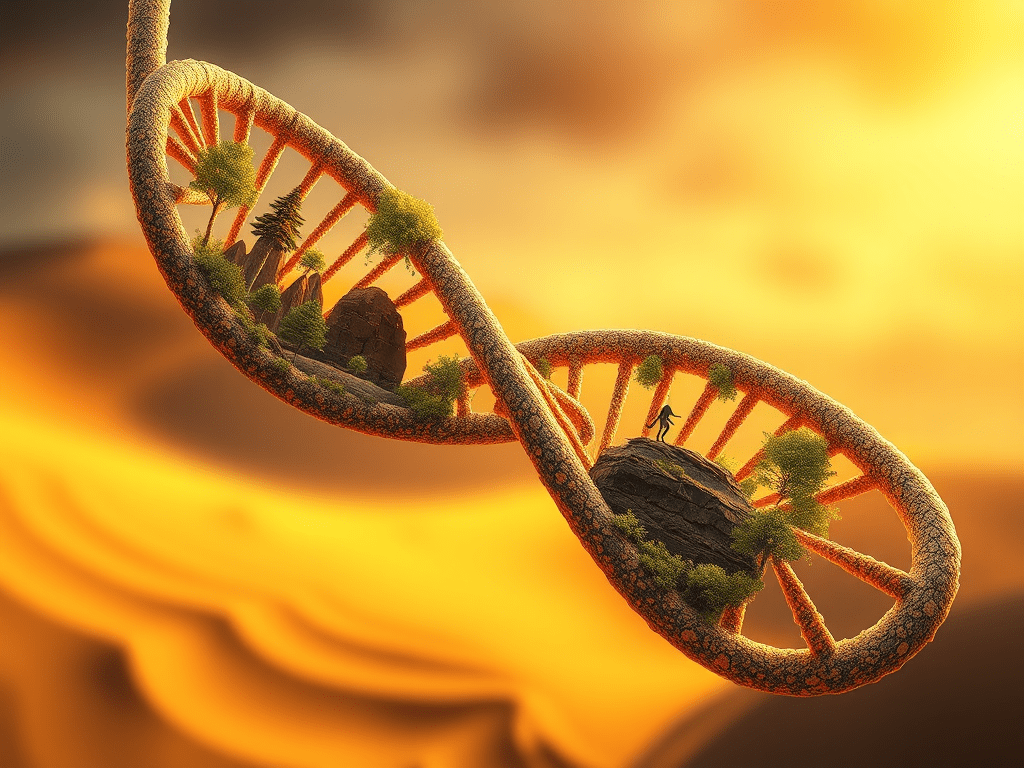
The legendary biologist Richard Dawkins returns to evolutionary theory with his third and fourth big idea, ushering in a true paradigm shift in how we view ourselves, the world, and the DNA that builds bodies to interact between the two.
Imagine if you can, extracting the DNA of an ancient eukaryotic cell, the earliest complex ancestors of all organisms and plants on Earth including humans, some 3.5 billion years ago. What would it say? Up until now, most people, even trained scientists, would describe it as a sort of recipe to create a specific type of cell, part instructions for the components of the cell and part instructions where to place those components. DNA, as it is usually conceived, encodes information about how to make the various proteins that make cells and ultimately how to combine those cells into more complex organisms like ourselves or the trees outside our windows. While this is undoubtedly correct, the renowned British evolutionary biologist, Richard Dawkins, has another, rather profound idea, detailed in his insightful new book, The Genetic Book of the Dead: In addition to encoding data about the organism, DNA can be seen as a model for the environment the organism inhabited, or more properly the environment the organism’s ancestors inhabited, as they place a live or die bet that the future will be mostly like the past. From this perspective, the hypothetical DNA of an early eukaryote is an algorithm for surviving and reproducing in a primordial landscape, a set of instructions designed to cope with a set of conditions and because they are passed down from generation to generation, containing detailed information about the environment and the ancestral history. If you doubt this, Mr. Dawkins begins by choosing an obvious example, a lizard that lives in the desert. Even at a glance, the most uninformed observer can see that the lizard’s skin almost perfectly matches the desert sands, helping to hide the creature from predators. Given that the skin grows and is patterned according to proteins and processes encoded in DNA, the DNA itself must contain a model of the environment, one passed down by its ancestors, who survived long enough to reproduce, the same way a photograph stored on a computer can be said to contain a model of the subject. Of course, the world isn’t entirely a desert, and as Mr. Dawkins puts it, if you were to place that same lizard on a golf green, the model would completely fail. Therefore, organisms that live in different environments encode different models, from the pattern of a tiger’s stripes or using a slightly different strategy, an insect that looks almost exactly like a leaf. Nor are inanimate objects and plants the only aspect of an environment an organism needs to cope with, thus some animal DNA contains models of other animals – a fly that looks like a wasp, or the pattern on a butterfly’s wings that looks strikingly like a set of evil eyes to scare off predators. Further, Mr. Dawkins argues that this beauty is far more than skin deep. As visual creatures, we can easily understand and appreciate the outward show, but if it’s true for the leopard’s spots, it’s also true of the leopard’s insides, all of which has been finely attuned to pouncing on prey in a jungle, which necessarily means its DNA must model key aspects of this jungle including the plants and animals the leopard will encounter, the food it must consume and where it must find it, the fellow leopards it must mate with, and more.
Mr. Dawkins goes so far as to suggest a scientist of the future, perhaps the far future, will have the technology to read a strand of DNA and reconstruct all of these various factors, seamlessly. Overall, he sees this approach as part of a continuum of his life’s work, proposing, analyzing, and understanding what he describes at the “gene’s eye view of evolution.” The process for him and the scientific world began with his first big idea, The Selfish Gene, published in 1976. There, he posited that Darwinian selection functions only at the level of the gene itself, making evolution the process of continually sorting and refining each species gene pool. At times, it may appear that individuals, groups, and even whole species are acted upon by evolution, for example a social animal that is more cohesive as a unit will likely outcompete a group that’s more dysfunctional, but ultimately the gene itself remains the casual element in the chain of factors, meaning the group is only more cohesive because the cohesion benefits the genes in the individuals in that group. If a gene arises that can short circuit this cohesiveness for its own “benefit,” as in duplication and reproduction, it will do so at the expense of the group – or even the individual, as in cancer cells that hijack the body as a host or genes whose only known purpose is inserting themselves without fail in either the sperm or the egg, doing nothing except replicating themselves. All that matters from the gene’s point of view is whether it’s propagated to the next generation. Six years later, he expanded upon the notion with the equally revolutionary concept of an extended phenotype, positing that genes do more than simply build bodies. They influence their environment and other animals, such as a cuckoo bird that tricks another species into feeding its young at the expense of their own, a beaver that builds a dam and changes the entire ecosystem, or a parasite that literally takes over the host, controlling it like a puppet, even able to force it to commit suicide as we see in so-called zombie crickets, which inspired the video game and hit HBO show, The Last of Us. These traits and more must also be subject to Darwinian selection, meaning that a gene might be hitching a ride on a body, but its effects can be much greater than any individual and from the point of view of the gene, it makes no difference whether the effect is inside the body or outside out, so long as it’s advantageous to reproduction. Beyond parasites, Mr. Dawkins details the machinations of the large Caddis fly, which can only be described as building its own home while in a larval stage, before it sprouts wings and flies. Rather than finding a nesting place or burrowing into some hole, the Caddis carefully selects rocks of varying sizes from a river bed, using large ones to make a frame, and smaller, more flexible ones to allow the little creature to move once it is snuggled inside. Crucially, if a rock falls off or is removed in an experiment, the Caddis replaces it – not with any old rock, but with another that ensures a perfect fit, one it will select after a detailed inspection of the available building materials, like a carpenter might the perfect piece of wood for wainscoting. As Dawkins puts it, if we discovered chimpanzees that did such a thing, we would be declaring them fully sentient and questioning our place in the universe, but the Caddis isn’t an intelligent creature in that sense. However sophisticated it may seem, it does this purely because their genes have been selected to build themselves houses because it ensured they would survive long enough to reproduce.
Over the last fifty years, The Selfish Gene has become almost completely accepted in the scientific community, though it sometimes travels under another name, while The Extended Phenotype remains controversial for reasons I can’t claim to properly understand, except the language itself. In school, we were taught that genes build bodies, genotypes give rise to phenotypes, and many people, even those that should know better, seem unwilling to go either beyond the body or deep enough back inside the body to fully appreciate the gene’s eye view of evolution and embryology. For those who are willing to embrace these ideas, Mr. Dawkins provides suggestions for potential experiments to both test and probe the extent of his gene’s eye view of evolution. If he is correct and genes truly are models of their environment, we should expect to see organisms that share the same environment to have evolved similar genes. Though they do not share the same family tree, having to cope with similar conditions should prompt a convergence of the genes and the proteins they produce, and this appears to be the case in at least some instances that we know of. Bats, dolphins, whales, and some other animals have developed a form of sonar, known as echolocation, that uses sound waves to “visualize” the environment rather than light waves like normal sight. The ability isn’t shared equally across all species in the family, however, meaning it didn’t originate with a single common ancestor and instead arose as a result of convergent evolution. Therefore, only some bats, some dolphins, and some whales have it, acquiring the trait later in their evolutionary history than their most recent common ancestors, but rather surprisingly, they seem to have done so by “discovering” the gene for the same protein, prestin. Prestin is closely connected to hearing in mammals, present in cochlea in the inner ear. If you map the echolocating animals entire genome and compare it to their closest relatives, you find the distribution of genes one would expect descended from a common lineage, but if you focus on the prestin genes alone, the disparate echolocating animals are clustered together, appearing much more closely related on this set of genes than on their entire set. To Mr. Dawkins, this suggests a more general rule, that instances of convergence among animal lifestyles and environments should result in different clusterings of genes, bringing animals from different lineages closer together in key adaptations than they are generally speaking.
It also suggests a new way to consider the evolutionary history of DNA, one where we look backwards at specific genes and the bodies they found themselves in over countless generations. In the case of echolocating animals, the prestin genes were in bodies where sight wasn’t an effective means to survive and reproduce, regardless of how other animals closest to their family tree fared. Mr. Dawkins suggests that we see something both different and similar in the cuckoo birds of various species mentioned earlier, where the female has been carefully selected to lay eggs that look almost identical to the host their offspring preys upon, but the male mates with females that prey upon all species. On the surface, this seems to make no sense. How does the offspring of the male “know” what the egg should look like for each different variety of female? From the gene’s perspective, however, things are much clearer. The genes that define the shape and coloring of the egg are passed down on the cuckoo’s sex chromosome, which functions similar to ours, but is reversed, where the female has the different version rather than the male. Because the females and only the females are specialized to a certain species of host bird, they pass the genes down specifically for that host – and these genes have never been in a male body. If you were looking backward in time from the perspective of the gene, it would have evolved exclusively in females and never so much as seen a male. While this may seem strange, the cuckoo would not have evolved without it. Laying randomly colored eggs in random species nests, the way males behave, would have been a tremendous disadvantage. It is only because this particular set of genes was able to propagate down the female line that the species survived to terrorize other birds. Incredibly, Mr. Dawkins generalizes these two approaches in the final chapter, where he proposes an even more radical paradigm shift. What’s true of sex chromosomes and other instances of convergent evolution, is true of our entire genome. While the fitness and smooth operation of our bodies might make it appear that we are orderly constructions of coherent genetic information, organized on chromosomes, following specific rules to replicate, build a new body, reproduce, and pass down our earned evolutionary battle scars to our offspring, we are messier things indeed on a genetic level, a collection of cooperating and competing viruses, bound together in an organism with only one way into the next generation.
This is because the DNA housed in the cell nucleus alone, even if we assumed it was orderly and well-behaved, cannot build a body. Instead, we take advantage of DNA scattered across mitochondria, other organelles, and even viruses, all of which is essential for our survival and reproduction, and yet all of which are essentially parasites, hitching a ride on our bodies and capitalizing on the environment and resources they provide. Mitochondrial DNA, passed down by females only, is well studied as a once-free roaming bacteria that has since adopted the cells of all complex life on Earth for a home, providing the means to breakdown carbon into usable energy, but it’s merely the beginning of the complex interplay, where the lines between what is actually what are blurred beyond recognition. IRBP is a protein crucial to the development of eyes in vertebrates, helping to separate retinal cells from one another to improve sight. A survey of 900 species found IRBP in all vertebrates – and a single, somewhat related creature that technically lacks a backbone. Of the 685 invertebrates, however, IRBP was present in only one crustacean. It has also been found in a castor oil plant and a few species of fungus, and yet it abounds in bacteria. When you compare the lineages found in bacteria to those found in vertebrates, it appears they all spring from a single ancestor, meaning somehow, some 500 billion years ago or more, this bacterial bit of DNA “jumped” into the ancestor of every vertebrate on Earth, the same way mitochondria jumped into our cells, except in this case, it’s just a single sequence of DNA, rather than a separate genome. Of course, many bacteria, viruses, and other parasites are not so accommodating. From the flu to smallpox, they can kill us outright. Why the difference between friendly and unfriendly? Mr. Dawkins attributes this to how they replicate themselves, either vertically through us or another animal, or horizontally by spreading from individual to individual like the common cold. In his view, the “goal” of both types of genes is to achieve a sort of immortality by copying themselves into infinity. If they propagate vertically, vertico as he calls it, we should expect their fates to be linked to our own reproductive fate, leading to a high level of cooperation and a vested interest in creating order out of chaos, resulting in a fitter, more finely tuned, and more reproductively successful organism, cooperation rather than competition. If, however, they spread horizontally, horizonto, we should expect the opposite, resulting in disease, manipulation, and even death. Mr. Dawkins believes this framework is the overall guiding principle of evolution, that all complex organisms are immense societies of “cooperating viruses,” united by their shared need to pass on genes through reproduction. As he puts it in the conclusion, “Our entire genome – more, the entire gene pool of any species of animal – is a swarming colony of symbiotic verticoviruses…They cooperate with one another in the enterprise of building bodies because successive, temporary, reduce-and-then-die bodies have proved to be the best vehicles in which to undertake their vertical Great Trek through time. You are the incarnation of a great, seething, scrambling, time-traveling cooperative of viruses.” A new paradigm, indeed, though I suspect one that will take an exceedingly long time for even the smartest minds to understand and accept.

 Confessions of a Conservative Atheist