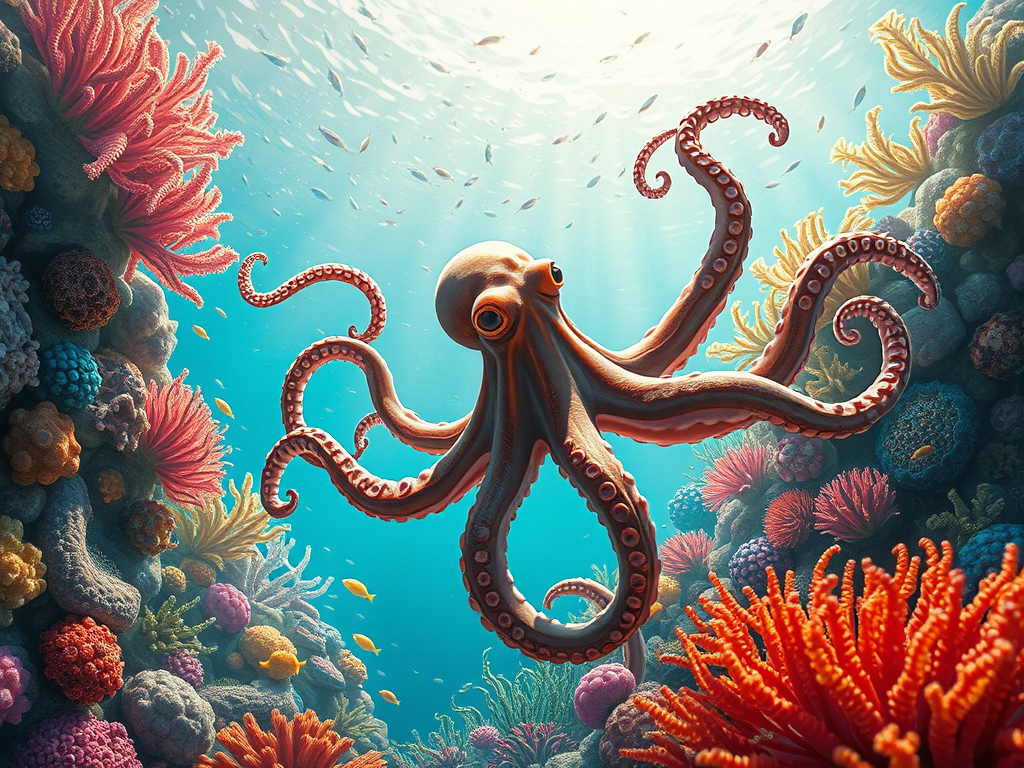
Can octopuses feel pain and pleasure? What about crabs, shrimp, insects, and spiders? The phrase “thought provoking” is frequently overused, but Professor Jonathan Birch’s new book on animal sentience and what we can do about it deserves the accolade and then some.
When I was asked to review an advance copy of Professor Jonathan Birch’s Edge of Sentience: Risk and Precaution in Humans, Other Animals, and AI, my expectations were exceedingly low. Previously, I’d only been exposed to the professor’s work via the mainstream media. Earlier this year, NBC News reported that he was among a group of scientists pushing “a new paradigm of animal consciousness, saying even insects may be sentient.” “Bees play by rolling wooden balls — apparently for fun,” the article began. “The cleaner wrasse fish appears to recognize its own visage in an underwater mirror. Octopuses seem to react to anesthetic drugs and will avoid settings where they likely experienced past pain.” As a result, Professor Birch and forty others had recently signed “The New York Declaration on Animal Consciousness,” asserting there’s “strong scientific support” birds and mammals have conscious experiences, a “realistic possibility” this extends to all vertebrates, including reptiles, amphibians and fish, and many creatures without backbones, including insects, some crustaceans, and cephalopod mollusks, like squid, octopus and cuttlefish. The declaration stated unequivocally, but rather vaguely, “When there is a realistic possibility of conscious experience in an animal, it is irresponsible to ignore that possibility in decisions affecting that animal, we should consider welfare risks and use the evidence to inform our responses to these risks.” What this might mean in the real world was left unclear, only the obvious suggestion that our current treatment of animals was cruelly lacking in some fashion. Professor Birch himself, a professor of philosophy at the London School of Economics, was quoted directly by NBC News, saying, “This has been a very exciting 10 years for the study of animal minds. People are daring to go there in a way they didn’t before and to entertain the possibility that animals like bees and octopuses and cuttlefish might have some form of conscious experience.” Before actually picking up the book and reading it, I assumed Professor Birch was going to deliver more of the same, yet another in an increasingly long line of experts who have taken a decidedly anti-human view in my opinion, where nothing about us is seen as particularly special. I figured I’d be snickering to myself the entire time, thinking how far we’ve fallen since the days of Charles Darwin and Teddy Roosevelt, two proud naturalists who were also decidedly humanist. After all, the back cover introduced the book by asking, “Can octopuses feel pain and pleasure? What about crabs, shrimp, insects, and spiders?” How could it get any better from there?
As if I needed yet another lesson in the old adage about judging a book by its cover, this one certainly did get much, much better and I was most certainly wrong in my initial assessment. Far from snickering, I was struck by two things from the very first pages. First, Professor Birch is an excellent writer, gifted with the rare ability to illuminate incredibly complex topics, distill them down to their most salient points, and connect those to competing ideas, finding similarities where none are said to exist and highlighting hidden, fundamental differences. The overview on the various theories of sentience and consciousness that opens the subject, ranging from locating it in specific brain structures present only in mammals to measuring it purely based on behavioral responses that could exist in any creature, is among the best I’ve ever read, reminding me of famed science author Richard Dawkins (whom he references briefly at the end) at his very best, which is high praise indeed. Like Dawkins and other greats in the field , if there’s an important question, Professor Birch asks it. How much emphasis should we place on the size of the brain, when each individual neuron can serve multiple purposes and even a tiny brain has millions of potential states? If there’s an unknown, he highlights it. How can we possibly tell if a computer is sentient when the program might be smart enough to fake it, gaming our own criteria? If there’s a different approach, even one he disagrees with or would prefer not to be true, he describes it in detail though it could derail his entire program. For example, he describes how we must consider the possibility that neither sentience nor consciousness is a single, truly measurable thing in the first place. Does it (or did it) spring into existence all at once, the emergence of something radically different from everything that came before, or did it arise via a gradual process? Can something be half sentient? While considering the possibilities, Professor Birch connects our own individual experiences with the development of an organism in utero and the grand sweep of evolution itself. “Think of transitional processes of various kinds: waking from sleep, emerging from a coma or from general anesthesia, a fetus developing sentience in the womb, or a lineage evolving sentience over millions of years. In all of these cases, we face the question of whether there is a sudden jump from the complete absence of phenomenal consciousness to its presence in at least minimal form – a ‘lights on’ moment – or a gradual transition with a region of borderline cases in which there is no determinant fact of the matter about whether phenomenal consciousness is present or absent. On this second view, the metaphor of the light switch is no longer appropriate (not even a dimmer switch, because a dimmer switch still has a sharp transition from off to on). The transition is more like the transition from being non-bald to bald, or young to old, where there is no sharp threshold, no single moment at which the transition happens.” Even better for those interested in seeking the truth, he has the courage to admit this a problem for his point of view because it would make sentience and consciousness almost impossible to clearly define or detect in borderline cases, and yet he admits we cannot rule the possibility out either, more on that in a moment.
If anything, Professor Birch is even better at arranging different approaches to consciousness and sentience on a continuous spectrum, one that provides a meta analysis of various theories in an easily understandable and measurable way. Of particular interest for his purposes is establishing a “zone of reasonable disagreement,” that is ensuring a wide range of approaches and beliefs are represented while limiting the influence of fringe theories, far, far outside the mainstream. While he doesn’t believe these more radical ideas are unworthy of discussion or couldn’t be proven correct in the future based on new evidence, he rightly concludes that we cannot form current and short-term public policy on completely untested ideas in the present. For example, Professor Birch synthesizes the various theories about how sentience is achieved in the biological world into a spectrum, ranging from the most restrictive varieties, those that would require complex brain structures present only in mammals, to the less restrictive that would extend to other vertebrates such as birds, potentially reptiles, and finally those that would include invertebrates. He labels these five mainstream ideas as the “range of realistic possibilities that must be taken seriously in practical contexts,” but also plots what lies outside that range. On the less inclusive side of the spectrum, he addresses non-infant humans as the only candidates for sentience and considers even only those who can use natural language, which would exclude some adults. On the more inclusive side, he includes creatures without a brain and even simple collections of tissue. This same ability to consolidate disparate ideas into a meaningful analysis is applied during the discussion of the various secular and religious ethical frameworks that govern our relationship with animals, once again focusing on what unites us rather than what divides us. “I…want to challenge the assumption that there is a deep opposition between religious and sentientist outlooks,” he writes, accurately in my view. “There are tensions, and they are serious, but I think they are not so deep as to preclude consensus on many issues.” Particularly, he focuses on the concept of “stewardship” in the Judeo-Christian tradition, noting that it “suggests a relationship between [humans and animals] akin to the relation between shepherd and flock…To the extent that extensive farming methods often exclude true stewardship, replacing it with ruthless exploitation, there is room for a Christian critique of those methods.” Ultimately, he concludes that whether you believe humans have absolute dominion over animals for whatever religious or secular reason, we all have an ethical responsibility to reduce the amount of unnecessary suffering we cause, whether that’s because causing suffering in others degrades us personally as philosophers have claimed or because of religious doctrine. This, he sees as another zone of reasonable disagreement, through which we can consider how to best treat animals that might or might not be sentient depending on the definition.
Second, but no less important from my perspective, Professor Birch is an expert who understands that we cannot simply listen to the experts on all things and leave it at that. As he puts it, when the average citizen is excluded from policy making, there is the potential for a “tyranny of expert values.” Experts, in his view, do not have direct access to a mysterious realm of facts, particularly when it comes to judgements on the ethical impact of applying their expertise, noting “that does not mean that ethicists have any special insight into the mysterious realm ethical facts, including facts about the correct weights to give to different values. Nor does it mean they have the ability to confer democratic legitimacy on their preferred resolutions.” Boldly in my opinion, he cites the British government’s response to the pandemic as a primary example of this “tyranny of expert values.” “The school closures and national lockdown of March 2020 were driven by forthright advice from epidemiological advisers, who told the government that (to quote from published documents) a strategy involving school closures ‘should be followed as soon as practical,’ that it was ‘the only viable strategy at the current time,’ and that ‘evidence now supports implementing school closures on a national level as soon as practicable to prevent NHS intensive care capacity being exceeded.’ As critics noted, this strategy caused serious harm on schoolchildren, who are generally at very low risk of contracting severe COVID-19, and were thought even in the early stages of the pandemic to be at very low risk. These harms will have a legacy stretching far into the future. At the heart of the advice to close schools was an implicit value weighting…Instead of an inclusive, democratic process for making a difficult trade off that would affect the whole of society, a small group of scientific advisers were put in a position where they had to make the relevant trade-offs using their own values.” To avoid that situation in the future, decisions regarding how to apply the emerging science of sentience in animals need to be made by citizens themselves rather than the philosophers, scientists, and bureaucrats. He believes we can separate the expert-input required to ensure the latest research is included in these decisions, to understand the risks of both acting and not acting, any associated costs, and to highlight any ethical concerns from the various judgements that need to be made, which necessarily must balance ethics, animal welfare, and the needs of humanity itself. The best way to do this in his opinion is by forming citizen panels that would translate scientific concerns into ethical frameworks and regulations subject to review by our elected representatives as part of an inclusive, democratic, bottom up process. These citizen panels would be charged with considering the potential harm to the animal, what our shared values demand, along with the costs of any specific proposal prior to its implementation. Moreover, they could be adapted to other areas where expert opinion requires democratic judgement.
After detailing the necessary scientific and democratic policy foundation for his approach, Professor Birch details his preferred criteria to evaluate whether an organism can be considered sentient or a possible candidate for sentience, which would make them subject to greater scrutiny and precaution in their treatment. Crucially, he is wise enough to separate sentience from higher-order consciousness, self-awareness, and intelligence, things which clearly are reserved for humans and perhaps a few other species. Sentience, in this case, is defined as the ability of an organism to have valenced experiences, that is an organism that synthesizes data about the world and weighs it internally as positive, negative, or neutral, and can adapt to future situations based on that weighting. Rather than embrace any of the specific theories mentioned earlier, Professor Birch provides a list of independent criteria that includes key neurological and behavioral factors that are likely to be shared across a wide range of animals, whether vertebrates or invertebrates. These include, in abbreviated form, the presence of senses to identify harmful stimuli that are connected to other parts of the nervous system, brain regions that centralize the processing of these senses, a response to drugs that can change an organism’s reaction to external stimuli and a tendency for the organism to seek those drugs when needed (for example, opioids for pain), the ability of the organism to make trade offs that balance risk and reward, to act flexibly for self protection, and to display some level of associated learning. In Professor Birch’s view, the presence of one of these structures or behaviors is not enough to justify the possibility of sentience, while all of them would guarantee it and some of them would make the organism a candidate for sentience. He proceeds to apply this framework to animals most would previously have considered non-sentient, octopuses, insects, and even flatworms. In many of these cases, he admits that there is a lack of research to make an informed decision, while highlighting evidence that suggests the potential for sentience. In crabs and lobsters, for instance, scientists have observed a catastrophic nervous reaction that occurs when they are cooked alive in boiling water lasting over two minutes. He believes the animal is experiencing great pain and recommends stunning it first, though even that might result in more pain than we would like in an ideal world. Professor Birch also extends this approach to the world of Artificial Intelligence, detailing how technology companies are pursuing different avenues to a potentially sentient machine. Everyone is familiar with ChatGPT and Google LaMDA by now, but some of the other techniques, such as OpenWorm, an attempt to model the neurons of a flatworm and place them in a robot body, have received much less attention. While he doesn’t find any existing Artificial Intelligence to be sentient, he urges precaution given how quickly technology is advancing, another common theme throughout the book.
Ultimately, it is difficult to find much to disagree with on the surface. Professor Birch’s proposals for detecting sentience and the democratic approach to improving animal welfare are all well reasoned and well supported by the evidence. (I could take issue with his requiring companies experimenting in new insect and non-vertebrate farming to empanel an independent group of exports to vet their practices as part of a new licensing scheme, but that seems like a minor disagreement and based on the overall style of the book, it seems likely Professor Birch would be willing to listen to my concerns.) At the same time, there is the sense, to me at least, that much of Professor Birch’s overall argument means something very different to me than it does to him. The discovery that sentience is far more common than we thought might sounds surprising, but it shouldn’t be on closer consideration. A complex organism, even one that we humans might look down on as simple, needs to make a lot of choices to survive and reproduce, choices that frequently compete with one another. When and where to rest, when and where to eat, what animals to avoid and which are harmless, what natural occurrences to avoid and which are harmless, when and who to mate, and many more. Scientists and philosophers have long proposed that this can be done without consciousness or sentience, and we might imagine a world of unconscious zombies who behave exactly like we do without really feeling it, but we’ve never actually found one in the real world, where every complex animals seems to feel something and feel it deeply. Evolution, it appears based on all the evidence, has solved the decision-making challenge with sentience, but evolution also requires two other things. First it needs variation in order to function, either physically or behaviorally, and the ability of an organism to form its own judgement about its experiences and react differently than another of the same type is crucial in this regard. Therefore, we should not be surprised that sentience and the varied, flexible behavior that springs from it is far more common than we might have believed, present almost anywhere we look. Second, evolution works through the accumulation of small changes, and we should also be prepared to accept that the emergence of sentience must be gradual process, from barely any sentience to sentience in humans. When Professor Birch refers to sentience candidates and investigation candidates because we have found some evidence for it in these species, it seems likely to me that we are actually finding some of the history of evolution in action, beings that exhibit partial sentience, leading up to the whole in higher animals. There is no lightbulb or dimmer switch in this view, nor is it clear that there could be.
Putting this another way, Professor Birch’s criteria for sentience are exactly what I think we should expect to find across almost all complex organisms, but that doesn’t imply these organisms are experiencing the world as we do. While I agree that language isn’t a requirement for sentience and I wouldn’t place the bar for sentience as high as humans, there is no doubt that we cannot experience the world without using at least the self-referential quality of language. When you talk about pain or pleasure or anything else, there is the feeling itself and the metareference in our mind as to what these feelings are in the first place, what they are and what they mean. We cannot separate the two. There is always us in the moment, and us reflecting upon the moment, making it unclear to me that applying the word “experience” to the perspective of both a bee and a human amounts to anything resembling the same thing in any measurable way. It’s long been known that the world around us is populated with amazing creatures that do amazing things, many of which are beyond our own capabilities. Even if humans could spin webs out of our backsides, most of us lack the engineering skills to replicate the efforts of a simple spider, but the spider itself (an organism Professor Birch believes should be an investigation priority to determine if it’s sentient) has no idea what it’s doing or why. It simply does it because the behavior, however complicated, is programmed by instinct with some variation. Because that programming includes the spider placing itself seamlessly in the world around it, making countless choices about location, timing, and more, shouldn’t imply a greater level of experience than the bare minimum required by evolution, which seems to me to be far below what most would consider sentience in a meaningful sense. Throughout the book, Professor Birch urges us to follow the precautionary principle, meaning that ethics requires us to take precautions even when we aren’t certain of the underlying truth. Hence, he argues that candidates for sentience, such as some insects, should be treated in some cases as if they had sentience, but I would argue that the precautionary principle should also apply when we attempt to ascribe deeply human notions, rooted irrevocably in the language we use, like experience, emotion, learning, striving, etc. to animals.
Regardless, this doesn’t make The Edge of Sentience any less stimulating or remarkable a book. The phrase “thought provoking” is frequently overused, but Professor Birch deserves the accolade and then some. Whether you agree or disagree with his conclusions, and I agreed far more than I thought I would, there’s a beauty to being wrong, to encountering new ideas and new personalities you might not have fully considered or even rejected outright, a joy to discovering you don’t know everything you think you know. In this case, I was most certainly wrong in my initial assessment: Professor Birch is an increasingly rare talent – lucid, charming, honest, forthright, and founded in principles we can all admire. Anyone interested in this topic, should read the book and see for yourself.
Author’s note: In the interests of brevity, I wasn’t able to address some of his specific proposals for a more ethical treatment of sentient animals. I will have the unique honor to conduct a question and answer session with Professor Birch himself, and will address these topics in a second post.

 Confessions of a Conservative Atheist