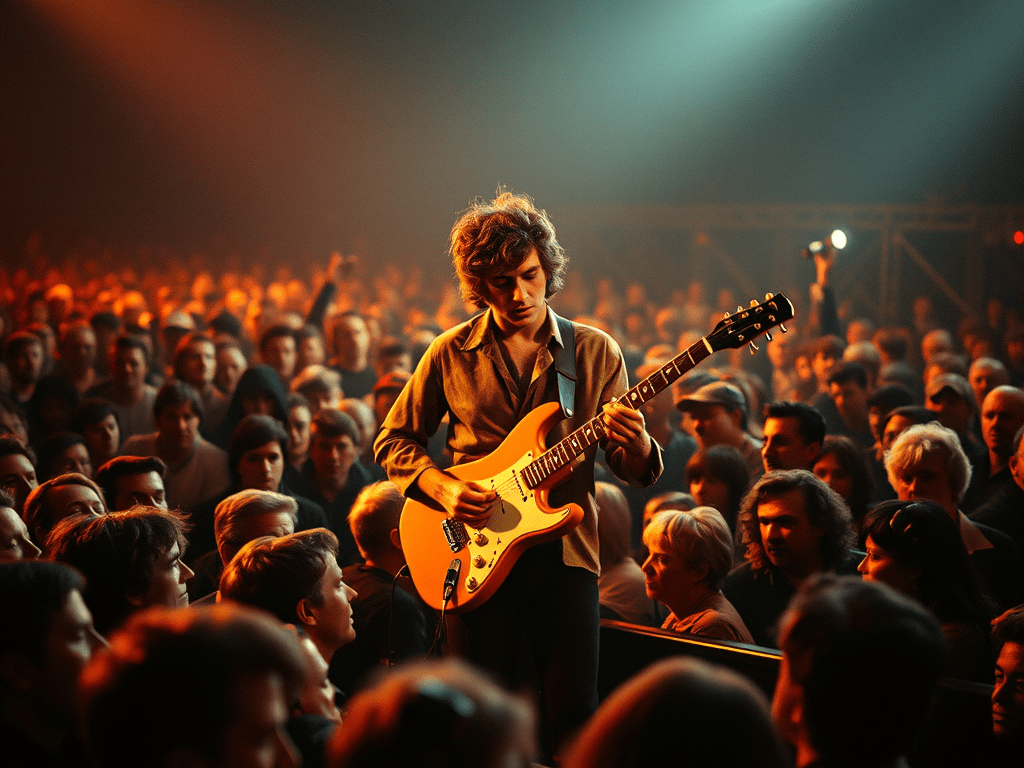
The intersection between art and technology isn’t confined to the music industry, but strangely, the idea that modern artists are merely inferior copies of past greats isn’t generally applied outside of it.
Bob Dylan is sometimes credited with taking the electric guitar mainstream when he “plugged in” at the Newport Folk Festival in 1965. By that point, he had released five albums, but it was only on the fifth that he began to perfect the modern fusion of classic folk and full band rock that would ultimately change the world forever. Before Dylan took the stage, he was urged by many to keep it acoustic, to which he was said to reply, “Well, fuck them if they think they can keep electricity out of here, I’ll do it.” To do so, he assembled a band, rehearsed at a mansion for a single night, and then took the stage on Sunday, July 25th. Joe Boyd, who was a sound-mixer for the festival, described the audience reaction in his memoir, White Bicycles: Making Music in the 1960s, “By today’s standards, the volume wasn’t particularly high, but in 1965 it was probably the loudest thing anyone in the audience had ever heard. A buzz of shock and amazement ran through the crowd. When the [first] song finished, there was a roar that contained many sounds. Certainly boos were included, but they weren’t in a majority. There were shouts of delight and triumph and also of derision and outrage. The musicians didn’t wait to interpret it, they just plunged straight into the second song.” Of course, Dylan wasn’t the first to play electric guitar in public. The Beatles, the Rolling Stones, The Who, and others all had plugged in hits during the same period. Last weekend, I found myself thinking about how these trends came together at the Woodstock Museum in Bethel Woods, NY. One can’t help being struck by the wide range of styles and sounds featured at the world’s most famous music festival a mere four years after Dylan first plugged in. Today, festivals are arranged primarily by genre, from folk to metal with little crossover in between, but in 1969 the situation was much more fluid. Woodstock boasted everything from performers firmly in the folk camp such as Arlo Guthrie, Joan Baez, and Country Joe and the Fish to those who would usher in the next generation of hard rock including The Who and Jimi Hendrix, who put in an epic performance complete with an electric national anthem before his untimely death. The full list of performers is eclectic to say the least (https://www.woodstock.com/lineup/), suggesting a music industry that was still in flux, still discovering itself, one might say the same as the country itself was, still in the process of creating the genres that would one day define the industry. Many of the bands were experimental, even psychedelic like Jefferson Airplane, existing on the border lines between what would soon be completely different types of music. Some would fade entirely or see their star dim. For example, a staff member at the museum told me that Sly and the Family Stone were his favorite act at the time, above and beyond everyone else. While they are still remembered fondly, would anyone today rank them above Hendrix?
At the same time, perhaps this shouldn’t have been surprising when the electric guitar was something of a new instrument and a curiosity in these early years, having only been invented in 1931. For centuries, music was limited to what mechanical acoustics could produce, whatever a genius like Beethoven or Bach might hear in their head, but electrification offered the equivalent of an entire rainbow of new sounds, a brand-new spectrum that supported innovation on a scale not seen since the Renaissance. With such an opportunity at their disposal, it should not be surprising that enterprising musicians capitalized on the chance to do something entirely new, either melding the existing folk forms with the new electric phenomenon like Dylan or using blues standards like Led Zeppelin. Of course, no one back then knew that electrification in general would soon become the dominant force in music, a staple of everything from rock to pop, but a young musician devoting themselves to this marvelous new device had the unique opportunity to create what no had ever created before and few artists with any talent would pass that up under any circumstances. The result was a revolution in music so complete it changed the entire world, and the release of a series of albums between the 1960s and 1970s by which everything is still judged today. Judged, and frequently found wanting because this everything is always compared to the original without really acknowledging that no one will ever have that chance again. Thus, the question before us fifty years later: Is that a remotely fair way to analyze and appreciate music when there might be an infinite number of songs but only a finite number of sounds? Led Zeppelin, for example, were not only excellent musicians. They were also the first band of their kind operating in a genre that didn’t exist. The classics they created, take your pick of the standards like “Stairway to Heaven” or the less heralded “The Rover,” had both virtuosic musicianship and the benefit of being unlike anything anyone had ever heard, allowing for a lasting impression that set the standard for the future of music. No one writing today, however talented, has that opportunity or ever will again, leading to almost every modern band having been accused of sounding like some predecessor when it’s impossible for it to be otherwise. In that case, how can we properly judge modern music knowing there will never be another Led Zeppelin?
The intersection between art and technology isn’t confined to the music industry, but strangely, the idea that modern artists are merely inferior copies of past greats isn’t generally applied outside of it. In comparison, Thomas Edison pioneered motion pictures by demonstrating what he called the kinetograph on October 16, 1889. Edison was so obsessed with moving pictures in general he spent years devoted to developing the technology and went on to set up something close to a modern studio in New Jersey, but for various reasons, no one would truly call him a filmmaker, nor is he generally credited as one despite inventing the entire medium and popularizing it with the public. Similar to the rise of the electric guitar, that title was reserved for the generation that came a little over two decades later. By the 1920s, F.W. Murnau had released Nosferatu (1922), Sergei Eisenstein, Battleship Potemkin (1925), and Fritz Lang, Metropolis (1927). Though they were silent pictures, this sequence of films and others introduced (almost) all of the conventions of modern cinema, and the same as the great musicians of the 1960s and 1970s, there isn’t a filmmaker alive today who doesn’t use and repeat them. Moreover, these conventions weren’t merely technical in nature, what we might call the equivalent of the chords from which songs are composed, techniques like shots and counter shots, the use of long, medium, and close up shots, point of view shots, the 180 degree rule, and others that enable us to extract meaningful information from what is essentially a sequence of disconnected images. They were stylistic, thematic, and narrative, essentially what we would expect from a modern movie. Metropolis, for example, tells a complex story of familial relationships and class conflicts in a science fiction setting, complete with dream sequences and special effects. Indeed, it is only a small stretch to say this almost 100 year old film contains everything every science fiction film does to this day (literally given Francis Ford Coppola’s Megalopolis certainly comes to mind). As I described it in another post, “Robots? Check. Roberts impersonating humans? Check. An inventor that regrets his role in building a new society? Check. Futuristic cities with skyscrapers and flying cars? Check. Video calls? Check. A class struggle? Check. A love story? Check. Religious overtones? Check. Surrealistic, avant garde sequences and dreams? Check. Special effects combining miniatures, mirrors, projection screens, and imagery created for the purpose? Check.” This first generation of filmmakers was followed by another group of pioneers who introduced sound and other narrative elements – Fritz Lang, interestingly, also pioneered the use of offscreen noises as well in M (1931). Directors like Alfred Hitchcock, who I have only half-facetiously credited with inventing the modern movie, John Huston, Howard Hawks, followed by Stanley Kubrick, and others seemingly did everything that was possible to do with a movie, and yet when we we watch a modern masterpiece, we don’t have the same tendency to insist it views like Fritz Lang or Howard Hawks, the way we do with music. Instead, we can appreciate the influences of the prior greats, but we have an inclination to give the filmmaker the benefit of the doubt and attempt to appreciate the work on its own terms.
Music, however, is treated differently for some reason and perhaps there is no better example of that than Greta Van Fleet, the first Gen Z rock band with a following large enough to sell out arenas. Despite a loyal and growing fan base, a line up headed by a vocalist capable of ridiculous high notes and a penchant for catchy, driving rhythms, many critics have simply dismissed them as nothing more than a Led Zeppelin knock off from the very beginning. Rolling Stone probably put it best while reviewing their second full length album, The Battle at Garden’s Gate. The band, to that point, set “themselves apart by playing Seventies classic rock that seemed wholly unburdened by distance, irony, cultural point-making or even self-awareness. They just really, really liked making songs that sounded like Led Zeppelin (with some Rush thrown in there, too).” In their view, “Greta Van Fleet are just as guilelessly impassioned on their second record. You would think that maybe at this point they would have moved on to ripping off less obvious Zeppelin songs. Nope. Their stairway still goes directly to heaven: ‘Broken Bells’ bustles in your hedgerow with such gusto that it’s not hard to imagine GVF finding themselves on the business end of a whole lotta legal action.” Around the same time, Guitar Magazine asked, “Why does Greta Van Fleet’s music sound so much like Led Zeppelin? The Detroit rockers are often claimed to be ripping off Page, Plant and co, but why is that? And is there anything wrong with it? We take a closer look at the music to try to find out.” There is some truth to these and other claims — if you subscribe to the view that any post-1980 band featuring a screaming vocalist and hard and heavy rhythms that relies on mystical tropes at times for their lyrics is a Zeppelin clone, meaning if you do not attempt to appreciate their songwriting and musical artistry on its own. If, however, you take a view closer to what prevails in film analysis, you are likely to come to a rather different conclusion. While there are obvious call-backs to the legendary founders of hard rock, as even Rolling Stone admitted before dismissing the fact, there’s also a more progressive sound, representing a fusion of other influences combined into something all their own. As my wife – who currently ranks Greta Van Fleet in her top ten bands of all time – and I are fond of noting, somehow, we know it’s them rather than Zeppelin or anyone else from just the first few seconds of any song, even if we’d never heard it before. Like all great bands, they have a distinct sound of their own, whether the song in question is a rocker, a ballad, or an acoustic throwback.
“Heat Above,” a seamless blend of classical tropes and modern ballads from their second album, encapsulates this phenomena in my opinion. The song opens with a building sequence of seemingly disconnected sounds, somewhat disjointed, instrumental, slowly taking shape until an extended drum roll introduces the main riff, which seems birthed by what came before, distinct yet ushering in some new era in the music. There are similarities to other classic rock standards at this point, in particular Led Zeppelin’s “All of My Love” comes to mind, but these exist amid threads borrowed from classical and Eastern music, wrapped together with Greta Van Fleet’s signature style of adapting and evolving the main riff throughout the song. Thus, the initial acoustic guitar gives way to variations on the organ, as the song ebbs and swells, taking its own course, both using and eschewing a traditional structure. Josh Kizka, lead vocalist, soars above it all, sometimes screaming, sometimes serving as another instrument. The lyrics themselves include their fascination with the oxymoron of a “peaceful army,” combining existential dread, “This is what life is worth When the fires still burn and rage all around. Can you hear that dreadful sound? Fire still burning on the ground,” with the idea that we can somehow transcend our earthly scars, “Can you feel my love? Rising with the heat above. Life’s the story of Ascending to the stars as one.” The band themselves described the song as about “different cultures and civilizations inside of this world searching for some kind of salvation or enlightenment.” “‘Heat Above’ is theatrical, eloquent, and exaggerated,” the band also said in a statement upon releasing the video, which is all a fair enough description, though one that Rolling Stone mocked when they claimed the band was “unburdened by distance, irony, cultural point-making or even self-awareness.” “This is a dream in the clouds, a moment of peace in the storm. Thematically, we are dead center in the cult of Heaven, surreal, strange, alive, and free.” While some have called the work “ethereal,” it’s not as if it doesn’t rock in that particular ballad way when everything kicks into high gear over the chorus. Overall, it’s difficult to describe in words, as all great songs are. It needs to be experienced instead, from the drum role that kicks it off to the lilting “Yeah, yeah, yeah, yeah, yeah, Yeah, yeah-yeah, yeah-yeah, yeah-yeah, yeah-yeah, yeah-yeah, yeah” that winds it down – experienced and appreciated on its own terms, terms where we can unravel the threads that weave it all together, while acknowledging its unique and magical in its own right.
You can judge for yourself, but this to me at least, is how music should be judged in the modern era, unburdened by the past save to understand how influences continue to create new artists. The alternative is to believe that somehow the generation between 1965 and 1985 boasted the only meaningful concentration of music talent to ever pick up the electric guitar, and to reduce yourself to appreciating what can only be in the past.

 Confessions of a Conservative Atheist