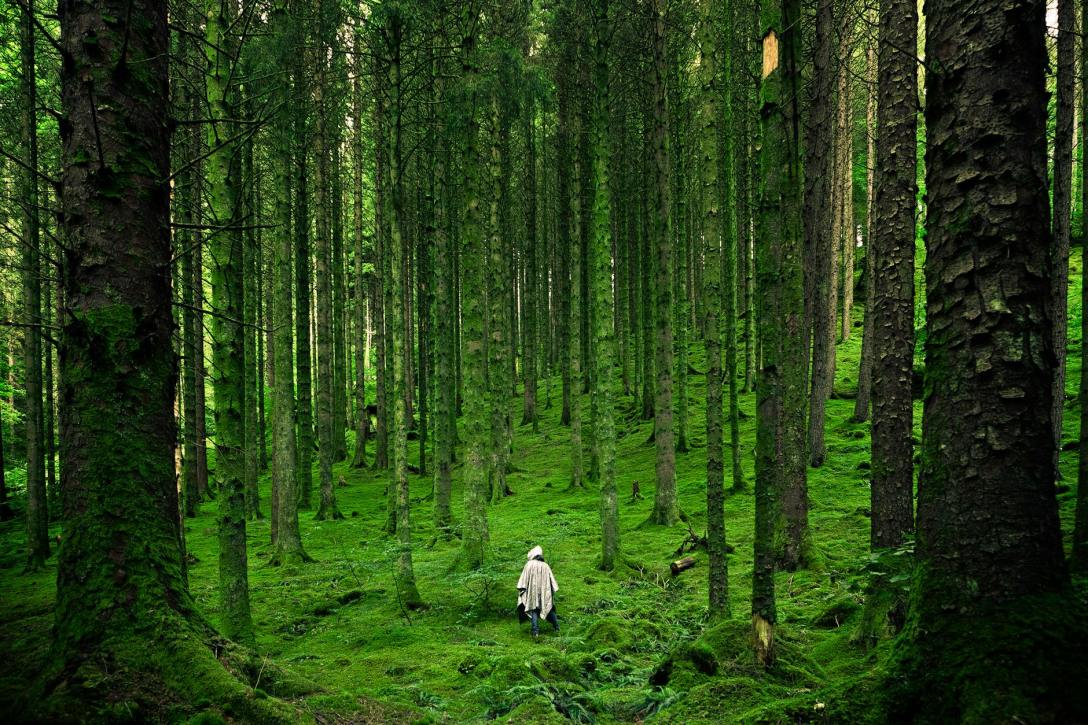
For hundreds of millions of years, life persisted on Earth with no meaning at all. Trillions upon trillions of creatures lived and died, born as dust and returned to it without remark. Humanity changed all that, making the meaningless, meaningful.
Nature means nothing without people might seem a bold statement on the surface. Nature, after all, includes the entire world and all the stars in the heavens. It is at various turns astounding, unfathomable, mesmerizing, and even frightening in matters both large and small. Earlier this week, I saw a video on Facebook of a squirrel defending their offspring from a snake. The smaller squirrel, not quite a baby yet not full grown, was already in the snake’s grasp and was rapidly being constricted. You could see its life ebbing away. To save the little creature, the larger squirrel, presumably its parent, attacked the snake in fit of rage with no regard for its own life, biting and clawing at whatever part was closest, snapping and tearing across the entire body. The snake responded in kind, striking back at the squirrel repeatedly while refusing to give up its grip on the smaller animal. Ferocious barely begins to describe it, as neither the squirrel nor the snake would relent. Over the course of more than two minutes, there were dozens of bites landed on both sides, all while the squirrel remained constricted. When all seemed lost, the snake finally gave up, either from exhaustion or the wounds, releasing the smaller squirrel and simply lying on the ground beside it, completely spent from the struggle. The larger squirrel took advantage of the opportunity to pick up the smaller one, using its own little paws, and dragged it away from danger. The smaller squirrel was still alive, though whether it would make it was unclear. The larger squirrel was wounded as well, covered with bites from the snake. Still, it managed to carry the smaller one away from the scene before fleeing up a tree and disappearing into the branches. The video was equal parts exhilarating, like watching two unlikely opponents face off in a boxing match with no idea who would prevail, heartbreaking given lives were at stake on both sides, and incredible considering the lengths the older squirrel went to protect the younger one, up to and including giving its own life in the battle, as if were a human mother. That it was a video, however, only serves my original point: If this had happened when no one was watching, it wouldn’t matter in the least. Uncounted numbers of animals live and die every day, everywhere around us, even in the most urban areas, and the great majority of these struggles – complete with battles to the death like this one every time a fly is caught in a spider’s web – pass unnoticed. It’s like the old adage about whether a tree falling in a forest with no one there to hear it makes any sound. That’s the wrong question. Physically speaking, a falling tree will cause the air to vibrate in waves whether or not anyone hears it. Sound, however, the idea that a tree is falling in the first place, only has meaning because we have given it such by asking the question in the first place.
Meaning, meanwhile, is a uniquely human concept. Animals, especially what we might call the higher ones like our cousins, the great apes, dolphins, dogs, and perhaps a few others, are capable of astounding feats, but they are incapable of imbuing anything with meaning, save for what we give it. This is because meaning requires the separation of an idea from an object via the miracle of language. When one refers to the meaning of something, we are referring to an abstraction if it, its essence, its fundamental qualities, its higher order relation to something else. The same way the “meaning” of one of Shakespeare’s great tragedies isn’t the play itself, the meaning of nature and all her vastness, is not nature itself. In this view, nature exists without us, but all of the beauty, grandeur, mystery, majesty, and suffering means nothing unless we are there to observe these things and label them such. A dog who lives in a mansion doesn’t marvel at the spaciousness, the quality of the furnishings, the priceless works of art, or anything else. He doesn’t evaluate these trappings of the world and make judgments about it, considering himself superior to dogs confined to an apartment building. A grizzly bear might call the most majestic places on Earth home, high up in the mountains of Montana, but majesty isn’t a concept they understand or has any meaning for them. This doesn’t mean they are incapable of what might be termed “proto emotions” or even “proto relationships.” We’ve all seen dogs that are obviously scared or in pain, or pleased when you pet them, but even here we should be careful. A human emotion exists on two levels. There is the automatic response we have to events or the environment, the reaction that takes place on an unconscious level, like when we yank our hand away from a hot stove before we even feel the pain. There is also the meaning we give it in how we label and consider the abstract concept of an emotion in the first place. Thus, we might wonder why certain things scare us or please us, compare our reaction to these things with others who feel differently, and even in some cases take steps to change it. Animals, with the possible exception of great apes, are not capable of this because, to the extent they can be said to experience emotion at all, they are only capable of experiencing the primal, instinctual version. A dog that is in pain or afraid does not know they are in pain or afraid the way we do. This might seem a subtle difference that is either meaningless or hard to define, but consider a dog that has been injured, losing one or both legs. The dog doesn’t bemoan its state as we might, get depressed over what they have lost, or compare itself to other dogs and find itself lacking. The dog just continues because it doesn’t understand the meaning of what has been lost. We might look at such a dog and say to ourselves, poor thing, but it simply persists as best it possibly can.
This ability to ascribe meaning to things and reflect on meanings in general has elevated humanity throughout history, prioritizing our needs above other species and the overall environment. Implicit in this view is the idea that nature exists to furnish humanity with food, shelter, and more, and to delight and amaze us as well. This doesn’t imply that we should be wasteful of our natural resources or unnecessarily cruel to animals, merely that their existence is subservient to ours. Beauty is a trait and a meaning prized by people, and preserving natural beauty is a natural imperative. We might debate the extent of our impact on the environment, argue over what lands should be preserved and conserved, but the underlying belief that nature existed to serve humanity’s needs was largely unquestioned for centuries, if not millennia. We can see this in the lives of early naturalists and conservationists, from Charles Darwin himself to Teddy Roosevelt. Both men were scientists and explorers, who studied the world and mapped out new portions of it, viewing nature with an almost religious reverence. Roosevelt, for example, once claimed that he felt closer to God in a forest bower in the mountains than in any church. In Yosemite, while lying on the fresh, untrodden earth, he remarked “It was like lying in a great solemn cathedral, far vaster and more beautiful than any built by the hand of man.” Darwin and Roosevelt were both also avid hunters, however, killing animals for sport and pleasure. After leaving the Presidency, Roosevelt went on an expedition to Africa on behalf of the Smithsonian Institution. Over the course of a little more than a year, Roosevelt and his team killed or captured some 11,397 animals including almost 5,000 mammals, 4,000 birds, 2,000 reptiles and amphibians, and five hundred fish. If you include invertebrates and plants, the number rises to over 23,000. It took the Smithsonian eight years to catalog all his findings. In his book detailing his personal experiences, African Game Trails, he condemned both “butchery as objectionable as any form of wanton cruelty and barbarity” and those who condemned hunting for sport, saying it was “a sign of softness of head, not of soundness of heart.” Roosevelt, earlier in his career, was also a rancher, raising some 3,200 cattle and another thousand calves for slaughter, herding them the old fashioned way on horseback. This is the legacy of the man generally considered the first great conservationist, a person who loved the environment far more than most, especially in his era, but clearly prioritized the needs of humanity over nature for nature’s sake.
Over the past several decades, however, a movement has begun to upend this vision, placing humanity on the same plane as the rest of nature, no better, no worse, and with no right to actively cultivate the land and animals as needed for a prosperous civilization. Two weeks ago, NBC News described how scientists are “pushing a new paradigm of animal consciousness, saying even insects may be sentient.” Previously, I had opined that if all animals are sentient, no animals are sentient, but it’s worth revisiting here considering how radical this and other proposals are. Citing new research, such as “Bees play[ing] by rolling wooden balls — apparently for fun. The cleaner wrasse fish appear[ing] to recognize its own visage in an underwater mirror. Octopuses seem[ing] to react to anesthetic drugs and…avoid[ing] settings where they likely experienced past pain,” they reported that a group of “top researchers on animal cognition” have published a new pronouncement, “The New York Declaration on Animal Consciousness,” which places animals on an equal plane with humans in almost all things. Rather than the traditional approach of protecting endangered species, ensuring natural resources are not exhausted, and conserving key environments, they propose that animals, all animals should be given rights because they are conscious the way we are. “The declaration says there is ‘strong scientific support’ that birds and mammals have conscious experience, and a ‘realistic possibility’ of consciousness for all vertebrates — including reptiles, amphibians and fish. That possibility extends to many creatures without backbones, it adds, such as insects, decapod crustaceans (including crabs and lobsters) and cephalopod mollusks, like squid, octopus and cuttlefish.” “When there is a realistic possibility of conscious experience in an animal, it is irresponsible to ignore that possibility in decisions affecting that animal,” the declaration says. “We should consider welfare risks and use the evidence to inform our responses to these risks.” As NBC News describes it, the declaration “shows [the] field is moving in a new direction.” For some reason, they fail to mention that this new direction is completely antithetical to humans and the lifestyle we enjoy. Further, they embark on this journey by redefining common terms, rather than truly breaking any new ground.
For centuries, consciousness and sentience have been defined as higher order brain functions that require the ability to self-reflect, separating word from object and ascribing meaning as described earlier. Descartes’ famous maxim that I think, therefore I am. Consciousness here, however, has been completely dumbed down, robbed of its previous uniqueness. The new phrase is “subjective experience,” that is “to sense and map the outside world, to have capacity for feelings like joy or pain” and for some reason, scientists are surprised that animals have these capabilities, using that fact to push a radical agenda. They should not be: First, all animals with a nervous system extract data from the outside world. Given that no two animals’ nervous systems, even within the same species, are identical, there will be variation in what each individual animal does with this data. This is fundamental to evolutionary theory, and it means, by definition, that every animal’s experience is inherently subjective because all experiences are subjective. There are no objective experiences and cannot be. Claiming we have suddenly discovered subjective experiences in animals is simply a linguistic trick. Ironically, the trick relies on the very anthropomorphism, that is elevating human experience, they are attempting to counter because they assign motivations to animal behavior that align with ours. Hence, they might well have observed a fish that appears to recognize itself in a mirror (in a lab), another fish that exhibits curiosity when its environment changes, a cuttlefish that remembers by sight and smell, and a crayfish that benefited from anti-anxiety drugs, but they are ascribing meaning to these observations in a way unique to humans. Simply because a fish sees itself and appears to respond to it, does not mean it knows itself in the conscious sense. Likewise, a fish that explores its environment isn’t necessarily exhibiting curiosity, nor should we be surprised that animals have prodigious memories, some far exceeding our own. All animals have evolved to be uniquely adapted to their niche, and in many cases, this results in extraordinary behavior that might appear to require higher order thinking on the surface, but appearance is not reality. Before any one leaps to the radical conclusion that fish are sentient beings, one should consider their evolutionary history, how that behavior might have evolved, for what purpose. This hasn’t been done here. Instead, they have watched a spider weave its web – an astounding feat if ever there was one – and declared it to be an architect and an engineer. They have seen a bee do its marvelous dance – one of only three animals including us that appears to communicate about objects not present in the environment – and declared it to be language.
Alas, they are not alone. As if this was part of a coordinated effort, The New Yorker revisited a similar topic recently as well. They asked it this way, “How Far Should We Carry the Logic of the Animal-Rights Movement?” They quote the “philosopher” Peter Singer who made some of these claims back in the 1970s, concluding that humans were no different than animals because a “chimpanzee, dog, or pig” could demonstrate “a higher degree of self-awareness and a greater capacity for meaningful relations with others than a severely retarded infant or someone in a state of advanced senility.” More recently, another “philosopher” Martha Nussbaum has proposed that we should help “live the kinds of lives they seem to want to live” to use The New Yorker’s phrasing. “Wonder,” she wrote, “suggests to us that animals matter directly, for their own sake—not because of some similarity they have to ourselves.” Animals somehow “strive for flourishing,” and are frequently blocked by humans. “We are all animals,” she wrote, “thrown into this world together, striving to get the things we need, and often thwarted in the attempt.” A cat, for example, exhibits the “active pursuit of ends.” To address this issue, she proposes that animals be granted entitlements based on their species. These entitlements would, perhaps needless to say, be decided by the “experts who have lived closely with a certain type of animal and studied those animals over long periods of time.” As part of a global government, the experts would be charged with drafting “a legally enforceable constitution” for every animal. As The New Yorker described it, “Dolphins, for instance, would be granted the right to roam, to socialize, and to have as much or as little contact with humans as they choose. She holds that, because animals generally ‘seek maturity as a central goal,’ killing the young is probably harder to justify than killing the old. And she writes that virtually all creatures under human control should be guaranteed ‘at least one or two chances at sex and reproduction.’” This would include even pets, which Ms. Nussbaum rebrands as “companion animals,” meaning the next time you get a dog or a cat, be prepared to have several as they multiply in your house.
I used to be fond of saying that the experts were always wrong, but now they appear to have gone completely insane to the point where they believe you should have to respect the rights of a beehive in your backyard before you call the exterminator. At the core, this is nothing short of a war on civilization itself. For hundreds of millions of years, life persisted on Earth with no meaning at all. Trillions upon trillions of creatures lived and died, eating each other for survival in life’s eternal struggle for no purpose save reproducing the species and no record whatsoever of their plight outside a relatively small number of fossils. They were born as dust and returned to it without remark. Humanity, by observing, recording, and exploring the world changed all that, making the meaningless, meaningful. This is undoubtedly one of our greatest achievements, but there are those – aided and abetted by the media – who loathe humanity for it. As Alfred Lord Tennyson once wrote, “To strive, to seek, to find, and not to yield.” Today, the experts want to yield.

 Confessions of a Conservative Atheist
people redefine “consciousness” and “sentience” and then act surprised when entities formerly excluded by these categories are now included by them…
LikeLiked by 1 person
Good point – I did some searches, and couldn’t even make sense of how these terms have changed over the past few years. Basically, they don’t mean anything, except humans no longer have any distinct cognitive abilities. Similar to the “my truth” nonsense, they might as well be talking about “fish truths.” :)
LikeLiked by 1 person
[…] Nature means nothing without conservative/conservationist lovers of nature, not bureaucratic experts… […]
LikeLike