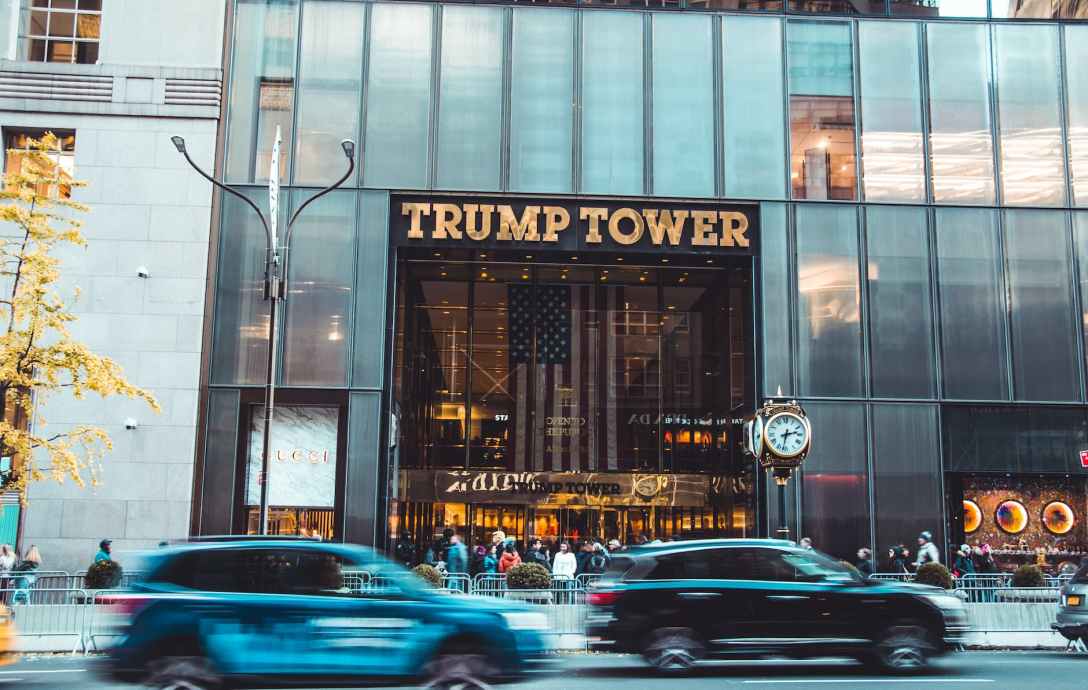
Whatever your opinion on the former President in particular or the Trump Organization in general, the ruling and the fine rest on a fundamentally backwards reading of how the free market works and the rights of parties entering freely into a business arrangement.
Last week, former President Donald Trump was ordered to pay $355 million in fines and was barred from operating a business in New York State for three years by Judge Arthur Engoran for fraudulently inflating the value of his properties in private documents shared with his banking partners. Judge Engoron, an outspoken liberal, both convicted the former President and decided the penalty entirely on his own, a novel arrangement if ever there was one. As described in his ruling, “Donald Trump and entities he controls own many valuable properties, including office buildings, hotels, and golf courses. Acquiring and developing such properties required huge amounts of cash. Accordingly, the entities borrowed from banks and other lenders. The lenders required personal guarantees from Donald Trump, which were based on statements of financial condition compiled by accountants that Donald Trump engaged. The accountants created these ‘compilations’ based on data submitted by Trump entities. In order to borrow more and more at lower rates, defendants submitted blatantly false financial data to the accounts, resulting in fraudulent financial statements.” He said so, and then points out the obvious: “Alleging the elements [of fraud] is easy; proving them is difficult. Is the statement one of fact or opinion? Material according to what standard? Knowledge demonstrated how? Justifiable subjectively or objectively?…In the Laws of 1965, the words ‘fraud’ and ‘fraudulent’ were expanded to include ‘any device, scheme, or artifice to defraud and any deception, misrepresentation, concealment, false pretence [sic], false promise or unconscionable contractual provisions.’ The statue casts a wide net.” So wide, in fact, that the judge admitted that no one was actually defrauded a short two pages later. “Here, despite the false financial statements, it is undisputed that defendants have made all required payments on time; the next group of lenders to receive bogus statements might not be so lucky,” as if one of the key functions of a lender wasn’t to assess risk and adjust statements. The false statements are detailed by the Judge himself as “materially misrepresent[ing] the value of Trump Tower Triplex, The Seven Springs Estate, certain apartments in Trump Park Avenue, 40 Wall Street, and a golf course in Aberdeen Scotland.” Judge Engoran determined this first by establishing that the Trump Organization was the source for the numbers, not the accounting firms hired. For example, Mazars USA LLP alleged that the defendants “withheld records, such as appraisals, that Mazars had requested while preparing the compilations, leaving Mazars to conclude that the Trump Organization has falsely represented that it had complied fully and truthfully with all inquiries from Mazars.” An audit partner from Whitley Penn, “buttressed [this testimony] that compilers simply use the numbers provided by the client; they do not check them.”
The Judge proceeded to note that various lenders used these financial statements with the supposedly inflated values to grant loans to the Trump Organization and that the statements were provided annually, making the fraud repetitive. One such lender was Deutsche Bank, who despite being a victim of this fraud, testified on the former President’s behalf and noted clearly that the business arrangement was not as the Judge described it. First, they did not accept the Trump organization’s valuations or the statements. In fact, they reduced them by 50%, the “standardized number for commercial real estate assets,” which might well be fraud under this strange standard, and that the loans issued were not even based solely on the assets themselves. The “Private Wealth Division would not have done business with Donald Trump without a personal guarantee, and that personal guarantee was the reason for favorable pricing on the loan and the large size of the loan itself.” As they put it, “Given that this was unusual collateral as a golf resort and spa, we would not really want to have to foreclose on that collateral and so we would likely look to the guarantor to remedy any default.” In other words, the bank neither accepted the valuations provided by the former President nor provided the loan specifically because of those valuations, meaning the supposedly false statements influenced precisely nothing. From there, Judge Engoran cited the reasons he found the Trump Organization guilty of fraud based on various information about the properties in question. Some input was gleaned from individuals involved in potential real estate deals, such as Doug Larson, “a valuation adviser and certified New York real estate appraiser.” Mr. Larson’s name was used in reference to an appraisal, but he did not do an official appraisal, which he said was “inappropriate and inaccurate…I should have been told and, you know, an appraisal should have been ordered.” On another property, he provided an appraisal, but Trump ultimately listed the value of the property $200 million higher, but why either the Trump Organization or the court should defer to Mr. Larson is left unsaid. Does an appraiser now have the power to dictate prices and order appraisals themselves? My own house was purchased for slightly more than the appraised value. Is the previous owner guilty of fraud? What if the appraisers disagree as they often do? Similarly, there are debates over the value of potential new units to be constructed on Trump Organization golf courses and similar ventures that the Judge finds objectionable, but ultimately the case hinges on the “fraudulently” inflated value of the specific properties noted above. Of particular interest to Judge Ergoran was the “Triplex” apartment in Trump Tower which had a claimed square footage of 30,000 in the annual filings compared to an actual square footage of slightly under 11,000, which supposedly resulted in overvaluing the property by $114 to $217 million dollars. The number was corrected in 2017. In another valuation, a series of “implausible assumptions” were used to generate an income of $26.2 million for a building that was losing money at the time. Another claimed a property was a liquid asset, when it was not. Mar-a-Lago was valued in a way it wasn’t permitted for. Similarly, rent control apartments were not listed as such on another.
Former President Trump, perhaps needless to say, disagrees that the values were inflated and in some cases claimed they might have been undervalued. While testifying, he insisted in his usual bombastic fashion, “I thought Mar-a-Lago was very underestimated, but I didn’t do anything about it. I just left it be. It didn’t matter. I didn’t care, because the numbers you are talking about here is, you know, they are very big numbers, big, very big. Far bigger – the values are bigger than what is on the financial statement.” Even setting aside possible variations on the valuation when there is no objective way to value a real estate asset short of an actual deal between a buyer and seller, Judge Ergoran attempted to determine how much money President Trump fraudulently saved by securing a lower interest rate based on these valuations (which weren’t used in the first place), even though several witnesses said that was fruitless. For example, “I can give you a range and give historica [sic] as to what has been out there and show illustrative examples of it, but at the end of the day as referenced in the Deutsche Bank documents, all of their risk rating, all of the pricing is proprietary. None of us have that information. None of us have that ability. None of us understand the total relationship value.” Neither this nor the fact that the bank itself didn’t accept the stated valuations – in several of the instances of “fraud” cited, their adjusted value removes any and all inflation – and approved the loan on personal guarantee prevented the Judge from assigning the $355 million penalty, claiming the lower interests rates obtained represented “ill-gotten gains.” “[W]here, as here, there is a claim based on fraudulent activity, disgorgement may be available as an equitable remedy, notwithstanding the absence of loss to individual claims for restitution. Disgorgement is distinct from the remedy of restitution because it focuses on the gains to the wrongdoer as opposed to the loss to the victim. Thus, disgorgement aims to deter wrongdoing by preventing the wrong-doer from ill-gotten gains from fraudulent conduct. Accordingly, the remedy of disgorgement does not require a showing or allegation of direct losses to consumers or the public; the source of ill-gotten gains is ‘immaterial.’” This is legalese for saying one can commit fraud without actually defrauding anyone, a Judge can order fines however they see fit without any actual money being illegally exchanged, and neither requires any actual gain. In this case, Judge Ergoran has determined that the Trump Organization committed insurance fraud despite that they received no insurance payments. From there, he is identifying potential differences in the interest rate of the loans as the source of these ill-gotten gains, despite that the interest rates were not arrived at as the result of the valuations and the loans might never have occurred in the first place at a higher rate.
Whatever your opinion on the former President in particular or the Trump Organization in general, the ruling and the fine rest on a fundamentally backwards reading of how the free market works and the rights of parties entering freely into a business arrangement. In principle, I am free to value an asset however I see fit. There is nothing that prevents me from listing my home for a billion dollars due to sentimental value, or my car for a million because of all the road trips I’ve taken. Likewise, there is nothing that compels anyone to accept this value and pay what I am asking. You are free to disagree with any valuation I may make, exactly as the bank has done here. The bank was also free to perform its own appraisals, inspect the properties as they saw fit, etc. as part of their own due diligence. They were not obligated to take the Trump Organization’s word on any of the materials they presented, and in fact they did not take these valuations at face value anyway. At the same time, the bank described the former President as a “whale” of a client and had a vested interest in doing business with him. They were also aware that Trump was free to reject any interest rate he perceived as too high, exactly as all of us are free to reject any offer on our own homes or other assets, and therefore both parties had a mutual interest in coming to an agreement. This agreement on what exchanges of goods and services are mutually beneficial is what drives the entire economy, and traditionally the government has refrained from inserting itself into the process outside a few highly regulated industries for obvious reasons. Judge Ergoran has taken the unprecedented step of playing the role of a referee in what is a deal between two parties, neither of which has made any complaint against the other. Crucially, he has convicted President Trump of fraud despite that the properties in question did not actually change hands, were not a part of the actual deal, nor were they intended to be a part of the deal. Clearly, selling a property that claimed 30,000 square feet of living space only to find 10,000 after the deal was completed or selling a business that claimed millions in revenue that didn’t exist would constitute fraud, but that isn’t what happened here, far from it. Even setting aside that several of the instances of fraud were corrected in subsequent years as we would expect for any complex financial document, the Judge has levied the largest fine for fraud in New York history and effectively taken over a large New York business over a private matter that should never have been made public if both parties had their way, one that has had no direct impact on any goods or services that exchanged hands, and is not governed by any reporting or oversight regulations – as the sale on a property or business would be for obvious reasons.
Putting this another way, the ruling is based on documents that were not filed to the government, are not subject to government filings in the first place, are not part of an audit or tax documentation, and were not reported to the government by any of the parties involved. The government, during the normal course of its operation, would not have access to these materials at all – save that Attorney General Letitia James launched an unprecedented blanket investigation into all things Trump that was not predicated on any reasonable belief a crime had been committed or any complaint by anyone. Left to their own devices, both President Trump and his financiers were pleased with the mutually beneficial relationship and continued working together. Regardless, the Judge has taken these private documents – the valuations of which were reduced by the bank to begin with – applied a new standard for what constitutes fraud, convicted President Trump of that new standard of fraud, and created an entirely new standard of penalties, all entirely on his own with no jury, no oversight, and no accountability. These penalties include effectively taking control of a private business that the judge himself agreed has not harmed anyone, stolen any money, or criminally violated any law. This has prompted even those who are far from fans of the former President, such as MSNBC host Katy Tur, to note “[The rule] doesn’t have to show the harm done. It’s not the burden. You don’t have to show that anybody was hurt by your practices. There’s nobody you defrauded specifically, [but] They looked at 150 cases over 70 years and found there was no case where there was a ban on doing business where there wasn’t harm shown. So even though the threshold is harm shown, in the past, it has only been used to ban someone doing business when it’s been shown that somebody was hurt, say you’re selling cosmetics that are poisoning you. Is it fair to go after Donald Trump like this in this environment, is my question?” To say this is an overstep of the traditional role of government in protecting financial and other markets, much less that this step was taken by a single person who considers themselves all powerful in these matters, fails to capture how radical this outcome truly is. By this standard, there is nothing that prevents the government from inserting itself in any private translation even without a complaint in the first place, like charging you with fraud for overstating the value of your own assets on a mortgage application, or for asking more than the market price of a used car. Anyone who thinks this will end with Trump himself hasn’t been paying attention.

 Confessions of a Conservative Atheist