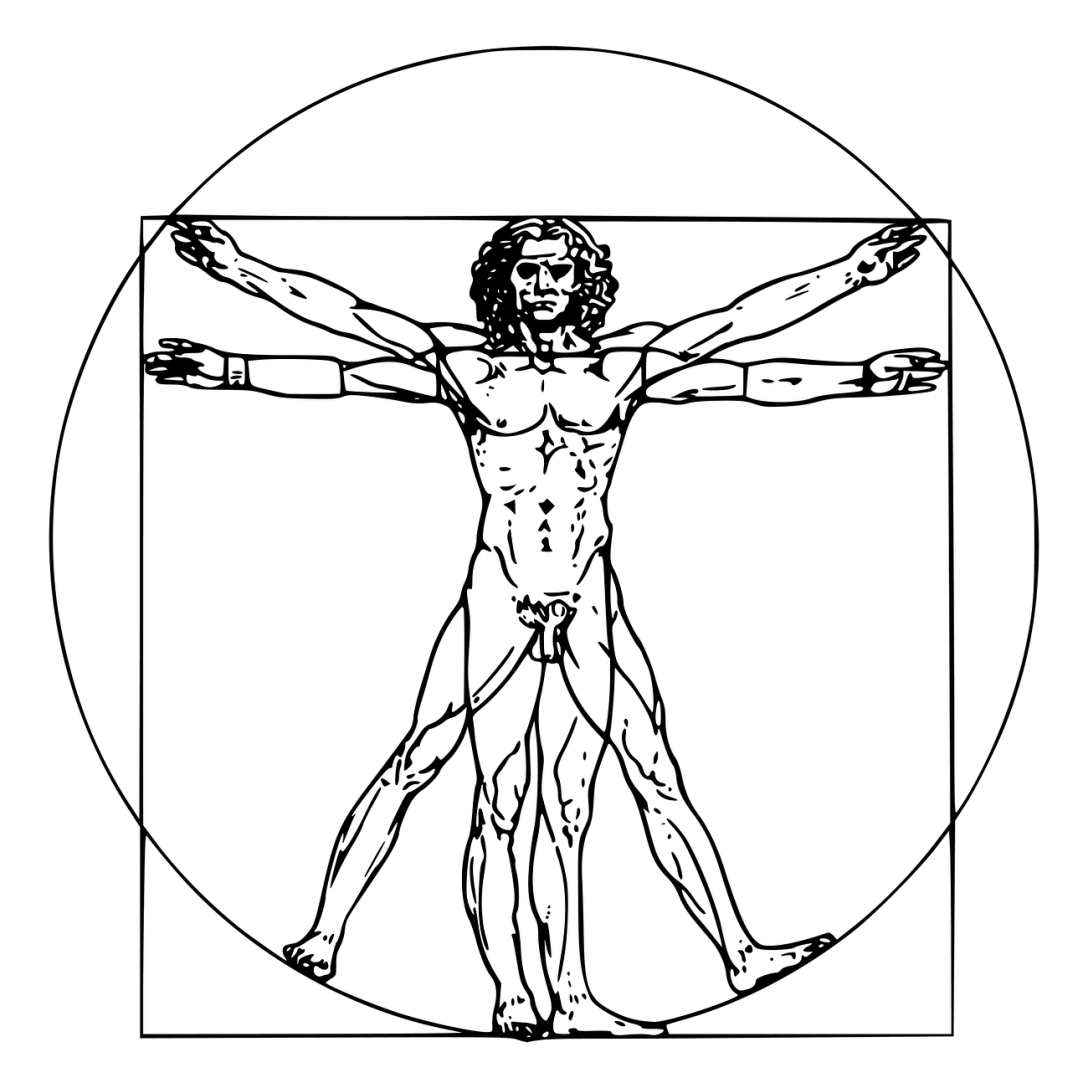
Rather than focusing on freaking out the squares, Pride Month should honor great thinkers and achievers throughout history who were members of the LGBTQ community. Leonardo da Vinci, one of the greatest thinkers of all time, is one such figure who led a tumultuous, very public life and produced some of the most cherished works in history.
I can’t be the only one who feels Pride Month has degenerated into yet another battle in the endless culture wars, where one side seeks primarily to freak out the squares and the other believes they are defending the last bastions of decency on the planet. June in general seems to be a never ending stream of increasingly disturbing stories, from baseball teams who wish to honor the LGBTQ community by inviting avowed Satanists that mock traditional religious beliefs in drag to perform outside their park to retailers who believe parents are interested in swimwear with a place for children to hide their penis, should a boy feel like a girl that day. Pride, in this incarnation, has become a celebration of gender and sexual identity in our increasingly exhibitionist culture, rather than a celebration of achievement, influence, innovation, and legacy, but it needn’t be that way. We can imagine another, better world where gay and lesbian figures are celebrated for both what they accomplished in life and, yes, their struggle for equality in a heteronormative reality. In other words, we can honor those who transcend the boundaries of their gender or sexual identity, and through genius, hard work, and perseverance have changed the world for the better. You might not know it, but the legendary artist and thinker, Leonardo da Vinci is one such figure. The man who created the most famous painting in the world, the Mona Lisa, and who imagined the first flying machines, was gifted, flamboyant, brilliant, charismatic, and openly homosexual in an era ruled by the Catholic church, more repressive than most people can imagine.
Thus, his story is one of both striving against the cultural currents of the day, and achievement of a historical significance that remains underrated and unappreciated, even as the entire world knows his name. Leonardo was born in the small town of Vinci, in the Tuscan hills of Italy, on April 15, 1452. The illegitimate son of a successful notary, Piero da Vinci, little is known about his childhood except both parents married other people within a year after his birth, and he appeared to have relationships with the entire extended family, which included 11 half siblings. As Piero’s eldest child, he would have continued the family tradition of serving as a notary by his place of birth alone, but bastards were not allowed in the profession, and even from a young age, he appeared too radical and creative in thought for such a bookish life. Sometime in the mid 1460’s, Leonardo’s family moved to Florence where his father arranged for him to work in a field more suited to his temperament, and he served as a studio boy, apprentice, and ultimately master painter in the workshop of Andrea del Verrochio, who had previously been a pupil of the master sculptor, Donatello. Florence itself was considered a progressive, artist friendly city for its day, boasting 84 woodcarvers, 83 silk workers, 44 jewelers and goldsmiths, and 30 master painters. The essayist Benedetto Dei described the city in 1472, “Beautiful Florence has all seven of the fundamental things a city requires for perfection.” These included “complete liberty,” “a large, rich, and elegantly dressed population,” clean water, mills, lands to rule over, a university, “masters in every art” and “banks and business agents all over the world.”
This description is something of an exaggeration. Medieval Florence was far from what anyone today would consider a democratic republic. It was effectively an autocracy, ruled with absolute authority by the wealthy and powerful Medici family, made infamous by Machievelli’s immortal The Prince, who Leonardo himself would work with one day and call a friend. There was also no shortage of regressive laws, and Leonardo himself was formally accused of sodomy with a male prostitute in April 1476, shortly before he turned twenty four years old. At the time, these accusations were made anonymously in a system something like a suggestion box. People would write the names of the accused and place the message in a “tamburo,” essentially a barrel for collecting them. Da Vinci and three other young men were accused of cavorting with Jacopo Salterelli, a seventeen year old who “dresses in black,” and was a “party to many wretched affairs, and consents to please the wickedness of those persons who request such wickedness of him.” The investigation into the affair was conducted by the aptly named “Officers of the Night,” and it is believed the four men accused spent at least a night in jail, but the charges were difficult to prove if no witnesses came forward. The situation was also complicated when one of the accused was a member of a family that had married into the Medicis. Ultimately, the case was dismissed “with the condition that no further accusations were made,” but less than a month later, the charges were repeated, this time in Latin. Once again, no witnesses came forward and the matter dropped, though it appeared to leave a lasting impression on Leonardo. He wrote contemporaneously that he felt alone and abandoned, “As I have told you before, I am without friends…If there is no love, what then?” Three decades later, he commented rather cryptically on the matter in one of his ubiquitous notebooks, “When I made a Christ-child you put me in prison, and now if I show him grown up you will do worse to me.” No one knows for sure, but some believe that Salterelli was a model for one of Da Vinci’s early paintings in addition to a lover.
Regardless, Leonardo was not cowed and generally made no real secret of his sexuality, living a life far from repressed and questioning why others seemed to be uptight. He wrote “Man is wrong to be ashamed of giving it [their penis] a name or showing it…always covering and concealing something that deserves to be adorned and displayed with ceremony.” This was no small thing when about sixty men per year were convicted of sodomy and sentenced to prison, exile, or even death. A decade later, Da Vinci adopted a mischievous young boy, nicknamed Salai, and took him for a long love affair when he was merely fifteen (keep in mind women would regularly be betrothed before ten and married at thirteen back then). Salai would be featured frequently in his notebooks, an object of affection Da Vinci drew over and over again throughout the course of his life, sometimes entirely naked. Leonardo himself conducted his affairs as a brash public figure who believed the way one appeared simply walking down the street was a testament to their worth. Later in his life, an inventory of his clothing detailed “One gown of taffeta. One velvet lining that can be used as a gown. One Arab burnouse. One gown of dusty rose. One rose-colored Catalan gown. One cape of dark purple with a wide collar and velvet hood. One coat of crimson satin. One pair of dark pulse stockings. One pair of dusty rose-stockings. One pink cap.” Salai was also well set up with a rose colored hose, a cape in the “French mode, once owned by Cesare Borgia,” more on him in a moment, “a tunic laced in the French fashion, and a “tunic of gray Flemish cloth.” One imagines the pair, one man in his 50’s, the other in his mid-20s, making quite a sight on the streets of Florence.
Beyond his sharp eye for clothing, Leonardo could play the lyre, sing, and was known as a skilled orator. An early biographer noted that, “He was a man of outstanding beauty and infinite grace. He was striking and handsome, and his great presence brought comfort to the most troubled soul.” A man who met him later in life described him as “friendly, precise, and generous, with a radiant, graceful expression.” “His genius for invention was astounding, and he was the arbiter of all questions related to beauty and elegance, especially in pageantry.” Ironically for an historical figure known primarily as a painter and a thinker, much of Leonardo’s career was based on his ability to produce mesmerizing spectacles and pageants for the court. He designed spectacular sets, rotating stages, flying machines, and other special effects to thrill the masses, all of which are sadly lost to history except for contemporaneous descriptions and jottings in his notebooks. One description of an event put on for the Duke of Milan, Ludivico Sforza, describes “First a wonderful steed appeared, all covered with gold scales which the artist has colored like peacock eyes. Hanging from a warrior’s golden helmet was a winged serpent, whose tail touched the horse’s back.” This display was part of a rotating stage, where the steed was followed by a horde of cavemen and other savages. It is believed that Leonardo’s work on the stage is what ultimately lead him to a lifelong obsession with flight, going from props that could fly and mechanisms that could life a person off the ground, to a study of birds, to designs for flying machines that he would tinker with for decades.
Artists in general were less celebrated in the 15th century than today, generally being seen more as craftsmen that collaborated in a studio than lone geniuses with a vision and a brush. Perhaps for that reason, Leonardo never exclusively called himself a painter, nor did he spend most of his time painting compared to other activities, having produced only 25 surviving works in varying stages of completion, many left almost entirely unfinished or not painted entirely by his own hand. In fact, early in his career when he sought a position with the (then-acting) Duke of Milan, painting was the last thing he mentioned in what can be considered his job application. As hard as it may be to believe, the man who went on to revolutionize almost everything about painting – from the use of perspective, to the representation of objects in three dimensions using light and shadow, to the use of painting to tell a narrative story rather than simply freeze a moment in time – and the man who would create some of the most cherished works in the world that now sell for tens if not hundreds of millions of dollars, once felt his painting skills were less important than almost everything else he believed himself capable of. Primarily, he claimed to be a military engineer of all things. “Most illustrious Lord, Having now sufficiently studied the inventions for all those who proclaim themselves contrivers of instruments of war, and having found that these instruments are no different than those in common use, I shall be bold enough to offer, with all due respect to the others, my own secrets to your Excellency and to demonstrate them at your convenience.” He went on to list a range of (non-existent) weapons of war he claimed to have developed, from portable bridges to fantastical cannons, before mentioning, “Also, I can execute sculpture in marble, bronze and clay. Likewise in painting, I can do everything possible.” The “job application” is doubly ironic considering Leonardo was an avowed pacifist, said to never hurt a flea and one who refused to eat meat because he believed animals suffered pain just like people.
In yet another irony in a life seemingly filled with them, Leonardo spent close to a year as a military engineer for the sadistically brutal Cesare Borgia, serving under him and Machiavelli as the Borgia armies swept through Italy when he was in his 50’s. Borgia himself was the model for The Prince. After he cut a local constable he had appointed in half and left his remains in a local courtyard to simultaneously show the populace he would protect them from such men and demonstrate that he was worse than such men, Machiavelli proclaimed, it was “an example that deserves close study and imitation by others.” Of Borgia generally, he said “He arrives in one place before anyone knows he has left the other,” and can “install himself in someone else’s house before anyone else noticed it.” Leonardo would make two lasting contributions to warfare during this period. First, he would revolutionize castle design, recommending curved walls and towers to blunt the force of increasingly powerful canons. Based on his studies of motion, he realized that the more oblique the angle of contact, the less damage was done. As he put it, “Percussion is less strong the more oblique it is.” Second, he would even more radically revolutionize cartography, creating maps of towns and fortifications with a birds eye view unknown the era, an attention to detail that shows elevation and other features of the landscape, and an exactness thanks to his previous invention of an odometer to measure distance. Some of the maps he drew would not look out of place in a modern atlas. Leonardo was a font of other ideas as well – from building canals, to flooding areas the enemy might use to penetrate defenses, to defending Venice with scuba gear, to draining entire swamps, none of which was actually undertaken, but all of which was hundreds of years ahead of its time. One possibly apocryphal story from his friend, the mathematician Luca Pacioli, reveals the unique nature of this genius, when he actually built that movable bridge. “One day Cesare Borgia…found himself and his army at a river that was twenty-four paces wide, and could find no bridge, nor any material to make one except for a stack of wood all cut to the length of sixteen-paces. From this wood, using neither iron nor rope nor any other construction, his noble engineer made a bridge sufficiently strong for the army to pass over.” Sure enough, there is a sketch for exactly such a bridge in one of Da Vinci’s notebooks.
The notebooks themselves are Leonardo’s primary claim for being among the world’s great thinkers, if not the greatest. Unlike Isaac Newton or Charles Darwin, Da Vinci did not publish any major treatises or papers while he was alive. He was a notorious procrastinator who never believed anything was completed to his satisfaction, and though he toyed with everything from books on why painting is a premiere artform superior to poetry to tracts on optics and geometry, he never actually finished them, much like many of his paintings. He did, however, write copiously in his various notebooks, combining drawings with schematics, texts, to do lists, and other ideas. It is here that we can fully appreciate the depth and breadth of his intellectual capacity as he veers from plans to design the ideal city to an analysis of the human eye and the underlying science. A keen observer of the world, Da Vinci proposed theories and experiments that would not be fully understood for centuries. He was close to a workable theory of relativity, correctly ascertained why the sky was blue, understood why rock formations were in sedimentary layers, dissected and analyzed the human body, developed metrics and ratios for every function of the human body, designed thousands of workable and unworkable machines including those that could fly, and drew most of it in extraordinary detail, inventing new ways to illustrate complex phenomenon that are still in use today. His anatomical drawings would not be out of place in a modern textbook. His technique of exploding the parts in a machine and detailing their individual functions is vital to how architects and engineers still function. All of this is even more amazing considering Da Vinci lived in an age where the modern conception of a scientist didn’t yet exist. Galileo would not fully define the scientific method to compare theories with the outcome of experiments for more than a century, and yet that is precisely what Leonardo does on almost every possible topic, foreshadowing every future achievement in science. He was wrong in many cases, even downright crazy in a few, but he understood almost instinctively how science would ultimately work, where observation leads to theory and theory leads to experiment, all of which were radical ideas at the time, especially for a person who only had the most basic education as not a “man of letters” as they said.
Lastly, the range of his intellectual adventures was truly astounding. In the 1490s, when he was in Milan, Leonardo wrote out something of a to do list for himself. The list included “The measurement of Milan and its suburbs,” followed by “Draw Milan,” presaging his invention of modern maps. Right beside these downright utilitarian items, he proceeded to write “Get the master of arithmetic to show you how to square a triangle…Ask Giannino the Bombardier about how the tower of Ferrara is walled…Ask Benedetto Protinari by what means they walk on ice in Flanders…Get the master of hydraulics to tell you how to prepare a lock, canal and mill in the Lombard manner…Get the measurement of the sun promised by Maestro Giovanni Francese, the Frenchman.” Elsewhere, he jotted down “Observe the goose’s foot: if it were always open or always closed the creature would not be able to make any kind of movement.” He wondered “Why is the fish in the water swifter than the bird in the air when it ought to be contrary since water is heavier and thicker than air?” Once, he instructed himself to “Describe the tongue of the woodpecker,” and “Inflate the lungs of a pig and observe whether they increase in width and length, or only in width,” and more bawdily, “Go every Saturday to the hot bath where you will see naked men.”
One would have to look far and wide to find a more expansive and admittedly bizarre at times field of thought, but Leonardo seemed to have it all, as if there was nothing in the entire world, the heavens above, or the rocks below that he didn’t think about, deeply. Of course, Leonardo is not the only great thinker who happened to be a homosexual. Interestingly, his successor and artistic rival, Michelangelo was also gay, though for more repressed and ascetic. The two actually lived in Florence together for a time and had a rather bitter rivalry before Michelangelo went to Rome to paint the Sistine Chapel. In the modern era, the visionary who founded the field of computer software, Alan Turing, was also gay and persecuted for it. These – and countless others – are the stories that should be told during Pride Month. At least in my humble opinion, we have an opportunity to celebrate what binds us all together via the achievements of the few who changed the world, but there are no profiles on Leonardo or Turing to be found. Leonardo’s life in particular would make an incredible television series, one can imagine the episodes devoted to his rivalry with Michelangelo as they worked on competing paintings in the same building, and yet in a world where we are repeatedly told there aren’t enough LGTBQ roles, no one seems interested in telling this truly exceptional, groundbreaking, and, yes, fundamentally gay story. Instead, we celebrate tuck friendly swimsuits and every other insanity, prioritizing our freak out the squares fetishes over real achievement.

 Confessions of a Conservative Atheist