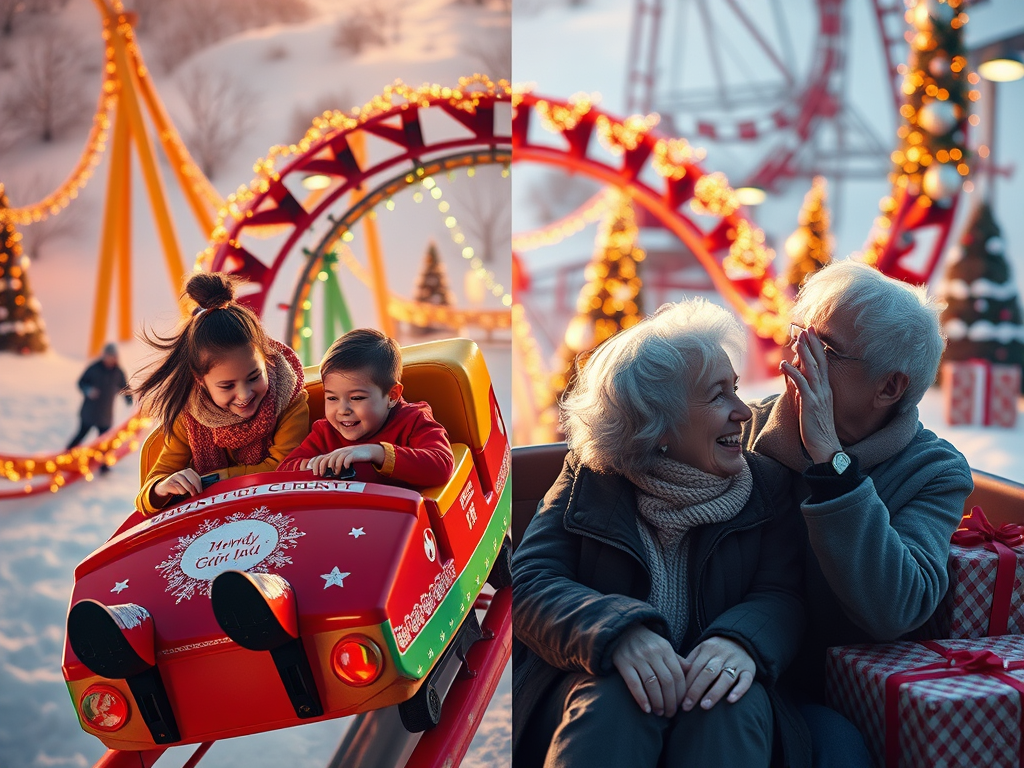
To the young, all is new. They’re on the ride for the first time, making it near impossible to understand what it will feel like for the fiftieth. To the old, the belief that we’ve seen it all before settles in along with the feeling that nothing can surprise us anymore.
It’s a bizarre irony of life that the only thing constant is change, but the more things change, the more they stay the same. In one sense, we are all careening forward on an out of control rollercoaster with ups and downs both unexpected and expected, unable to predict where we will be the next day, much less the next week, month or year, the world moving around us at such a lightning pace that it seems impossible to keep up. The best you can do is hang on, hope that what passes for a metaphorical steering wheel offers you at least some control over the future, and that there are more ups than downs on your particular version of the ride of life. In another, the rollercoaster isn’t going forward at all. It might move a little bit up or down, or side to side, but the speed is an illusion. Instead, we’re traveling in an endless loop, repeating the past over and over again until the ride stops. To some extent, your personal impression of which view is accurate will depend on your age. To the young, almost all is new. They’re on the ride for the first time, making it near impossible for them to understand what it will feel like for the fiftieth time. To the old, or even the middle aged like myself, the belief that we’ve seen it all before settles in along with the feeling that we’re just going through the motions and nothing can surprise us anymore. The truth, as ever, lies somewhere in between. There are, of course, certain patterns in life that play out over and over again, from the holidays we celebrate and rituals we observe every year to the day to day regularities of our existence, that can seem like inevitabilities, things that will and must happen. There are also necessarily things that are entirely new, which did not exist before, or even if they fit into an existing pattern, so upend it in your own personal experience that it constitutes a new pattern.
Sometimes the two perspectives collide, as when you celebrate the holidays for the first time after a loved one has passed or a new loved one has arrived. The holiday itself is the same in many ways. Christmas, for example, is always Christmas, or as Tom Petty once sang, “It’s Christmas all over again.” The date, the time of year, the trappings, the music, the movies, all pretty much remain unchanged. If a time machine randomly deposited you in a suburban shopping mall five, ten, fifteen, twenty, or even twenty five years into either the future or the past anytime in December, you would know it was the holiday season in an instant. While there might be a few subtle differences in fashion, technology, and the hottest gifts and gadgets, the overall atmosphere from the prominent, gaudily decorated tree in the lobby to the garland and lights decking the railings, from the music blaring through the speakers to Santa posing for pictures with the kids, would be unmistakable. The Christmas that you personally celebrate, however, could well be radically different than anything before. Beyond the particulars of the location, there could be someone missing, whether through death or divorce, an empty chair that will never be filled again. There could also be someone new, either from marriage or the birth of a baby. There could even be both at the same time, a departure and an arrival in the same year. In either or both cases, the celebration will likely be an unpredictable combination of entirely new and still the same – until you repeat it again the following year and the year after that, and a new tradition becomes established, a new ritual, a new routine, a new holiday out of an old one.
My lovely wife and I experienced this just last week, when our two granddaughters, one who will be three in February and the other who isn’t even eighteen months yet, spent Christmas with us since the first time both of them had been born. To them, everything is new. There are no rituals or traditions. There isn’t even a context for the concept of annual rituals in their young minds yet. At that age, there is some awareness of a daily routine, tasks that repeat themselves on a regular basis from eating in the morning to the nap in the afternoon and a bath before bed, but there is no meaning associated with it and no awareness that some things repeat on a less frequently recurring basis. More than likely, even the older one will not remember any of it, this, her third Christmas in this world, completely disappearing well beyond the point where real memories form, unknown and unknowable. This doesn’t mean they didn’t celebrate Christmas in their own way, however, being a part of our rituals and partaking in the early versions of their own. The almost three year old, for example, was not surprisingly enamored with the idea of presents, but the infatuation extended beyond simply receiving them. She liked that well enough, perhaps needless to say, but she also enjoyed unwrapping them on behalf of others, excited to tear at the paper and ribbons and bows, sometimes with a little help, and see what was inside. To me at least, this was an opportunity for some targeted outsourcing. While I generally love Christmas, it has long ceased being about the presents, from struggling to figure out what I want (my mom still doesn’t know what to get me!) to not being the biggest fan of extended unwrapping sessions where the family sits around and stares at each other, marveling at what they could probably have bought themselves if they really wanted. She, however, had a completely different view, eager to open anything you handed to her with wild abandon, even studying the boxes beforehand to see which she liked best. Interestingly, she also liked handing gifts out. If someone told her who a gift was for, she’d smile and march it right over to them, likely assuming they’d let her open it.
Thus, in the young, all that’s old can be made new again, but she will never have another Christmas like this either. Next year, she will be almost four and will have a more concrete notion of what the holiday means, associating it more closely with the arrival of Santa and the receiving of a lot of presents. Her younger sister will have likely moved into her role, and given that they’re expecting a new baby in March, the process will repeat itself for a third time, adding fresh love and life to the holiday (my wife, not surprisingly claimed this might have been the best Christmas ever, having not had a toddler present at one for a long time), but also needless to say, that won’t last forever either. They will grow up, absorb the rituals and traditions, add to them in their own way, and then ultimately make them their own as adults. The same, but different. Changed, but familiar. My wife and I experienced this as well shortly after Christmas, when close friends invited us to stay with them and their older children for a couple of days at a rental home in upstate New York. These were children we’ve known since birth, but at sixteen and seventeen, they’re well on their way to adulthood (or at least think they are) and aren’t kids anymore. They have friends and boyfriends or girlfriends, licenses or permits. They do their own thing, have their own little jokes and entertainments, their own likes, dislikes, opinions, routines, and more. This places them somewhere in between, combining the participation in established rituals (the old) and the forging of their own (the new), the change and the constancy at the same time in real time, except they don’t really know it yet. To them, their parents talking about how we took a similar trip upstate after Christmas when we were in college is just talk, things that happened before they were born and have, for the most part, no relevancy in their own lives, making them a part of a ritual without knowing why. As John Mellencamp put it in “Cherry Bomb,” when the aging narrator considers the children of his own, “I hope that they’re not laughing too loud, When they hear me talkin’ Like this to you.” The younger generation might laugh at an old story, either at or with their parents, repeat one of the phrases, perhaps even pass that phrase down for years, but they weren’t there and can’t really know what it was like when we were their age, anymore than anyone can know what it’s like to be my granddaughters’ age.
Whatever the case, this particular Christmas will never be repeated. We will never celebrate with our oldest granddaughter approaching three years again, nor go on a getaway afterward with our friend’s children at sixteen or seventeen, and yet, fortune willing, we will celebrate a different holiday next year, combining the old and the new, and at some point the grandchildren will be almost adults, forging rituals of their own even without fully knowing it. Though I have chosen to focus on Christmas for obvious reasons given the season, the same could be said of any holiday or other recurring event such as New Year’s Eve later tonight where our most recent ritual is celebrating ourselves with a nice dinner, even something entirely in the political sphere such as an election and inauguration, especially then the talking heads like to insist something is entirely new, even as you are personally old enough to have seen it before, knowing it is both the same and different like everything else in life. In my opinion at least, this leads to two conclusions. First, we don’t often notice the changes as they are occurring, focused instead on the similarities. There are moments like the birth of a new baby or catching up with a friend’s now almost adult children when there’s a clear before or after, but most of the time, gradual changes are beneath our notice. The same as you seem to look in the mirror one day to suddenly discover your hair is way too long or your nails need clipping, we are all the classic frogs in boiling water to some extent, enduring changes even dramatic ones that we are not fully aware of at the time. This doesn’t mean they aren’t occurring; time is change and change is constant. Even if things feel the same, it is our perception of them informed by experience that makes it so and the more experience you have, the more likely you are to recognize the pattern. In reality, however, we are not the same as we were and neither is the world. This leaves us in the middle, perpetually in a grey area between two extremes, generally able to notice only one or the other, rarely do we observe both at the same time. We do, however, observe, leading to the second point. Whether you choose to be aware of it or not, the world is moving around you every minute of every day. In a sense, our perception of time is irrelevant, meaning nothing except as a way to mark the milestones. You are here. You are in the present. You have this day, this hour, this moment. You can either keep pace and engage, or you can fall behind and give up, or as Bruce Springsteen once sang, “Just sitting around waiting for my life to begin, while it was all just slipping away.” What path do you want to take in 2026?

 Confessions of a Conservative Atheist