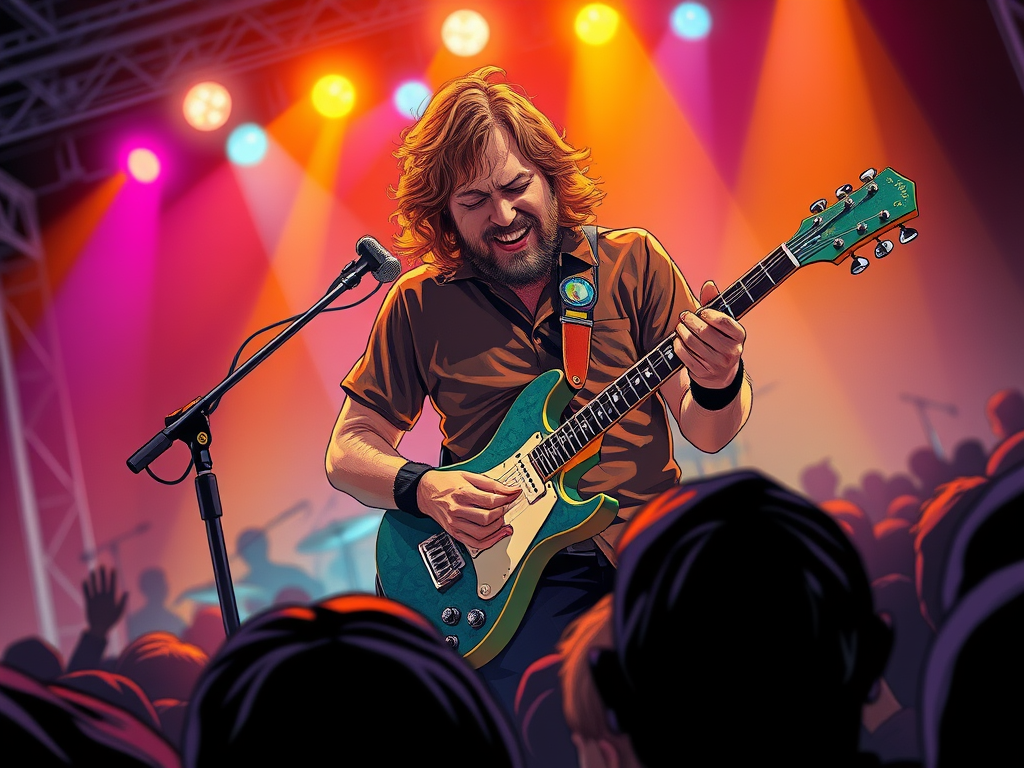
While the Phish guitarist, singer, and songwriter is far from a household name, he certainly should be. Over the course of three shows in barely six months with three completely different configurations, he belted out fifty eight songs or more than six full albums of material.
I’ve been fortunate enough to see Trey Anastasio three times this year, first playing solo acoustic at the Count Basie in Red Bank, NJ, second as part of the band that made him sort of famous in the first place, Phish, at the Saratoga Performing Arts Center in New York, and third with a bigger band he put together, complete with horns and strings, at the legendary Beacon Theatre in New York City. While Mr. Anastasio is far from a household name, he certainly should be. Indeed, there’s an argument to be made that he’s the greatest musician of his generation, but before I get to that, let me walk you through some of the metrics of my experience this year alone. Over the course of three shows with three different configurations totaling about nine hours of music, he played a grand total of fifty eight songs or more than six full albums of material. Of those fifty eight songs, he did not play the same one at all three performances, and only played a handful of songs twice at two different performances. Of that handful, he performed them radically differently each time, as though they weren’t the same song to begin with. For example, fan favorite “Harry Hood” was played in Red Bank with just him and a piano, while it was played in New York City on strings and guitar prior to a full band with horns. A more recent track on its way to becoming a fan favorite, “Everything’s Right” was played by the full band at Saratoga and then reimagined with horns at the Beacon. There were even a few songs he managed to choose that I’ve never heard before despite being a fan for three decades, and having around 300 songs in my music library. The first show was on April 6. The last was on November 28, less than eight months apart. In addition to writing most of the songs (there was only one cover) he plays lead guitar and sings. Putting this another way, Mr. Anastasio somehow managed to put on the equivalent of three decent careers worth of music for any other artist in barely six months, and he did so effortlessly, as if each performance, either solo or with two different groups, was the only way he ever toured in his entire life and each track was played every night in precisely that configuration.
To be sure, that’s not strictly true. If nothing else, one of the reasons Mr. Anastasio and Phish have developed such a devoted cult following after more than four decades playing together is their improvisational style. Not only do they almost never play the same song two nights in a row, they rarely ever play the same song the same way. Perhaps the approach was best characterized in a satirical meme that described their performances as singing five words and fucking around for twenty seven minutes, and there is at least some truth to that. A proper Phish concert isn’t a highly organized, focus-grouped affair where the artist has carefully selected tracks from throughout their career balancing the need to satisfy the audience by playing their biggest hits, the desire to showcase new material with the opportunity to highlight all of the various musicians in the group. Setting aside that neither Phish nor Mr. Anastasio has any real hits in the radioplay or sales sense, rather they boast a few dozen of what we might call fan favorites, they have chosen a radically different path far closer to what one might expect to see at a jazz club than a rock concert with tens of thousands of screaming fans. As a result, you never know what’s coming next, either in the selection of the song, how they will play it, or the final length given that some renditions have been known to approach a full hour in length, a half hour isn’t uncommon, and more than ten minutes is the norm. No, they are not for the faint of heart or short of attention, and while they have never generated much in the way of press coverage, a piece earlier this year in The New Yorker captured the phenomena nicely. “People who love Phish do so with a devotion that is quasi-religious—deep, eternal, and rhapsodic. People who dislike Phish do so with equal fervor, often while making jokes about the degenerative effects of LSD on the prefrontal cortex. This divisiveness speaks, in part, to the band’s abiding disinterest in capitulating to the Zeitgeist. The barrier to entry is high: to experience the phenomenon on any significant level, you need to see the band live, probably more than once. The songs will be complicated and partly improvised. There will be two sets, with a twenty-minute break in between. There will not be much in the way of banter, though there will be a light show designed by the band’s longtime lighting director, Chris Kuroda. You might hear a song in which the phrase ‘Gotta jibboo!’ [luckily enough, he played this at the Beacon with the full band] is repeated far more often than you’d like. Phish requires commitment—a subversive idea in our moment of minuscule attention spans. Even the songs that go viral on TikTok—a platform that already demands a kind of maniacal concision—often have their tempos increased in order to arrive at the hook sooner. Yet Phish fans embrace searching, forty-minute jams with enthusiasm. The band has built this world largely outside the architecture of the music industry, with minimal radio airplay, mainstream press, or strategic marketing.”
In many ways, my lovely wife might be a perfect encapsulation of the agony and the ecstasy. In principle, she’s a big fan, counting their song “Free” as one of her all time favorites and adoring several other tracks, but in practice the shows confuse or dare I say bore her at times, not to mention the conflagration of fans, most performing what should be considered a patented, wavy little dance number in their seats, in the aisles, anywhere they can get to, they sort of shuffle around, moving their arms, or simply jumping up and down to the rhythm. When I insist we need to see a show soon, she often remarks, how many times do you need to see them at this point? Why can’t they sing more and play less? When I told her I wanted to see Mr. Anastasio three times this year, it simply didn’t compute. What’s the point? Haven’t you seen him enough? Obviously, the answer was no and to me at least, the reason is simple: The thrill of a live performance is the reality of being there as it happened, of watching the band create the music for the crowd, practically seeing it pour forth from the instruments and the singer’s mouth. The magic of watching it happen. The skill of any gifted live performer is to convince the audience that they’re the only thing that matters. In principle, we know this isn’t true. A rockstar makes their living by traveling from town to town, performing for audience and after audience, and in most cases, playing the same songs, saying the same things, and doing the same thing every night. For us, it’s special. For them, it’s a routine, an act, a gig, a paycheck. The best might make it seem otherwise, that the show you are watching is entirely unique, a once in a lifetime experience, something that will never happen again – until the very next night when they are in a different city, pretending it’s the only city. Mr. Anastasio and Phish fundamentally alter this reality by making it so that each and every show is entirely unique in almost every aspect. It doesn’t feel unique in the sense of the performers tricking you into believing it. It is unique in the purest sense, that the moment will never happen again, turning the audience into an explorer along with the performers themselves, as though we were discovering something together.
This year, Mr. Anastasio has broadened that concept even further into three different styles of concert – an intimate, one man show with some piano accompaniment, where he is seated on a stool like a classic story teller, a four man power band, and an almost big band configuration with horns and strings. While I will likely see Phish again for another unique concert, I will almost certainly never see the likes of the other two and those who were fortunate enough to see them on a different night, will have seen something unique as well. This brings us back to the original assertion: Trey Anastasio is the greatest musician of his generation, but how to evaluate that? What is the measure of a musician, especially one that doesn’t have any true hits?
To me at least, it requires three things: The overall body of work, the overall skill of the musician, and their ability to perform live. While Mr. Anastasio hasn’t written any hits in the usual sense of the world, he has released 16 studio albums with Phish (credited as the solo songwriter for 141 of the songs), the most recent in 2024 and 11 solo albums, a substantial body by any means and one that is also substantially unique, unlike any other in the history of music. Outside of a relative handful of songs, Mr. Anastasio generally eschews the standard verse, chorus, verse, chorus, break or solo, repeat chorus formula most songwriters rely upon. Instead, the tracks that are beloved by fans embrace a more whimsical approach, combining long instrumental sequences with playful lyrics that waver at the edge of understanding or at times defy understanding entirely. Beyond playing with the music, Mr. Anastasio plays with the words. “Cymbal,” for example, is literally about a band. They’ve got cymbals, saxophones, and be-pop, but phonetically, “cymbal” sounds like “simple,” and so the song opens with the line, ‘We’ve got it simple, Cause we’ve got a band” and ends with them claiming to have skyscrapers as well. Nor is he afraid to use non-sequitors or repeated statements that simply sound cool without really meaning anything, such as “Harry, Harry, where do you go when the lights go out?” or “Oh, to be Prince Caspian and float upon the waves.” At times, he doesn’t even use actual words, merely sounds that might be words if you listen the right way. The fan favorite “You Enjoy Myself,” which he played acoustic in Red Bank, managed to combine both trends, opening with an extended instrumental before closing with a handful of words, “Boy,” “Man,” “Shit,” “Boy Man,” and then “Wash uffitze drive me to firenze,” almost as if he was mocking those songs where you have no idea what the singer is saying, yet you follow along anyway as if you did or perhaps belt out the wrong lyric entirely. At the same time, he has also composed some truly moving tracks. “Waste,” for example, where the speaker wants nothing out of life, “Don’t want to be an actor pretending on the stage, Don’t want to be a writer with my thoughts out on the page,” except to waste time with the woman he loves, and though he has nothing offer, implores her to “come waste your time with me,” or “Mountains in the Mist” where the speaker realizes the mountain he sees up ahead, is really his own demons, “I guess I’m just an obstacle, a thing to overcome, If I can sneak around myself again I’ll know I’ve won, The moment seems to hang and float before me with no end, Till I’m released, awakened beast, I’m on the road again.”
Beyond singing and songwriting, Mr. Anastasio is generally credited as being a virtuoso guitarist, combining a clean almost 80’s metal sound with complex melodies and some serious speed that rises above the rest of the music, shifting in tone from a gentle wisp of smoke to a strike of lightning. In 2023, Rolling Stone ranked him as the 53rd greatest guitarist of all time, ahead of legends including Ritchie Blackmore of Deep Purple fame and Alex Lifeson of Rush. As they put it, “It’s one thing to influence other guitarists, but Trey Anastasio’s expansive approach to the instrument has proved to be nothing less than a cultural beacon. Anastasio and his Phish bandmates, much like the Grateful Dead before them, have created a tribe of obsessive fans who follow the band from show to show and vigorously debate the merits of both official and bootlegged live recordings. And while psychedelic recreation is certainly part to the Phish ritual, it’s Anastasio’s preternatural ability to keep his slippery and sly modal improvisations fresh, kinetic, and almost telepathically connected to his bandmates that guides fans through their musical trip.” Mr. Anastasio himself is more modest, claiming, “During a lot of Phish jams, I’ll land on a simple phrase, almost childlike, and then run with it,” he told Guitar Player. “Some of my favorite improvisers work that way.” Personally, I’m not sure “run with it” is the right description, however, simple. When he plays, he seems to enter a sort of trance, transported to a different world, unaware of what’s happening right in front of him. At his peak, it’s the same as the audience itself.

 Confessions of a Conservative Atheist
“A rockstar makes their living by traveling from town to town, performing for audience and after audience, and in most cases, playing the same songs, saying the same things, and doing the same thing every night. For us, it’s special. For them, it’s a routine, an act, a gig, a paycheck. The best might make it seem otherwise, that the show you are watching is entirely unique, a once in a lifetime experience, something that will never happen again – until the very next night when they are in a different city, pretending it’s the only city. ” The same could be said of a “good” politician. Of which DJT is the best, by far. And, with Trump it truly is a unique experience as he is a mutant human who has risen to the top of THE mountain. Phish? Not my cup of tea, couldn’t name you one song so I gave “Free” a listen. Not for me. Nevertheless, great post.
LikeLiked by 1 person
Hahaha! Good point on the politician. Trump does the weave. 🙂
If I may ask, what kind of music are you into? In addition to Bruce and Phish, my tops are Zeppelin, Rush, Dio, Duran Duran, and Dave Matthews, though I pretty much love all classic rock and 80’s metal.
LikeLiked by 1 person
Love Dave Matthews. I grew up in the 50’s & 60’s so I love the old stuff beginning with Elvis. However, if I had to list time and genre – it’d be Dylan (all) & folk, psychedelic rock, Neil Young, Joni Mitchell (all), country rock, outlaw country. I like Bruno Mars, too. Heavy Medal, head banger we called it, I never got into. A big zero for ghetto rap, but I like some hiphop, like Dessa–a female, really smart white girl from Minneapolis. Also, :-), I like flamingo–Jesse Cook, Oscar Lopez. Good road tripping music. Cheers, my friend
LikeLike