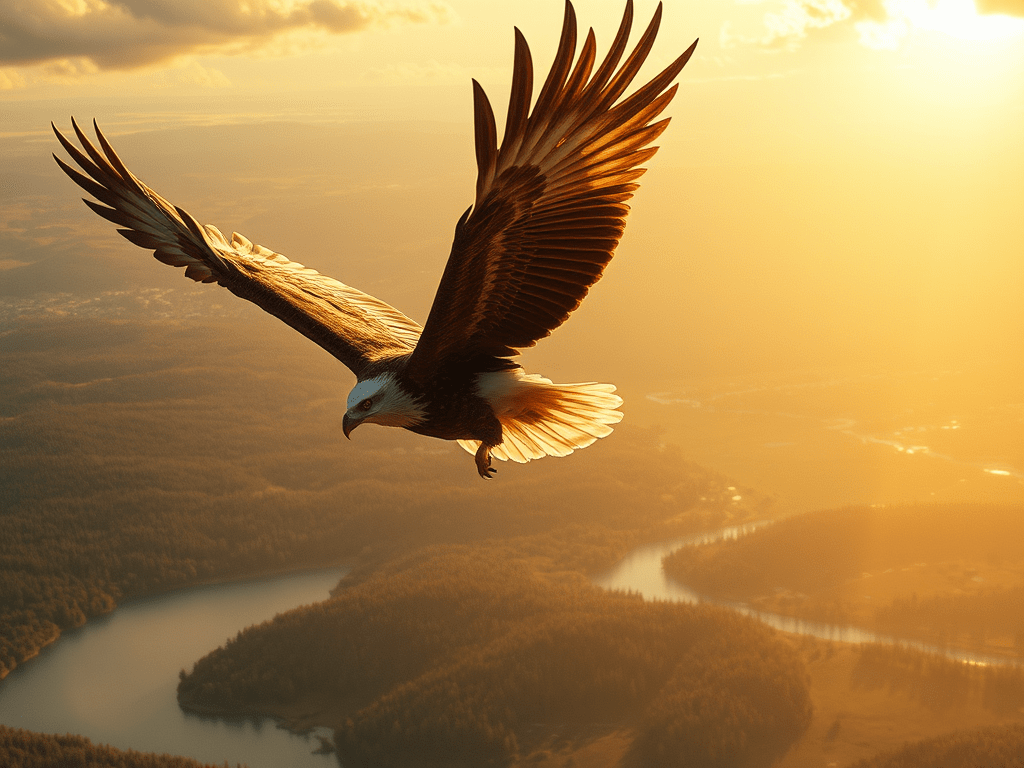
Soaring at an altitude of around 1,000 feet, I can survey a dominion in detail spanning over three square miles and am able to spot a rabbit moving a full mile away. I usually hunt fish, however, and I can see them swimming, even under the water from several hundred feet above before I strike.
I am an eagle on the wing, launching from my eyrie to hunt. I can soar up to 20,000 feet above the ground, looking down upon my territory with eyesight so sharp most other creatures including humans would need either binoculars or a telescope. Soaring at an altitude of around 1,000 feet, excellent for hunting, I can survey a dominion in detail spanning over three square miles and am able to spot a rabbit moving a full mile away. I usually hunt fish, however, and I can see them swimming, even under the water from several hundred feet above before I strike. In addition to having vision four times as sharp as a human, I can see in two places at once. I have two foveae, centers of focus, allowing me to look both forwards and sideways at the same time, an adaptation essential for flight where things can happen in almost all directions. Unlike those consigned to crawl across the Earth beneath the glory of my wings, I live in a world of three dimensions, not confined to where only my legs can carry me. A scientist once remarked that birds live out the evolutionary dreams of primeval fish, looking up at the sun from under the water and wishing they could rise above the surface. I am that dream made bone, muscle, and flesh, the pinnacle of predatory birds, superbly adapted for an existence in the skies, where other animals barely dare to dream.
In North America, where I roam, I am among the largest of birds, known by my scientific name Haliaeetus leucocephalus. As a female, I am larger than my male counterparts, weighing almost ten pounds with wings more than seven feet across, second in stature only to the California Condor, and even then, only by a fraction. Like all birds, wings and eyesight aren’t my only adaptation to life in the skies. My bones are light, thin and hollow rather than dense and heavy, but more than a third of my weight is concentrated in my chest, thick muscles that are attached to a specialized breast bone known as the “keeled sternum” which acts as an anchor, allowing me to flap my wings with enough force to take off and land. Rather than fur like other warm blooded animals, I have feathers, a rich brown across most of my body, with a white head and tail, bold and striking enough to have inspired those that have lived here for thousands of years. They are made of the same protein, keratin, that others use to make hair, nails, and claws, but they have evolved from the scales of my reptilian ancestors and use a unique, tree-like structure built around a hollow central shaft, the calamus, that breaks into branches, barbs, and smaller branches, barbules. These barbules have little hooks that allow one feather to connect to another, forming a single, light aerodynamic sheet that can move as one. Beyond flight, feathers come in many different shapes and sizes, and are used for many purposes. I have specialized wing and tail feathers, perfectly attuned to flying, adjusted by a set of contour feathers lining the outside, but I also have downy feathers for insulation, keeping me warm at high altitudes and in difficult weather conditions. I also have “filoplumes” that are special sensory apparatus, similar to whiskers in mammals, that collect information about the position of other feathers and the outside world. My breathing system is also significantly enhanced beyond what land-bound animals can achieve, capable of much higher rates of oxygen consumption although my lungs are smaller. The lungs themselves do not inflate and deflate, and air doesn’t flow through them bi-directionally. Instead, the sacs inside the lungs expand and contract on their own, following a complex pattern that forces air through in one direction, creating a continuous flow, making the process much more efficient than terrestrial animals. One of my cousin’s, the Himalayan geese, can fly over the peak of Mount Everest, where mere humans need breathing devices, and honk as they do so, mocking the puny creatures below.
Of course, I know none of this as I take flight. I cannot say what makes my body so finely tuned or why I am superior to the creatures below me even as the air flows perfectly through my lungs, but there is no mistaking that I was born for just this moment. I build my nest on hillsides or the tops of trees, constructing some of the largest among birds. My eyrie measures more than seven feet wide and over a foot deep, nestled into a vertical wall of cliff overlooking a spectacular lake. My nest was built over time along with my mate, assembled from sticks and twigs we gather for the purpose and some downy feathers for comfort. It is our home and where we rear our chicks. There are three of them with us currently, just starting to show their feathers at a little over three weeks old, a critical period on their lives. In fourteen weeks, they will leave the nest to make it on their own, but for now, my mate and I need to care for them and feed them. They are hungry and need fish to grow and thrive. They are also sensitive to heat and cold, requiring us to help regulate their temperature and keep them healthy. While you wouldn’t say I was aware of this in the human sense of the word as I take to the skies, millions of years of evolution, back when my kind were still dinosaurs, has instilled in me the importance of rearing our young and somewhere in the back of my brain, a force I cannot resist impels me to hunt more than I normally would. Fortunately, the day is fine for it. The sky above stretches into a blue infinity, beyond even where I can reach, broken by a few wispy, white clouds. There is a strong updraft, which allows me to glide over the crystal clear lake, like a mirror of the skies themselves. After leaping from the nest, I beat my wings a few times to catch the thermal air currents, then keep them wide to circle over the lake in search of fish, gliding at around 35 miles per hour. Up here, at least a thousand feet above the water, things move fast. The skies aren’t empty today. There are other, lesser birds, circling below me, equally eager for a meal or simply to cool off in the water. A collision would be fatal; my ability to see down and on both sides, tracking objects at great distance in both directions, enables me to build a complex, dynamic model of what is happening in my mind, aware of everything except what is directly on top of my head and behind me.
Perhaps even more incredibly, I am equally aware of what is happening invisibly in the air around me, feeling it through my feathers, continually monitoring it for updrafts and other sudden changes in the current that could affect my navigation. While my hearing and sense of smell are both similar to humans in their capabilities, I don’t rely on them much while hunting. You might say they round out the experience, filling me with the joy of flight, an experience a human will never have and can’t truly conceive, even those of you who have gone hang-gliding or jumped from an airplane. Unfortunately, eagles aren’t poets, able to describe what we feel, but I can certainly try. Humans are fond of fine views, building skyscrapers, climbing mountains, and more to watch the world from above. No one, however, has ever seen anything like this until people invented airplanes and even then, noting comes close. First, I can see four times as far. The details of the leaves on the trees far below are clearly visible to me, should I choose, though they are not nearly as interesting as food. The valley to the east of my domain stretches out to another range of low mountains, lost to a horizon far, far further than what you would see on the ground. When I fly as high as I can, I can actually see the Earth curve away from me in the distance, though I do not know geometry and wouldn’t describe it that way myself. Because I can see both down and to the sides at the same time, my conscious experience has dimensions that humans cannot access. You might think of it as an inset on a computer screen, where I can see what is directly below or in front me depending on where I am looking, and what is on the sides at the same time, or as if you saw the world through a concave mirror, that picked up what was happening all around you and displayed it all at once, a panoramic perspective at all times. This amount of visual information flowing through your brain at the same time would overwhelm you, especially when it would also appear magnified, but to me it’s entirely natural. I have never known anything else. Further, the visual panorama is supplemented with information about the air itself. I cannot see it anymore than a human, but I can feel it flow over me, far more so than you would the wind, even as it rustles the hair on your arms. Equipped with a sense you cannot truly understand, much less express, I know the direction, the temperature, and the velocity of the air itself, and I can remember how different air currents circulate over the lake, better than any sailor ever knew the ocean, following them like roads. You can attempt to visualize this as something like a map in three dimensions; the air is invisible, but in my mind, it is marked out with arrows of varying lengths and colors. The arrow head itself represents the direction of the current, the length represents the speed of the wind, the color its relative temperature as the atmosphere twists, turns, and flows over itself, creating conveyor belts, upward and downward slides, chutes and ladders where humans can’t see a thing, but which to me are clear as paths in the woods. To be sure, from where I soar, there are more impressive vistas than the empty air. The vertical cleft of rock where I make my home catches the sun, rising in the east, and turns the stone to gold, surrounded by thick, gorgeous greenery that crowds itself towards the top of the hill. The trees descend all the way down to the pebbly shore of the lake, which is actually the remains of an ancient glacier. The water is clear and cold, reflecting the sun, the trees, and the sky as though polished to do so. On the far side, the forest continues onward into a valley between two even taller hills. Neither is above the tree line, but their tops catch the wind and despite a mane of greenery, there are rocky, open patches, where one day I might make a nest.
From way up here, it seems I could hold the whole scene between two of my claws, like I was carrying a snow globe, but I am a predator, not a photographer, and though there is some part of my brain that is struck by something resembling beauty, I am far more focused on potential prey below the surface of the lake. The precision of my vision allows me to pierce the water, scanning for flashes of fish scales and motion for an unlucky animal that ventures too close to the surface, within a couple of feet. No one knows for sure, but it is assumed that my brain must also compensate for the refraction of the light. As every child has seen, if you put a straw in a glass, the angle and dimensions are slightly different above and below the water because light travels differently in both mediums. If I couldn’t somehow compensate for this, looking down upon the lake, I couldn’t successfully target my prey and I wouldn’t be much of a hunter. I have no idea how, am not remotely aware of the physics involved, or even the observation that there is a difference at all. All I know is that when I catch a glimmer of a fish, I lock onto it like you might imagine a fighter jet’s missile, and then I plunge down towards the water, almost straight, reaching speeds of over 120 miles per hour, directly through any other birds circling, who would be well advised to get out of my way. There are some who think my bones might be weak because they are hollow, but no one could believe that after I collide with the surface, causing a plume of water to erupt in a small geyser, reaching down under the water to grab the unfortunate fish in my talons, before flapping my wings, hard, and fast to regain altitude, shedding droplets like sparks as I do so. Flying while carrying the additional weight isn’t easy. I cannot go far, and in my world of fierce competition, where every animal is out for themselves, if I were to drop it, something would happily steal it, but fortunately I also have a great memory and a keen sense of direction in addition to vicious claws designed to trap my prey, even as the poor fish flops and struggles, pierced and suffocating.
I’m able to chart a direct course back to my nest, where my mate has been guarding the young, known as eaglets. I can hear the hungry beaks squawking as I approach, and some part of me knows one fish isn’t enough. I am off again almost as soon as I drop it, relying on my memory and my instinct to take me back to the lake, soaring once more. I cannot count the number of times I’ve made this journey over my lifespan. At ten years old, I am a mature, experienced raptor, who can look forward to another six or even ten years if I am lucky. My mate, for life, is around the same age. We have been bonded since we reached maturity. We have occupied a few different nests, using this one or the last two breeding seasons. I cannot say it’s my favorite. I do not have a word for such a thing or any words at all, but it has been a good nest and we have reared more than one brood here. We will likely lay our next, the following season; the idea of a new nest on the opposite side of the lake, not even the glimmer of a dream, or a wave across the lake itself. For now, I have no time to think about the future, even if I knew what it was: I have chicks that need feeding, and so I must hunt and hunt again, but hunting is good. It’s when I take to the skies, and what I was born to do, living out the evolutionary fantasies of the fish I hunt.

 Confessions of a Conservative Atheist