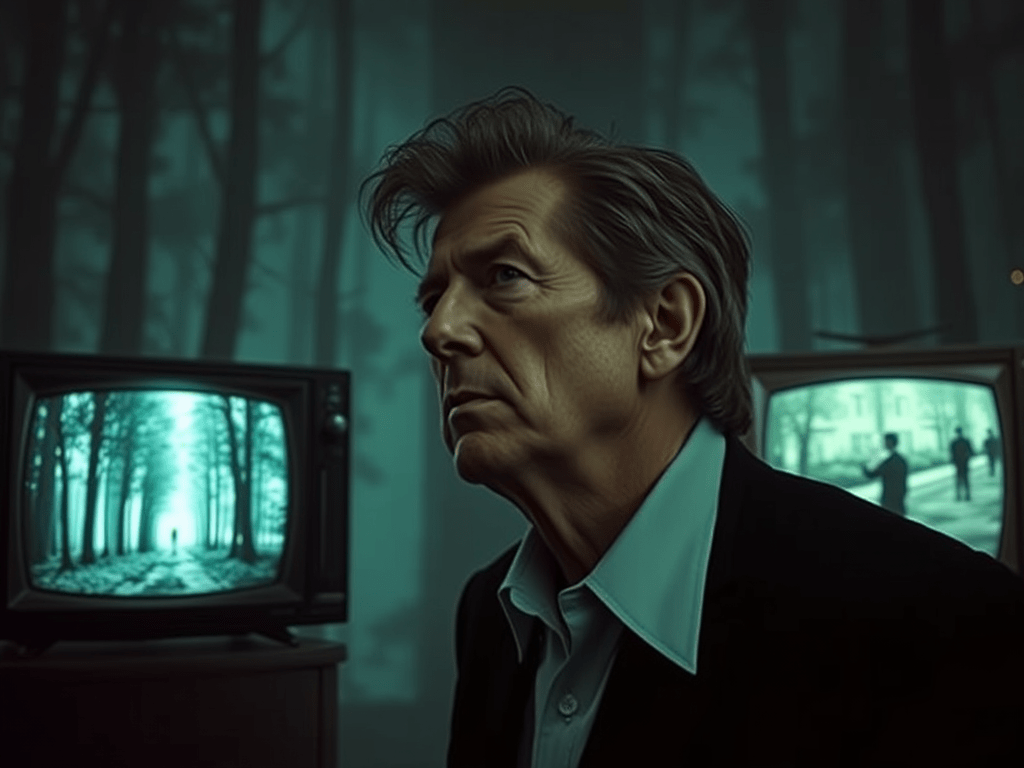
Mr. Lynch was a director’s director, an artist who operated well outside the mainstream, sometimes far outside of it, but whose appeal occasionally crossed over in both classic films such as The Elephant Man and the birth of prestige TV with Twin Peaks.
David Lynch as had a career perhaps as strange as the film’s he’s most famous for. After the death of the legendary Stanley Kubrick in 1999, I’ve claimed without hesitation that Mr. Lynch was the world’s greatest living director, and yet, in the almost twenty six years before Mr. Lynch passed away himself, he made only three films and revisited a TV series. One of them, the brilliant simply The Straight Story, was released in 1999 itself. His second, the weirdly unsettling Mulholland Drive originally began as a failed TV pilot, before he bolted on a Mobius strip of an ending and effectively turned the made for television portion into an extended dream sequence. His third, the daringly experimental Inland Empire, was filmed entirely on a primitive digital camera, not even in high definition, and was essentially an existential reaction to his failure to get Mulholland Drive produced as planned, at turns stranger than anything else he’d made in an already strange canon. Mr. Lynch’s only other “achievement” over the past quarter century was, if anything, even stranger in its conception, an 18-hour extension to his first, wildly successful TV series for a time, Twin Peaks, known as Twin Peaks: The Return, but rather than revisiting the world everyone was familiar with like most reboots, this was marked primarily by some of the weirdest sequences ever to air on Showtime. There were two full minutes of a man sweeping a floor in bar, a talking piece of steaming industrial machinery, and an extended black and white “origin story” featuring bizarre hobos looking for someone to light their cigarettes after a nuclear explosion unleashes an unnamable evil. Overall, on the surface at least for the last 25 plus years, there doesn’t seem to be much of a logical reason for Mr. Lynch to garner such accolades, and yet I am certainly not alone in my admiration for his unique genius. None other than far more acclaimed and popular director, Steven Spielberg issued a statement shortly after Mr. Lynch’s passing that captured some of his appeal, writing “I loved David’s films. ‘Blue Velvet,’ ‘Mulholland Drive’ and ‘Elephant Man’ defined him as a singular, visionary dreamer who directed films that felt handmade…I got to know David when he played John Ford in ‘The Fabelmans.’ Here was one of my heroes—David Lynch playing one of my heroes. It was surreal and seemed like a scene out of one of David’s own movies. The world is going to miss such an original and unique voice. His films have already stood the test of time and they always will.”
In that sense, we might think of Mr. Lynch as a director’s director, an artist who operated well outside the mainstream, sometimes far outside of it, but whose appeal occasionally crossed over in both classic films such as The Elephant Man and the birth of prestige TV with Twin Peaks. While many might not know his name, they might be aware somehow that he loved “damn fine coffee” and pie. They also cannot look at the media landscape today, from the moody work of Robert Eggers (The Witch, The Northman, and most recently Nosferatu) to Sam Esmail’s identity-confused TV hero, Mr. Robot with even the legendary The Sopranos in between, and not see his influence. How is that possible for such an obscure, enigmatic figure who made art perhaps even more enigmatic and obscure? However you explain it, it certainly didn’t seem likely following his first feature length directorial effort, the undeniably surreal, dystopian Eraserhead, released in 1977, where a man with an extraordinarily weird haircut and his wife give birth to a badly malformed baby. At some point sperm drop from the sky onto a stage that might or might not exist in an old radiator, where a woman with something resembling a cauliflower head sings and steps on them, and at some other point, there’s an eraser factory or something. Prior to making films in the first place, Mr. Lynch, born in Missoula, Montana, had been studying to be a painter, but after creating several short movies in an attempt to animate his artwork, he accepted a scholarship to the American Film Institute’s Center for Advanced Film Studies when he was 24 year’s old. Never one for structure or limitations, he came close to dropping out until he had the chance to to produce a script he wrote and use the entire campus as a set. Originally, he’d planned to make something even stranger than Eraserhead, if that can be believed. Gardenback was inspired by a painting he’d done of a hunched figure with, well, plants growing out of his back, and was said to be about adultery and feature a bloated insect that kept growing and growing to represent a character’s lust for their neighbor. When that was rejected, he presented Eraserhead instead and perhaps not surprisingly, it almost met the same fate until the Dean, Frank Daniel threatened to resign if the rest of the board didn’t approve the then 21-page script. Though Mr. Lynch began casting for the project in 1971, it would take six years to complete, wherein a scene of the main character opening a door and then entering a room was filmed a full year apart, giving new meaning to the phrase “shoestring” budget. The black and white movie was funded primarily through donations from friends and family, and Mr. Lynch’s own paper route, not exactly deep pockets.
As career beginnings go, Eraserhead itself wasn’t exactly marked to launch that of a would-be world-renowned artist, and yet the final product is one of those rare early works that somehow manages to capture almost every aspect of a true visionary, laying down the styles, characters, settings, and themes that would define Mr. Lynch’s work for the rest of his life. To his fans at least, Eraserhead has it all and then some. There is a setting that, while darker and more foreboding than the town of Twin Peaks, remains a character in its own right more so than a mere place, a living and breathing thing, that impacts and even threatens the characters, sometimes below their awareness, sometimes more overtly. Rather than a small town in a remote wilderness like the more famous Twin Peaks, Eraserhead owes its industrial, dystopian location to Mr. Lynch’s time spent in Philadelphia, where he’d lived for five years in atmosphere of “violence, hate and filth,” a “crime-ridden poverty zone.” Describing this period, he said, “I saw so many things in Philadelphia I couldn’t believe…I saw a grown woman grab her breasts and speak like a baby, complaining her nipples hurt. This kind of thing will set you back,” or inspire a stellar film career, I guess. Against this backdrop in Eraserhead itself, rendered in oily, inky, smoky, greyscale, characters that seem both familiar and wildly different than ordinary people must eke out an existence, as if the soot-smeared sky was weighing them down physically and emotionally. Henry Spenser is forced into a shotgun wedding after impregnating his girlfriend, who gives birth to a severely deformed child, focusing what passes for a narrative on both an everyday occurrence and the potential trauma that emanates from it, as do the scenes themselves. For example, prior to learning Mary is pregnant, he visits her parent’s house for dinner, where he is asked to carve the chicken – except it’s no ordinary chicken, it’s tiny and when he cuts into it, the little creature writhes on the plate, gushing blood. Subsequently, we can easily sympathize with the plight of a young couple dealing with a difficult baby who cries and refuses to eat. This baby, however, doesn’t even appear to be human, driving them both deeper and deeper into madness, prompting Mary to flee, Henry to consider affairs, have visions, go mad, and ultimately kill his own offspring.
At the same time, Eraserhead, like most of Mr. Lynch’s work, was never intended to be interpreted purely in terms of plot and character. If anything, Mr. Lynch wants his audience to consider what’s happening outside the frame of the movie, both above, transcending it, and primarily below, driving it in a darker, more twisted emotional sense. “Intuition is the key to everything, in painting, filmmaking, business – everything,” he has explained. “I think you could have an intellectual ability, but if you can sharpen your intuition, which they say is emotion and intellect joining together, then a knowingness occurs.” Elsewhere, he has described it as pursuing the logic of a dream. “Film exists because we can go and have experiences that would be pretty dangerous or strange for us in real life. We can go into a room and walk into a dream. If we didn’t want to upset anyone, we would make films about sewing, but even that could be dangerous. But I think finally, in a film, it is how the balance is and the feelings are. But I think there has to be those contrasts and strong things within a film for the total experience.” In another interview, he claimed “I love daydreaming and dream logic and the way dreams go.” From this perspective, even Eraserhead begins to make some kind of sense as a story of guilt, repression, loneliness, and fear. Becoming a father brings with it the joy of welcoming a new life into the world, but also anxiety and worry. For some, it can be a downright traumatic experience, especially for a young and isolated couple. Mr. Lynch dramatizes this reality, but does so in away that goes beyond traditional story telling. The trauma Mary and Henry are experiencing is visualized in the environment itself, the deformity of their child, Henry’s visions of sperm-like organisms variously being destroyed, his own desire to escape, and then ultimately his choice to stab the malformed infant to death with scissors, after revealing to the audience that its organs are held in place by swaddling. At least in my opinion, we aren’t supposed to believe these events happened in a literal sense to even a fictitious couple. Rather, we are supposed to experience the emotions a young couple might encounter when having their first child, emotions that can have an outsize impact on our perceptions and might not clearly be based in reality to begin with. If, as Shakespeare claimed, our thoughts are ours, there ends none of our own, our emotions are even stranger and more powerful, moving us from outside of our own awareness, prompting us to behave irrationally, imagine the absurd or downright dangerous, and behave even contrary to our own interests.
This is the world Mr. Lynch explores in Eraserhead and would continue to explore for almost another five decades. There are at least two occasions, however, when he would do so in a somewhat more conventional manner, starting with his next film after Eraserhead, the masterpiece that is The Elephant Man, which interestingly was produced by comic legend Mel Brooks, who had seen and was intrigued by Eraserhead. Once again, Mr. Lynch relies on black and white cinematography to tell the story of a deformed individual, used, abused and isolated before being discovered by a sympathetic scientist, but this time around, aside from two montage sequences, one where the titular character’s mother appears to get raped by an elephant, the narrative is linear, driven by dialogue and character. John Merrick suffers from a grotesquely deformative disease, so bad he cannot lie on his back without suffocating himself, and has spent his life as a carnival act until he meets Frederick Treves, a surgeon at London Hospital. Frederick shelters John and soon learns that he’s as intellectually and emotionally capable as anyone else, but this process isn’t without its own conflicts and contradictions. Rather than being a curiosity at a circus, John becomes the pet of polite society, essentially caged once more, albeit in a more comfortable Gilded Age fashion. As Frederick begins to question whether he has truly helped John or only himself, making him no better than the ringleader of the carnival, John realizes both that he is fully human and forever an outcast, incapable of living a normal life. In the final act, after being chased by an unruly mob, he speaks up for himself for the first time, declaring that he is not an animal, he’s a human being. He chooses, fully aware of what it means, to end his tortured life by going to sleep in a bed for the first time. Though the narrative is traditional, Mr. Lynch refuses to tell the audience what conclusions they should reach. Is Frederick, who raised John up and taught him that he’s a man, really no better than a carnival barker because he too profited from John’s suffering, advancing his own career? Did John, who had just gained his emotional independence, really make the right choice in killing himself or did he give up too easily? What about us as the audience, who was undoubtedly repelled by John in the first half of the film for purely superficial reasons, only to discover his humanity along with him? Are we John himself in this framing, having to discover our own humanity and decide what we will do with it, or are we carnival barkers ourselves, leering at, mocking, and exploiting those that are different from us? It is perhaps in this film more so than any other except The Straight Story that we truly understand the weirdness Mr. Lynch embraces, what has come to be known as Lynchian, is a choice. He could’ve, if he so desired, have had a more mainstream career like an ordinary director. We too make that choice in what films we want to watch, what we choose to value, how we balance the irrational with the irrational, how we let our feelings influence us for good or ill, what secrets we may keep and those we would share.
Like his films themselves, Mr. Lynch’s passing raises more questions than answers. We’re left both with the films he made, and those he might’ve been Hollywood more conducive to his sort of singular vision. Here, we find even stranger, more bizarre ideas. Immediately after completing Eraserhead, Mr. Lynch penned Ronnie Rocket, about a detective who could enter another dimension by standing on one leg. The second dimension, however, features a landscape of odd rooms and a threatening train where he’s stalked by “Donut Me,” able to wield electricity as a weapon. The film also weaves in the story of Ronald d’Arte, a teenage dwarf, who suffers a surgical mishap that requires him to be plugged into an electrical supply to continue living. Like a superhero, however, he can use this energy to electricity to make music or wreak havoc. The boy chooses to be a creator, names himself Ronnie Rocket, and becomes a rock star, befriending a tap-dancer named Electra-Cute along the way. One Saliva Bubble, conceived in 1987 along with his Twin Peaks’ co-creator, Mark Frost, imagines a government experiment gone awry, causing the residents of a small town in Kansas to spontaneously begin changing identities. A few years later, he was pitching Dream of the Bovine, which another Twin Peaks alum described as being about “three guys, who used to be cows, living in Van Nuys and trying to assimilate their lives.” Mr. Lynch tried to cast none other than Marlon Brando in this crazy idea, who, perhaps not surprisingly, described the script as “pretentious bullshit.” In 2010, it was Antelope Don’t Run No More, featuring “space aliens, talking animals, and a beleaguered musician named Pinky.” Up until he passed, he was working on ideas, perhaps each more strange than the last. He even find time to post a weather report on social media, where he talked about almost everything except the weather. His was a mind that never stopped exploring, never stopped pushing the boundaries of what he thought was possible in his chosen medium. Stanley Kubrick once said, if it can be thought, it can be filmed, but Mr. Lynch might well have gone one step further, substituting far more nebulous, inexplicable emotions for anything rational. “To me, a story can be both concrete and abstract, or a concrete story can hold abstractions. And abstractions are things that really can’t be said so well with words,” he explained. “Stories hold conflict and contrast, highs and lows, life and death, and the human struggle and all kinds of things.” When asked about what all this abstraction means, he pushed back, refusing to offer any easy answers. “It makes me uncomfortable to talk about meanings and things. It’s better not to know so much about what things mean. Because the meaning, it’s a very personal thing, and the meaning for me is different than the meaning for somebody else.” He would ultimately expand this idea to include all of life itself, saying “I don’t know why people expect art to make sense. They accept the fact that life doesn’t make sense.” Wise words from an artist who’s like we will never see again, but who like all great artists before him, made the world a richer place for all time. In this case, by living outside that place.

 Confessions of a Conservative Atheist