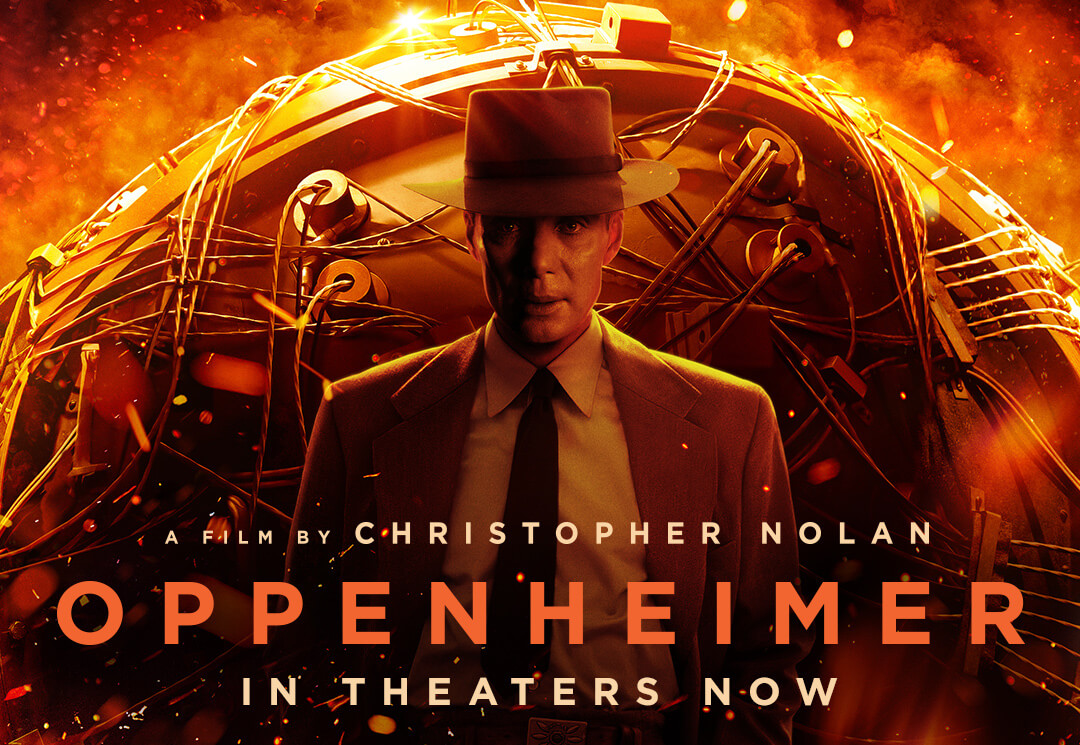
An otherwise fine movie suffers from an almost schizophrenia in attempt to devour itself, as if the goal was to put the breakdown of the atom that powers nuclear fission on screen rather than the even more incredible narratives that surrounded it.
Oppenheimer, which recently won best drama, best director, best drama, and best original score at the Golden Globes, is a worthwhile film, elevated by an excellent cast, artful cinematography and editing, sharp dialogue, and skillful direction. Few would regret watching it. Most would enjoy it and are likely to learn something about the extraordinary triumph and tragedy of the man most responsible for ushering in the atomic age, succeeding in translating quantum theory developed four decades earlier into reality, and ultimately proving to be the decisive factor in the Allied victory of Japan and a key to keeping Soviet Russia in check. I would recommend it to anyone as one of the better films in recent years, but at the risk of disagreeing with myself in the same sentence, the overall movie is also the proverbial hot mess, attempting to cram in every detail about events that spanned decades while succeeding in truly illuminating next to none of them, creating a situation where the real life history is even more amazing than it’s told. We might refer to this as the “kitchen sink” approach to the biopic, one where the person’s life, messy, complicated, contradictory, and frequently without a satisfying narrative arc, serves as the plot and the scenes are festooned upon it, rather than defining the story you want to tell and aligning the scenes accordingly. Last week, I opined that Ferrari was the best biopic since The Imitation Game because Michael Mann wisely chose the opposite approach – identifying a brief period in a person’s life and using that to tell the person’s story. I did so without having seen Oppenheimer, nor did I need to: It did not take any special insight to conclude that Christopher Nolan’s reach would exceed his grasp because it’s nearly impossible to make sense of a man’s life as some kind of ready made narrative, whoever they may be, and then end result was almost certain to be confusing and contradictory. As an old professor once told me, real life is no excuse for bad drama. Here, Mr. Nolan doesn’t suffer from bad drama, but rather too much drama, too fast with too little backstory and grounding, and no consistent point of view that would enable the viewer to interpret events or unlock any meaning.
On a basic level, Oppenheimer’s life can be divided into three parts, each with its own unique narrative concerns. There are his younger years when he was somewhat troubled and flirted with radicalism, first as an expatriate in Europe, then back in the US, but gained renown as the professor who brought quantum physics to America. There is the Manhattan Project, where he led a team of thousands in a race against time to one the greatest scientific achievements in the history of the world, one many thought was doomed to failure if not impossible in the first place. As a White House Chief of Staff described it, “This is the biggest fool thing we’ve ever done. The bomb will never go off and I speak as an expert in explosives.” Then, there is the regret he experienced afterwards for creating the bomb in the first place and starting an arms race with Russia, regret that leads him to be targeted as potentially treasonous. The earlier years set the stage for the other two, but not necessarily in the same way. His schooling in Europe and time as a professor, established relationships with other leading scientists and a knowledge of scientists working on the German project to build a bomb that proved essential to his success. The flirtations with radicalism make him an unlikely choice to lead the project and any easy target after the war. If you are focusing on the Manhattan Project, his career as a scientist is essential, but if you are focusing on the post war period, his other associations become far more important. Mr. Nolan’s attempts to tell both simultaneously result in each undercutting the other. We do not quite understand what about Oppenheimer makes him a gifted scientist and why other scientists, who are shown to be generally egotistical, hard to control, and supremely confident in their abilities to follow him. This is doubly strange when Oppenheimer is established as a theoretician, who is not good in the lab, but that goes on to lead what is essentially a tremendous laboratory in the practical application of theory rather than the theory itself. What changed? How did he manage to so successfully make the shift from thinker to practical leader, enough to accomplish what had never been done before? The flirtations with radicalism are easy to understand through the prism of youth, but the screen time consumed only pays off in one arc and not the other.
These challenges are only more acute once the focus is on the Manhattan Project and his persecution during the communist scare. The Manhattan Project, on its own, is a story of human triumph tinged with tragedy because success is the creation of a new, never before seen weapon. The project itself required Oppenheimer to recruit thousands of scientists and support staff, build what was essentially a small town in the middle of nowhere (Los Alamos, New Mexico where 4,000 people lived and worked in 300 apartment buildings, 50 dorms, and 200 trailers created literally from nothing), set up additional sites to enrich nuclear materials, and more in record time frames, and he had to do it all in secret. He then needed to lead this diverse team into the unknown, developing technology that didn’t exist, and even as it came to fruition, proved especially dangerous and difficult to predict. The logistics alone were enough to challenge a Henry Ford. The scientific complexities would daunt a Thomas Edison. It would be the equivalent of asking Karl Benz to jump straight from his first bicycle powered by an engine to a 1951 Mercedes-Benz 300. In principle, the internal combustion engine’s physics didn’t change. In practice, the two are worlds apart, combining technology of all kinds in a way that was inconceivable when the automobile was invented. That Oppenheimer pulled this all off in 2 years is nothing short of a miracle, one that is likely never to be repeated again. Because Mr. Nolan tried to include everything, the outcome of this effort seemed inevitable save in a few passing comments, requiring no special skill on Oppenheimer’s part, just a little hard work and luck. In addition, the reasons for the project as a whole, the tight time frame, and the intense security do not make sense outside the context of the war. We didn’t build the bomb because we wanted to. We built it because we believed we had to. World War II was the most destructive conflict in the history of the known universe, so staggering the numbers are almost impossible to comprehend. Somewhere around 73 million people including soldiers and civilians died between 1937 and 1945; more than a fifth of the current US population. At the time the Manhattan Project began the Nazi war machine seemed unstoppable, and the Japanese completely intractable, so extreme they would launch raids with hundreds of suicide bombers at once. The Nazi’s were also known to be working on their own project, lead by one of the pre-eminent scientists in the world, Werner Heisenberg. In retrospect, the war was winding down as the bomb came to fruition, but Japan remained unwavering in their attacks and no one had any clear idea when it would end. It was believed that hundreds of thousands, if not millions of lives were still at risk.
If those stakes weren’t high enough, the United States and the United Kingdom’s relationship with Russia was rapidly deteriorating in 1944 and 1945, as Joseph Stalin reneged on prior agreements to manage post-war Europe, seizing territory, torturing prisoners, setting up puppet regimes, and restricting the movement of Allied forces. Many in the United States government and beyond believed World War II would end only to see the birth a new, perhaps even more deadly conflict with Russia. Prime Minister Churchill described the threat in April 1945, “The whole relationship of Russia and the Western Allies was in flux. Every question about the future was unsettled between us…New perils, perhaps as terrible as those we had surmounted, loomed and glared upon the torn and harassed world.” The sudden death of Franklin Delano Roosevelt shortly after this was written and the ascendency of the little known, even less experienced Harry S. Truman to the Presidency was considered potentially catastrophic; if Roosevelt couldn’t handle it, no one thought the former and failed clothing store owner had a chance. Truman wasn’t even aware of the Manhattan Project until he sat in the Oval Office, and had no idea our relationship with Russia was on the brink. (Oppenheimer himself merely hoped that he would be a good “carpenter” compared to FDR the “architect”). The White House was desperate for something, anything that could change the dynamic and they believed the success of the Manhattan Project, still several months off, could do it. Jimmy Byrnes, who would soon become Truman’s Secretary of State put it this way, “the bomb might well put us in a position to dictate our terms at the end of the war.” Mr. Nolan, unwisely in my opinion, provides none of this crucial information to truly understand the threat and the overall dynamics, all of which came to a climax in the Potsdam Conference that July, which was barely mentioned in the film.
Potsdam, named after the ravaged Berlin suburb that served as a venue, was the first time Truman met Churchill or Stalin personally, and the first time the Allies met fully knowing the Russians could not be trusted. The Germans had recently surrendered, but the war in Japan raged on. At stake was whether any promises the Russians had previously been made could be salvaged and whether or not Russia would join the fight in Japan, even knowing that made it likely they would conquer broad swaths of China. To say these goals were at odds with what Truman and his team desired is to barely capture the reality of the no win situation they were facing – without the ace up their sleeves of the atomic bomb (Truman himself was a poker shark, known to play late night games with Churchill), it seemed inevitable Russia would do whatever it wanted and seize China on their way to Japan. As Oppenheimer himself said, “We were told that it would be very important…to know the state of affairs before the meeting at Potsdam at which the future conduct of the war in the Far East would be decided.” The movie, however, mentions precisely none of this, only that the bomb needed to be operational by July as if the date was entirely arbitrary. It wasn’t. Truman needed the bomb before the conference to fundamentally alter the dynamic with Russia. In one of those weird twists of fate that seem to define critical moments in history, what actually happened was even stranger: Oppenheimer conducted the first test, which is depicted in the film, while Truman was in Potsdam itself. A.J. Baime, author of The Accidental Presidency: Harry S. Truman and the Four Months that Changed the World described the timing, “As Churchill and Truman were conferring in the Little White House for the first time on July 16, Robert Oppenheimer and General Leslie Groves were in a control bunker ten thousand yards from ground zero.” He continued, “In one of history’s macabre ironies, the Trinity shot went off at roughly the moment when Harry Truman and Winston Churchill were striking a blow for liberty [having a shot of bourbon], unaware thousands of miles away.” Truman received word a few days later from General Groves himself on July 21 because the information was too explosive, pardon the pun, to send by cable, “At 530, 16 of July 1945, in a remote section of the Alamogordo Air Base, New Mexico, the first full scale test was made of the implosion type fission bomb. For the first time in history there was a nuclear explosion. And what an explosion!…The test was successful beyond the most optimistic expectations of anyone. Based on the data which has been possible to work up to date, I estimate the energy generated to be in excess of the equivalent of 15,000 to 20,000 tons of TNT.” Incredibly, Mr. Nolan chose not to even show the impact in the area, “For a brief period there was a lighting effect within a radius of 20 miles equal to several suns at midday; a huge ball of fire was formed which lasted for several seconds. This all mushroomed and rose to a height of over ten thousand feet. The light from the explosion was seen clearly at Albuquerque, Santa Fe, Silver City, El Paso, and other points generally to about 180 miles away.” The memo went on to report that windows were shattered a full 125 miles from ground zero.
Thus, by trying to do much, Mr. Nolan ends up doing too little. The same problem plagues the third chapter of Oppenheimer’s life, where he is betrayed by the man who hired him at Princeton University, Rear Admiral Lewis Strauss. This is a far more personal story, wherein Oppenheimer’s regret over kicking off the arms race places him at odds with Admiral Strauss as part of the Atomic Energy Commission. Oppenheimer defies him in public, mocking him in Congress for wanting to block the export of isotopes (the actual mocking was handled well in the film), and then Admiral Strauss ultimately outflanks Oppenheimer to convince Truman to proceed with the development of the hydrogen bomb. Admiral Strauss, however, continues to hold a grudge, believing scientists are too much Oppenheimer’s fanboys, and so he leaks Oppenheimer’s security file to an FBI agent, prompting him to be investigated as a potential spy. Mr. Nolan handles these scenes well in general, but the result is still tacking on a mystery to an already bloated story, and we have almost no insight into their personal relationship before their falling out, other than Albert Einstein of all people is in the mix. Instead, we jump around in time to Rear Admiral Strauss’ confirmation hearing before the Senate, and learn that Oppenheimer has struck back by enlisting scientists to savage Strauss in public. On its own, parts of this are compelling, but the constant changes in timeline, the dramatic shift from the Manhattan Project narrative, the choice to do parts in black and white and parts in color, sometimes switching between the two, and the general lack of Cold War context make it more difficult to follow and less compelling than it should be.
Even more inexplicably, this is the part of the story that was never told on film and would make for a compelling drama in its own right. Instead, it relies on things we’ve only glimpsed before, like when Oppenheimer poisons an apple with cyanide while at University, only to regret it and throw the apple away, suggesting he has potentially murderous impulses. This character trait is promptly discarded however, only to surface midway through when he mentions in passing that he was working with a psychiatrist for a couple of years after the incident. We are left with no idea of whether these tendencies were something he struggled with his entire life, or simply a momentary lapse into insanity, nor do we know about any other psychological issues that might have plagued him. Likewise, Oppenheimer carried on a long term affair with a member of the communist party, Jean Tatlock who ultimately commits suicide, but the story as told onscreen is near impossible to follow and is rendered largely meaningless. The two first meet at a Communist Party gathering, have sex, appear to break up shortly afterwards before he meets his future wife, Kitty, but then she disappears, resurfacing later as still his lover, when he rebuffs her because of security concerns regarding the Manhattan Project. Essentially, Ms. Tatlock serves as a plot device – establishing his dalliance with radical politics to give the government reason to question his loyalty later in the film. The reality of their relationship, which in real life went on for years, is swept away in service of the “twist” when Oppenheimer is transformed from a hero of the war effort into a potential villain. The viewer, meanwhile, has no idea he was still carrying on an affair, and that Oppenheimer apparently carried on many affairs, the latter fact only mentioned in passing in the final act of the movie. Kitty is presented in a bit more detail, but even then we meet her completely out of the blue, learn she is pregnant with his child and suddenly the two are married. There is the brief suggestion that she suffers from postpartum depression, but that is completely disregarded shortly thereafter, and we are left with the impression that they loved each other yet had a troubled marriage.
The failure to truly explore key aspects of Oppenheimer’s life in a meaningful way is compounded with seemingly random stylistic choices. For example, when Oppenheimer recounts his final meeting with Ms. Tatlock, Kitty imagines her naked on top of her husband while he is being questioned about his security clearance. The scene is jarring and somewhat effective on its own, but nothing like it ever happens again. Similarly, at times Mr. Nolan uses visual and sound effects to represent Oppenheimer’s emotional state, but they seem to come and go at random, lacking any consistency, or even rhyme or reason why those scenes in particular require a different treatment. It’s not that none of this is effective; in particular, when Oppenheimer is overwhelmed by the reality of what he has accomplished after the bomb goes off for the first time, but has to give a positive speech to his team, the visuals that show what he is feeling versus what he is saying are powerful. It’s that all of it seems like a plot device – as if they decided a certain scene needed extra _______ and just made up how to achieve it on the spot. In most of these cases, the film would be better served with a more natural approach and fully fleshed out narrative that visual gimmicks, but as with the kitchen sink of a story, Mr. Nolan cannot seem to help himself. To be sure, it is somewhat refreshing to see an A-list director boldly try new things, and yet he doesn’t seem to grasp that there’s a reason these techniques are rarely used, not even in most David Lynch films. In the case of Oppenheimer and his life story, truth is more amazing than fiction, the reality is even more compelling than what’s on screen, and the movie suffers from an almost schizophrenia in attempt to devour itself, as if Nolan’s goal was to put the breakdown of the atom that powers nuclear fission on screen rather than the even more incredible narratives that surrounded it. He would have been better served to tell it tight and straight.

 Confessions of a Conservative Atheist