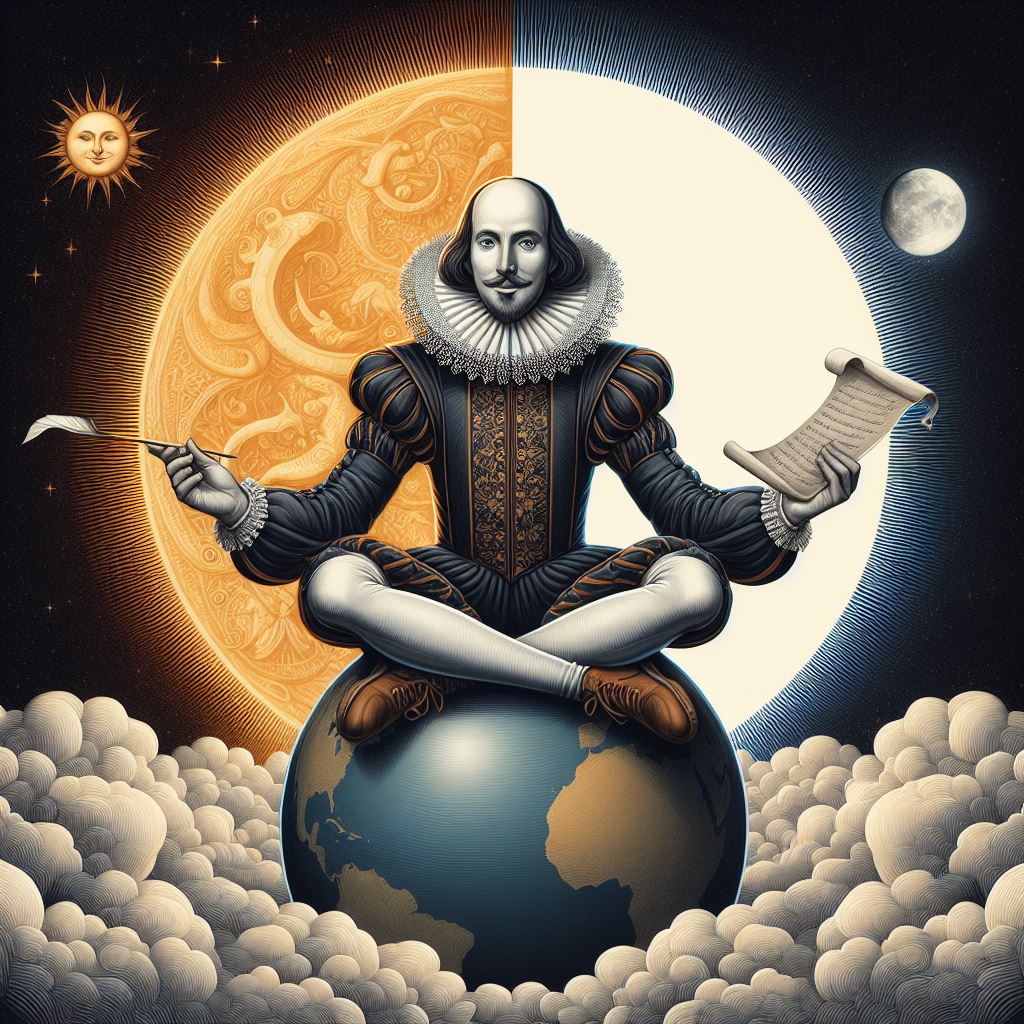
Shakespeare isn’t a puzzle box to be unlocked or a cipher to be decrypted. He is instead a universe to be explored and in that regard, no one in history has even come close. Ultimately, your opinion is likely based on your opinion on the purpose of art itself.
The 400th anniversary of the publication of Shakespeare’s First Folio, the first major printing of all his collected works and a book that would ultimately change the world, has been an occasion to celebrate the legacy of the greatest, most influential author of the English language, if not any language, who ever lived, as well as consider the less than positive opinions of his few detractors. Ironically, it is via these detractors that we sometimes see the true genius of Shakespeare more plainly than his worshippers. Indeed, we can find hints at the underlying meaning and purpose of art in general, and why art means different things to different people. Worship, one sees, is relatively easy. Given Shakespeare’s large body of work and undoubted skill at turning a phrase, praising him is not difficult. Quite literally, you can open up almost any of his plays, randomly flip to a page, and find something unique or interesting. I performed that exercise myself, randomly choosing The Tempest, Act 2, Scene 2, where Caliban discovers the new arrivals on his island have liquor. He sits with Stephano and Trinculo, who have just survived a shipwreck, remarking, “I’ll swear upon that bottle to be thy true subject, for that liquor is not earthly.” Stephano, meanwhile, is interested in how Trinculo survived in the first place. “Here, swear then how you escaped’st.” “Swum ashore, man, like a duck. I can swim like a duck, I’ll be sworn.” Stephano offers him a drink, saying “Kiss the book” instead of bottle to continue the theme of “swearing” and then notes “Thou canst swim like a duck, though made like a goose.” The reference here is unclear – perhaps Trinculo is heavy set, built like a goose, or perhaps he waddles under the excess of liquor. Regardless, Trinculo asks if he has any more booze. Stephano claims he has an entire stash. Caliban, dumbfounded at this development having been confined to the island with almost no human contact, asks, “Hast thou not dropped from heaven.” Stephano replies, “Out o’th’ moon, I do assure thee. I was the man i’th’ moon when time was.” This is far from Shakespeare’s most compelling scene, of course, but even so, at completely random, we can see some of the hallmarks. The delight in language and imagery – Caliban wants to swear fealty because they have liquor, Stephano asks Trinculo to swear how he escapes, Trinculo swears he can swim like a duck, and then asks him to swear “kiss” the bottle as if it were a bible, comparing the other man to a goose. The skill at characterization – in just a few lines, all three have unique personalities, playing off each other, revealing more or less of themselves as the conversation continues. The genius at setting a scene – Caliban is the outsider, marveling at these new arrivals. The arrivals themselves are simply trying to survive after almost dying in a storm. All are pleased they have alcohol as they banter. There is the opportunity for both conflict and cooperation, both of which will necessarily occur.
True genius, however, requires something more than all three, that hard to define element that separates Shakespeare from mere mortals and might well be missed merely by praising him. Is it the body of work, having written almost 40 plays and over 150 sonnets complete with some of the most recognizable characters in all of human history (Hamlet, Macbeth, Romeo, Juliet, King Lear, Julius Caesar, and more) or the language he deploys where a single soliloquy such as “To be or not to be” can provide the basis for at least three movie titles hundreds of years later? This is part of it, of course, but still ultimately unsatisfying, suggesting art can be reduced to a simple numbers game where more is necessarily better, evaluating the merit of a work via spreadsheet. Is it simply that his fans were the most vociferous and influential, giving him more credit than he was due and hundreds of years later Shakespeare’s popularity and influence is based on a biased assessment? Undoubtedly, Shakespeare did have some strong proponents, some who were gifted authors in their own right. Samuel Johnson, Samuel Taylor Coleridge, William Hazlitt, W.H Auden, Harold Bloom and more all helped craft his legacy, but this too seems rather unsatisfying – suggesting that the average person or even amateur scholar cannot read his work on their own and decide for themselves that Shakespeare is above all other authors. We might believe that Bloom, for example, was exaggerating, at least a little, when he claimed the Bard “taught us to understand human nature,” that his powers of characterization were “beyond explanation,” and he can only be viewed as “a system of northern lights, an aurora borealis visible where most of us will never go … almost too vast to apprehend.” This belief, however, cannot explain the remarks of someone like Maya Angelou who once wrote that she was convinced Shakespeare had to be a young black woman because his words resonated with her so deeply, reflecting her own experiences in a way that is almost shocking considering the time and distance between. In this view, Shakespeare’s cultural elevation might be partially the result of his champions, but clearly, individual readers, acting and thinking completely on their own, see something deep, powerful, and above others in his work whatever the so-called experts might think. Putting this another way, everyone on the entire planet could claim Shakespeare was overrated and I’d still think Hamlet contains every human emotion in a way no other work does. Critics are helpful in guiding our analysis, showing us what to look for, coming up with interpretations we may not have on our own, but the work speaks for itself each and every time we read or see it.
This doesn’t mean the opinions of Shakespeare’s detractors are without merit or not helpful in any way. As I mentioned earlier, they can be more helpful in some ways than the worshippers. Joseph Epstein, writing for Commentary Magazine, provides an illustration of this phenomenon in a recent article “Brush Off Your Shakespeare, A dissent on the bard.” Mr. Epstein begins by summarizing both the Bard’s supporters and detractors (the Bloom quotes above were sourced from him, though I have read the source material myself). The list of detractors includes Voltaire, George Bernard Shaw, and Tolstoy. Mr. Epstein relies primarily on Tolstoy’s criticisms, starting with “If people wrote of Shakespeare that for his time he was a good writer, that he had a fairly good turn for verse, was an intelligent actor and good stage manager—even were this appreciation incorrect and somewhat exaggerated—if only it were moderately true, people of the rising generation might remain free from Shakespeare’s influence. But when every young man entering into life in our time has presented to him, as the model of moral perfection, not the religious and moral teachers of mankind, but first of all Shakespeare, concerning whom it has been decided and handed down by learned men from generation to generation, as an incontestable truth, that he was the greatest poet, the greatest teacher of life, the young man cannot remain free from this pernicious influence.”
Tolstoy, in particular, believed that Shakespeare suffered from some kind of moral or religious failing, that is, his works were not instructive enough or he had no consistent moral point of view. Tolstoy looked too high art for religious and spiritual guidance, claiming that it should provide “not the direct inculcation of any religious truths in an artistic guise, and not an allegorical demonstration of these truths, but the exhibition of a definite view of life corresponding to the highest religious understanding of a given time, which, serving as the motive for the composition of the drama, penetrates, to the knowledge of the author, through all of his work. So it has always been with true art, and so it is with every true artist in general and especially the dramatist.” Instead, “Shakespeare always speaks for kings in one and the same inflated, empty language. Also in one and the same Shakespearian, artificially sentimental language speak all the women who are intended to be poetic: Juliet, Desdemona, Cordelia, Imogen, Marina. In the same way, also, it is Shakespeare alone who speaks for his villains: Richard, Edmund, Iago, Macbeth, expressing for them those vicious feelings which villains never express.” Setting aside the criticism of his uniformity of language – which is not even broadly agreed upon by his critics – Tolstoy looks to art for “religious understanding” and “definitive view of life” that Shakespeare simply doesn’t seem to have. Ultimately, Mr. Epstein summarized his own opinion, “What I find missing from the plays of William Shakespeare is engagement of a kind that is central to the writing I care most about. One admires his range, but not his depth. He could do comedy and tragedy, magic and realism, fools who are intelligent and kings who are fools, witches and bitches both. Yet he tends to view the world of his characters from 30,000 feet above the earth. More amused than concerned about the moral complexities of their plights, he sometimes seems more puppet master than playwright. Let others read him and rave on, I, for one, have had my fill of the old Bard of Stratford on Avon.”
At the risk of contradicting myself as a Shakespeare worshipper, there is some truth to this, both Tolstoy’s criticism and Mr. Epstein’s more generalized gripe. Shakespeare does not provide any answers or any guidance, refusing to be concerned about “moral complexity” in the sense that he does not comment on anything and nothing seems his concern. We do not find moral instruction or enlightenment in his work, nor do we find anything resembling a consistent point of view. For a man who wrote so much about so many things, we know precisely nothing about what Shakespeare himself thought about anything. We have no idea if he considered himself a religious man, or what he thought about the political, religious, and spiritual squabbles of his day. Shakespeare is not our teacher in that sense. One might say he flat out refused to be one given anyone with his poetic talent could easily have resorted to moralism. He is instead far closer to an astronomer who catalogs the stars, probing their composition, organization, and inner workings, but steadfastly refusing to comment on what it might mean to you personally to walk under a clear sky at night. Are you to believe the heavens happened by accident? Arose from some cosmic plan? Are they there simply to add beauty to the darkness? The astronomer, as a scientist, doesn’t opine. He or she, instead, tells you what’s out there and leaves it for each individual to interpret what it means (or doesn’t mean) to them personally. Similarly, Shakespeare’s subject was humanity, every glorious, tragic uncertainty and contradiction. He explored it all the same way an astronomer might map the stars, and yet he comments on what none of it means, holding up a mirror to ourselves and allowing us to see or own thoughts and emotions reflected in kings and queens, serfs and peasants, tragedies, comedies, and romances. He does not, however, tell us what is true or false, just or unjust, moral or immoral, right or wrong, simply what is, leaving it to the reader or viewer to decide for themselves what import or meaning to place upon it.
Falstaff, the lovable rogue from Henry IV Part 1 and 2 (and The Merry Wives of Windsor), is perhaps the character that makes this approach most plain. Unlike Shakespeare’s other legendary personalities, we have no access to Falstaff’s thoughts. He does not deliver any soliloquies to explain or rationalize his actions in any way. He doesn’t even speak in verse. Instead, we must take him only by what he says and does in as plain an English as Shakespeare gets. Like Shakespeare’s other characters, however, he appears to the reader or the audience as a bundle of contradictions, a person that simply cannot exist – indeed many have claimed the role is the most difficult in the entire canon, near impossible to perform properly – and yet there is a realism to him, for everyone knows someone with at least some of these qualities. Falstaff is a knight and we can see flashes of wit, charisma, and charm, perhaps even a certain greatness, but he behaves himself like a scoundrel, lying and scheming as easy as breathing. He drinks all day, plots and executes robberies, makes up stories, and is also a coward, running and hiding from danger. He describes himself in near-tragic jest, “If sack (cheap wine) and sugar be a fault, God help the wicked! If to be old and merry be a sin, then many an old host that I know is damned: If to be fat be to be hated, then … banish plump Jack, and banish all the world.” He is concerned first and foremost with the pleasures of the moment, commenting on the world as it is, not really as he would like it to be. “What is honour?” He asks in typical fashion. “A word. What is in that word honour? what is that honour? air. A trim reckoning! Who hath it? he that died o’ Wednesday. Doth he feel it? no. Doth he hear it? No.” The closest he gets to a theory on anything might well be that he is a wild, unrestrained child of the night, rationalizing his bad behavior and recommending it onto others, even the future king, because it is their nature. “Marry, then, sweet wag, when thou art king, let not us that are squires of the night’s body be called thieves of the day’s beauty. Let us be Diana’s foresters, gentlemen of the shade, minions of the moon, and let men say we be men of good government, being governed, as the sea is, by our noble and chaste mistress the moon, under whose countenance we steal.”
In other words, he is id and appetite unrestrained, engaging and fascinating, but not someone anyone in their right mind would want to spend any time with by any means unless they want their wallet stolen – if you only look at him from one perspective. He is given depth, however, because he truly loves at least one thing in life, Prince Hal, soon to be King Henry V. How the relationship between these two disparate men began or what brought them together is unexplained, but the obvious affection and corresponding emotional depth is undeniable. (For that matter, what made Falstaff the way he is, is also completely unexplained.) It is not an exaggeration to suggest that Falstaff can be seen as Hal’s adopted father, while his own kingly one is occupied with his duties running the country. Together, the two exchange witty banter, drink a lot of sack, plot pranks, and generally speaking, have a grand old time over the course of thousands of lines across two plays, reveling in their comradery in the classic way many men do to this day – until Hal ascends to the throne and becomes Henry V, that is. Then, in one of Shakespeare’s most gut wrenching scenes, Henry banishes Falstaff at this moment of triumph rather than embracing him. Falstaff greets the newly crowned king, hopeful that their relationship will prevail. “God save thy Grace, King Hal, my royal Hal…God save thee, my sweet boy!” The King, however, refuses to even address him directly, telling his Lord Chief Justice to do the dirty work. “I know thee not, old man. Fall to thy prayers. How ill white hairs becomes a fool and jester. I have long dreamt of such a kind of man, So surfeit-swelled, so old, and so profane; But being awaked, I do despise my dream.” Shakespeare leaves it to us to decide what to make of this development and their overall relationship. We’ve seen them together across two plays and have every reason to believe their relationship was real, but can’t help think: Was Hal using Falstaff merely for support or political gain, knowing he was going to banish him once he ascended the throne? Was perhaps Falstaff using Hal as well, hoping to cultivate a connection once he was king? Or were they truly two comrades in arms for a time who were ultimately torn apart by fate, knowing a character like Falstaff had no place at Court and couldn’t be trusted there? If so, what did each see in the other that was so special? Who was right and who was ultimately wrong?
I’d argue that these questions are impossible to answer because any answer is going to depend largely on whose perspective we take and who we choose to sympathize with at the time, and this element of Shakespeare – that something always lies beyond easy explanation – is by design. We know Falstaff is a scoundrel, and yet we feel for him when Henry banishes him. Whether or not Henry is right in this regard depends on how we ask the question. Emotionally, he can clearly be seen to be wrong, banishing one of his closest comrades and crushing him in public – unless we assume Falstaff has been courting Hal only for a future reward, using him because one day his investment will pay off. Henry is king, however, and to be a great king, one must make decisions about what is best for the country, not themselves personally. From this vantage, Henry is clearly correct – unless we assume he was using Falstaff for sport the entire time, relying on him when it suited his purposes, knowing all along that he would banish him one day. On quite another level, does it even matter when they truly were comrades, bosom buddies at some point? Few, if any of us, can be said to engage in “pure” relationships. There is a transactional element to everything we do, even with our closest loved ones. To a large (and rather cynical extent), it might be said that every relationship we have is primarily based on what it does for us now and in the future, even if it is only how another person makes us feel in the moment. Shakespeare, somehow, manages to include all of this and more in the strange bond between two disparate men. In a nutshell, to use one of Shakespeare’s own choice words in Hamlet, this is his genius, but if you are looking for straightforward answers or any direction on how to live your life you will not find it, save what you reason out yourself. Shakespeare isn’t a puzzle box to be unlocked or a cipher to be decrypted. There is no single interpretation of anything he wrote that will suddenly illuminate the text and enable you to perceive the truth. He is instead a universe to be explored, a mirror of ourselves, and in that regard, no one in history has even come close. Ultimately, your opinion on him is likely based on your opinion on the purpose of art itself. Is the artist an instructor, telling us what and how to think, or are they an explorer themselves, probing the depths of all of our natures?

 Confessions of a Conservative Atheist