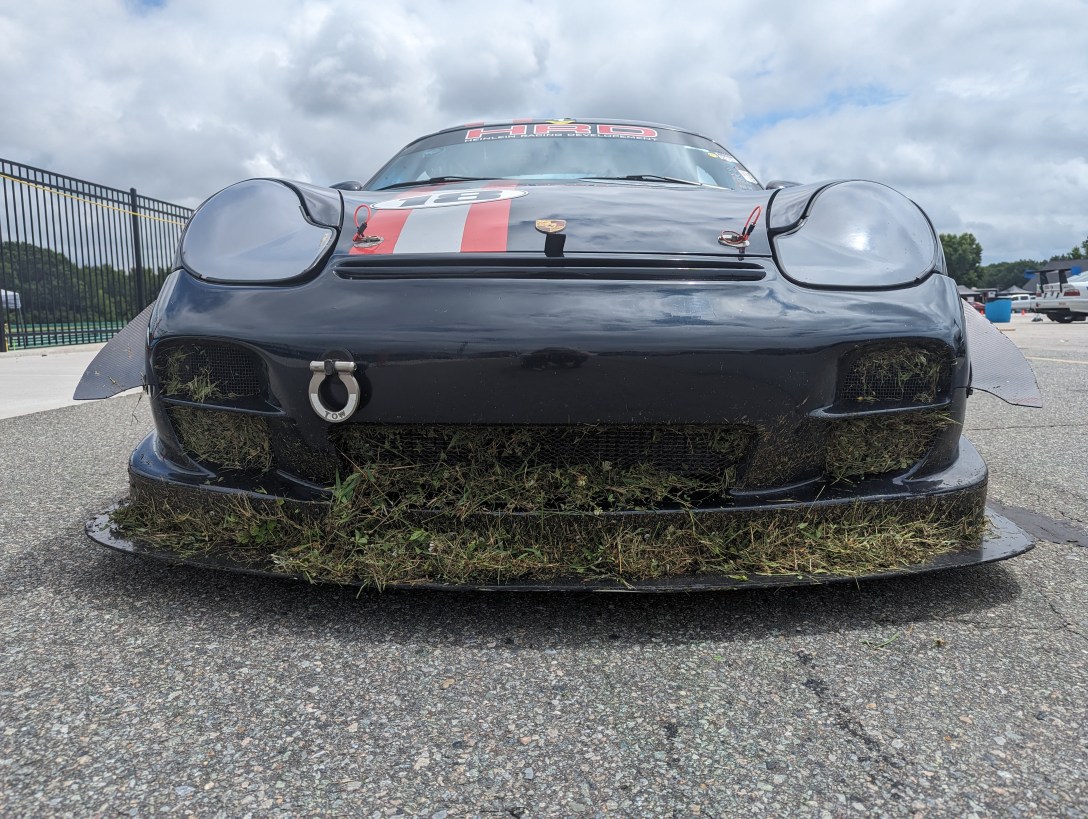
There is no politics or religion at 100 plus miles per hour. There is no conservative versus liberal going up the Climbing Esses at VIR. Your religion doesn’t matter on the Rollercoaster. No, you might never drive a racecar, but racing is not the only community out there.
Racing isn’t for everyone. I think a reasonable percentage of people fancy they like to drive fast and imagine what it would be like to be behind the wheel of a race car, but it takes a special sort of ___________ to actually strap into a fire suit and do it. You can fill in the blank with a wide variety of words, everything from gearhead to adrenaline junky if you are being generous, to fool and insane enough if you wish to view things from a more negative angle. Whatever word you choose, racing is a daunting proposition. It’s not simply driving fast on a purpose built track. For starters, your body is encased in three layers of fireproof material known as Nomex, supposedly enough to give you 90 seconds to escape a conflagration, not exactly a comforting thought. There is no exposed flesh. Your head is wrapped in a baklava, covered with a tight fitting helmet that weighs several pounds. The helmet is connected to your shoulders via a head and neck restraint, which will save your life in the result of an accident, but doesn’t allow you to look up or down, or far left or right. There are special gloves and of course special shoes, and this is all before you actually get in the car. Inside the vehicle, there is a six point harness that comes over your shoulders, around your hips, and between your legs, locking everything in place right in the middle of your torso. Unless you have a death wish, these harnesses are all tight, so tight you cannot move the core of your body, only your arms and legs. The seat itself has bolsters on the right and left of your head, limiting your vision to what is directly in front, and less than 30 degrees in either direction. The driver’s window is covered by netting anyway, and there is usually another set of webbing on the right side. The result is good forward visibility, but nothing else outside the mirrors. This is well enough given there isn’t much to see in a race car. The inside panels of the doors have all been removed, the handles replaced with wire. The carpet of the floors, middle console, and anything unnecessary are also stripped away. The inside of the body panels are fully exposed, and it’s not unusual to have a portion of the dashboard removed. The gauges are all you care about anyway, and in that regard there is normally a custom digital display right above the wheel. The problem with the lack of visibility only becomes apparent when cars seem to suddenly appear behind you, and you are forced to judge their position, frequently at speeds over 100 miles per hour, purely based on the limited view through the mirrors.
I do not write this to brag or claim I have any special skills or talent, only to describe how different the theory of driving a race car is from the practice. Once you are out on the track, I think most people tend to assume from watching NASCAR or F1 that the cars are capable of achieving approximately the same speeds, acceleration, and cornering, but this is not normally the case in grassroots racing, where there are all sorts of different cars on the same track at the same time. In series like American Endurance Racing, World Racing League, ChampCar, or LeMons, the cars are organized into classes via a variety of means, either based on your actual lap times on the track during qualifying or a points system that attempts to measure the overall performance. Whatever the case, the result is cars of vastly different speeds competing at the same time. If you have a lower powered car, there are other vehicles on the track that can pass you by practically as if you were standing still. These cars appear in your rear view mirror and seem to fast forward all the way in front of you. Given most race tracks have turns, your rear view mirrors aren’t necessarily reliable either, showing the woods or an open field behind you, rather than the cars. It’s not infrequent to complete a turn, only to discover a faster car practically on your rear bumper, as if it fell from the sky. If you are in a higher powered car, the opposite is true. You come up on cars so fast, you can only hope they’ve seen you as you execute a pass going into a high speed turn or even in the middle of one. There are, of course, no lanes on a track, meaning a car could be anywhere, sometimes even off the track proper, and cars moving at high speed are subject to the effects of high momentum. You might enter a turn on the inside of the track, but exit it on the far outside. If someone is going through the turn next to you, physics itself might carry you directly into them, however you turn the wheel. Considering the number of cars on track, normally forty plus, or in some cases over a hundred, this presents no shortage of opportunities for what are euphemistically called “racing incidents.” In other words, accidents, often at high speed. Accidents are, unfortunately, inevitable in racing, there is no way to reduce the number to zero. There will be thousands of turns and thousands of passes over the course of a race weekend. The numbers alone mean someone is going to collide with someone. It’s a question of when, not if, and how much damage.
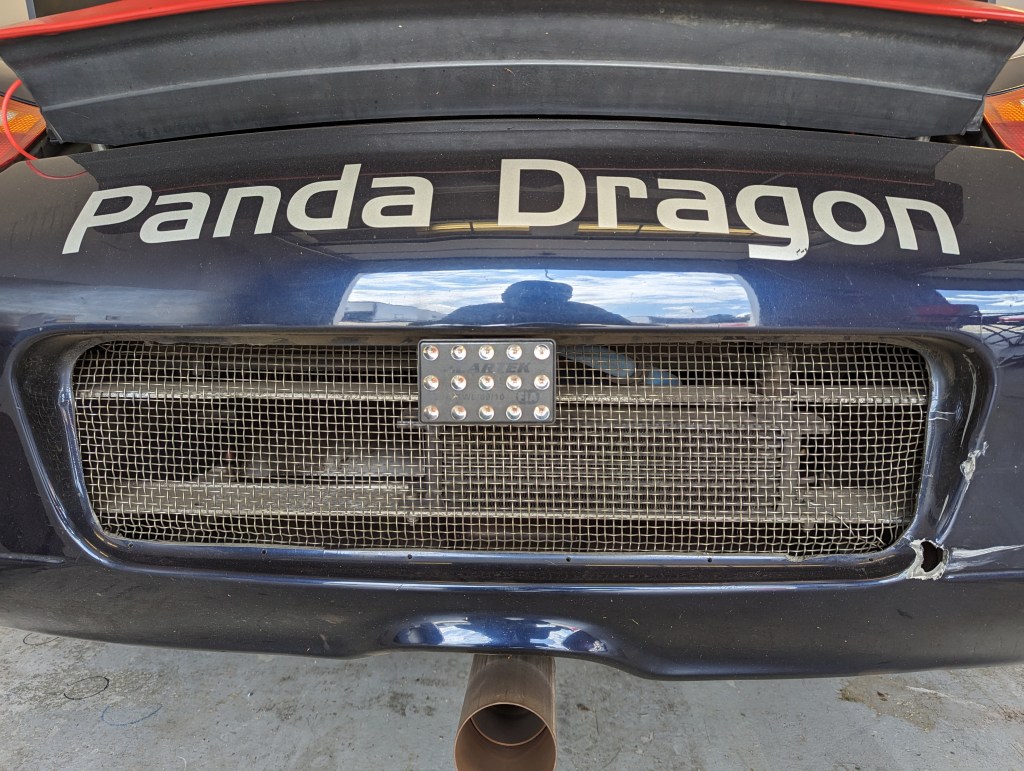
At the same time, the number of accidents compared to what the cars are actually doing is almost surprisingly low. Consider Virginia International Raceway (VIR), one of America’s most famous tracks, located in Alton, Virginia. There is a sequence known as the Snake that runs into the Climbing Esses. The sequence begins with a tight right turn leading into a left, right, left series where the track itself is too narrow for two cars. Each of these turns is marked by curbing on either the right or the left. You exit the tight right turn at full throttle, then careen from one set of curbing to the other while keeping your foot on the gas the entire time. If you hit the curbing too hard, your car will lurch or even leave the track. If you do not hit the curbing, your car might well not be on the right line, meaning it could spin out, fly off the track, or you are simply going too slow. The Snake exits into a “gentle” right hand sweeper before the Esses begin, left, then right, then left, then right, all uphill. In racing, uphill means you can go much faster through a turn because the car is pressing against the ground. In this particular case, you will enter the Esses making a left hand turn at over 110 miles per hour in even a relatively lower powered car, do your best to keep the accelerator at full throttle all the way up, once again careening from curbing to curbing, and then exit at the top somewhere over one hundred miles per hour. Writing this is much easier than doing it. There is a tendency to believe that if the car is capable of such a feat, the driver need not do much other than press the gas and turn the wheel, as if the racetrack was a highway. When you are actually in the car, however, things look rather different, especially when there are other cars around you, all trying to go their very fastest from turn to turn. The scream of the engine at full power makes it clear you are not attempting anything ordinary, even forgetting the race seat, fire suit, and helmet. The heat inside the passenger compartment is intense, even on colder days and even with a cool suit pumping cold water through your chest. This should not be surprising when the water temperature hovers around 220 on a hot day and the oil coursing through the engine reads 260. The brakes will smoke afterward, far too hot to touch along with almost all of the exposed metal. You can quite literally smell it during and after a session.
The momentum of a car turning at speeds over 100 miles per hour is equally unmistakable, especially when the smooth surface of the track turns into the bumpy curbing, raising either the right or left side by an inch or more at speed. The result is something far closer to a rollercoaster than a road, and indeed there is a section of VIR known as the Rollercoaster. There is the sense, even when it is not accurate, that you are hovering just on the edge of control, as if some gossamer thread connected you to the car and the car to the road, even as you push the car further and further, flying up the turns, bumping up against the curbing and bouncing off, ultimately launching yourself off the top as if it were a ramp and you might well kiss the sky. The thread is thin and fine, gleaming before you like a fishing line, defined by the pull of the vehicle and the slight squeal of your tires biting into the pavement. It will not break if you are appropriately gentle; if you listen to what the car tells you through your hands, feet, and body, as though it were a lover, everything will stay in sync and remain properly connected. This sense is both true and false, an illusion that seems real until it isn’t and is then revealed as smoke and dust, often in an actual cloud of smoke and dust. Control in these situations only exists to a point. If you are within the limits of the car, assuming you know what those limits are, control is possible for a time, but a mere couple of inches either way can result in a disaster, what we call driver error or simply running out of talent. A blink at the wrong moment, a slight overcorrection on the steering wheel, even ironically letting off the gas and unsettling the car at an inopportune time, and all is all lost. If you exceed the limits of the car, something on the car itself fails, a not infrequent occurrence given the stress on a mere machine, or encounter some debris on the track, only a miracle can save you. At its core racing is physics, primarily the law of conservation of momentum. The key, in this view, is to find the line around the track where the car needs to turn the least, keeping changes of momentum as low as possible and speeds as high as possible. Momentum, under control and within the limits of the tires and brakes, can be harnessed to achieve tremendous speed and take turns so fast it astounds the uninitiated. Momentum outside the limits results in disaster, and disaster is only a fraction of a moment away most of the time.

The question arises: Why does anyone do it in that case, knowing that no matter how good you are, no matter how careful or controlled, a racing incident of some kind is inevitable? Personally, I came to the sport later in life, never having thought I’d actually do it and bringing only a love of cars in general with me. I had no plan, no real experience, and not much talent. I also rarely do anything outside of work that doesn’t involve alcohol. In fact, when my then fiancé asked me if I was really going to fork over thousands of dollars to suit up, I joked that she should be happy I was finally choosing an activity that didn’t involve drinking. This, I believe, gives me something of a unique perspective. There is the thrill, of course, and the magic of the machines themselves, mechanical works of art tested to their very limits. I would also suggest something deeper at work, at least for me, though it was surprisingly unexpected: The feeling of community. When you are at a race, there are hundreds of people sharing the experience with you. They are competing against you, yes, but you are one of them and they are one with you. Everyone descends on the track on Thursday or Friday, towing their car, carting the carloads worth of equipment, tools, and assorted gear supporting a race weekend requires. They unload, organize, and prepare themselves for the event. The garages are teeming with engines and tools, somewhere, someone fires up a BBQ. Elsewhere, people are sitting and chatting, making last minute adjustments, giving and receiving last minute tips. Greetings are made, stories are exchanged, bonds are built. When needed, help is offered, a necessary tool or part loaned, even someone lending you expertise you don’t have but desperately need to get back out on the track. I’ve been fortunate enough to race in the same league for the past seven years along with several other teams. The cars might change, but many of the faces remain the same. These are people I know beyond the bounds of work or school, the confines within which most of my social network exists. People I would not have met if I didn’t race, knowing nothing of their lives or personal stories. The bond between us is the sport itself and the particular league.
It can seem tribal, yes, but it is not of the tribalisms that have come to define this country, those that seem close to tearing us apart. There is no politics or religion at 100 plus miles per hour. There is no conservative versus liberal going up the Climbing Esses at VIR. Your religion doesn’t matter on the Rollercoaster. All that matters is how you drive and how you conduct yourself outside the car. In that sense it is both more tribal and more primal, existing on a level beyond any “ism” you can name, making it more essential. If you think the country is in danger of a civil war, visit a race track on a racing weekend, and see for yourself how people come together in a world beyond the differences we hear far too much about in our regular lives. Putting this another way, there is a whole world out there where people actually get along without caring who you voted for in the last election or what you think of the latest Supreme Court decision. You might never drive a racecar, but racing is not the only community out there. If you want to find out what this country is really like, find the community that’s right for you and start doing it. Somewhere, a world you didn’t expect is waiting for you.

 Confessions of a Conservative Atheist
Wow! Not for me. But great job.! Thanks
LikeLiked by 1 person
[…] Everyone needs a racecar or something like it in their lives — Confessions of a Conservative Athei… […]
LikeLike