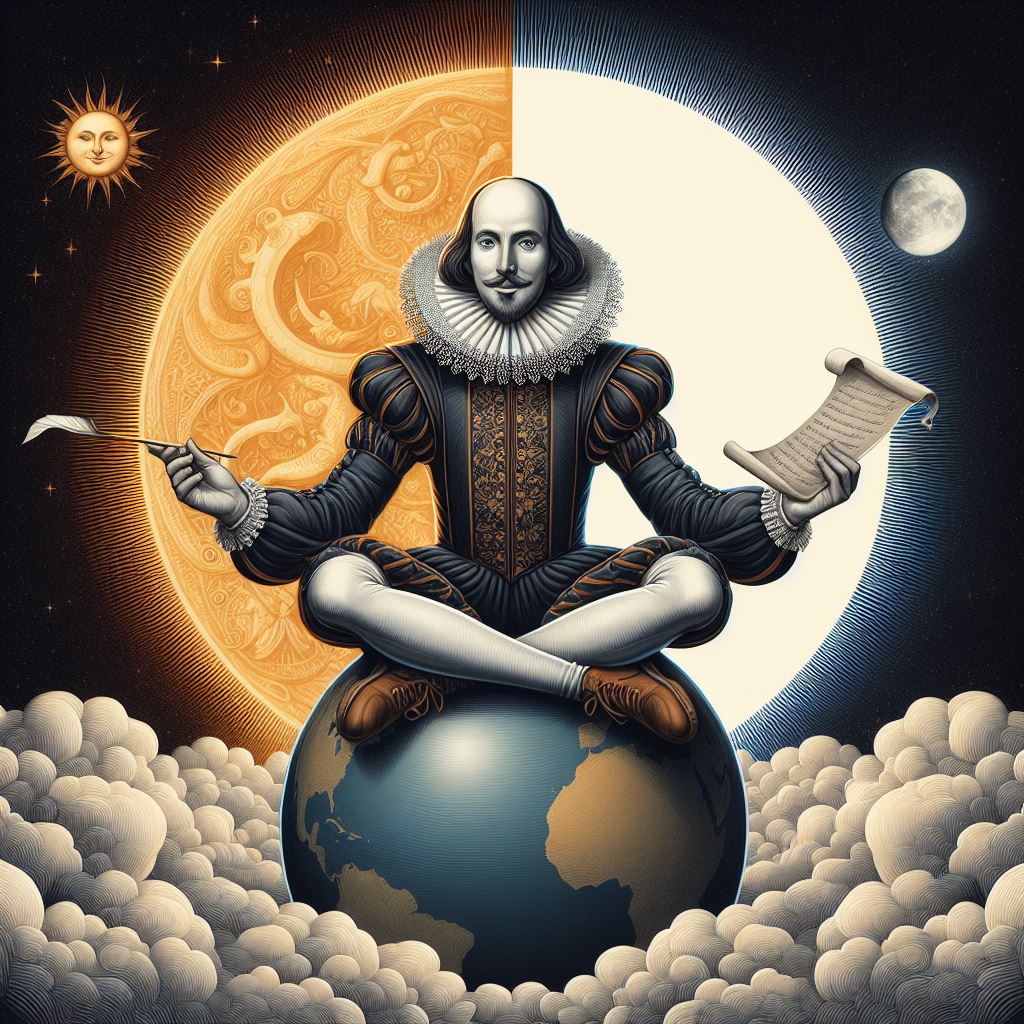
The Bard wasn’t a scientist, unless you consider him an explorer of the human mind as some critics have asserted, and yet if we can divine one overarching theme he pursued, we might say it is uncertainty itself. Sonnet 94 is perhaps his greatest achievement in this regard, as the meaning changes based on the… Continue reading Shakespeare’s quantum mechanics in verse form
Tag: hamlet
I could be bounded in a nutshell, Shakespeare’s genius in three cryptic phrases
In one sense, Hamlet spins out the statement in a play of words, not intended to have any logical meaning, but to confuse his audience, hiding his real thoughts beneath the mask of insanity. In another, it contains the meaning of the entire play and Macbeth besides. O God, I could be bounded in a… Continue reading I could be bounded in a nutshell, Shakespeare’s genius in three cryptic phrases
Time, consciousness, and the constancy of the two
It is a sign of our times that a green haired, eye-shadowed non-binary person wearing a dress with hairy legs sums up the position of establishment scientists for the BBC more succinctly than many of them ever would or could. The establishment, as ever, is likely wrong... We are prisoners of our minds and the… Continue reading Time, consciousness, and the constancy of the two
An atheist’s case for optimism in the face of oblivion
There might have been a time when existence was so bleak and life so cheap, humanity had little choice except to hope for more, but that period has long passed and developed countries, at least, are world’s of plenty. As an atheist, I’ve been occasionally asked how one copes with the idea that this life… Continue reading An atheist’s case for optimism in the face of oblivion
Celebrating 500 posts: Why and how I write
My writing process can best be described as vomiting on the screen and sifting through it in search of an editable morsel. The morsel is then preserved as I throw up again and repeat the process. Many morsels do not make it, some do as the process repeats itself into something resembling a final product. … Continue reading Celebrating 500 posts: Why and how I write
This Christmas let thinking make it so and be merry from the inside out
Hamlet’s lessons for a happy holiday season and a successful life in general. Who knew Shakespeare’s tragic Danish Prince could offer such good advice on positive mental health while careening towards a bloody end for him and his entire family? “There is nothing either good or bad, thinking makes it so.” Hamlet speaks these few… Continue reading This Christmas let thinking make it so and be merry from the inside out
Station Eleven, Hamlet, and the importance of the stories we tell each other and ourselves
HBO Max’s Station Eleven could’ve been a standard post-apocalyptic drama, but the introduction of a traveling caravan of actors who perform Shakespeare after the world ends, transforms the show into a story about stories. Their importance, their interpretation, how they are shared and how they change over time, something made apparent in the very first… Continue reading Station Eleven, Hamlet, and the importance of the stories we tell each other and ourselves
Hamlet, The Northman, and Shakespeare’s genius through the looking glass
Robert Egger’s The Northman is based on the same source material as Shakespeare’s Hamlet, a Viking legend circa 1,000 AD, but takes a completely different path, crafting an almost anti-Hamlet. This “Shakespherean” mode of adaptation presents unique opportunity to return to Shakespeare’s original roots and illuminate both works. Despite attempts to cancel the world’s greatest… Continue reading Hamlet, The Northman, and Shakespeare’s genius through the looking glass
“To be or not to be” is the most famous speech in the English language, but what does it really mean?
On the surface, Hamlet ponders life and fear of death, but the subtext veers far beyond that into morality and conscience, reflecting the themes of the play and the broader range of the human condition. Not bad for a speech that seems almost accidentally stuck into the final product, as if Shakespeare wrote it for… Continue reading “To be or not to be” is the most famous speech in the English language, but what does it really mean?
Negative space: How the things left unsaid connect the diverse genius of Shakespeare, Kubrick, and Springsteen
Three very different masters of their craft, three unique mediums, one connecting concept that illuminates what makes their work timeless and yet somehow outside our reach at the same time Like William Shakespeare, Stanley Kubrick can be something of an acquired taste. People are vaguely aware of the reputed genius, but prefer to appreciate it… Continue reading Negative space: How the things left unsaid connect the diverse genius of Shakespeare, Kubrick, and Springsteen