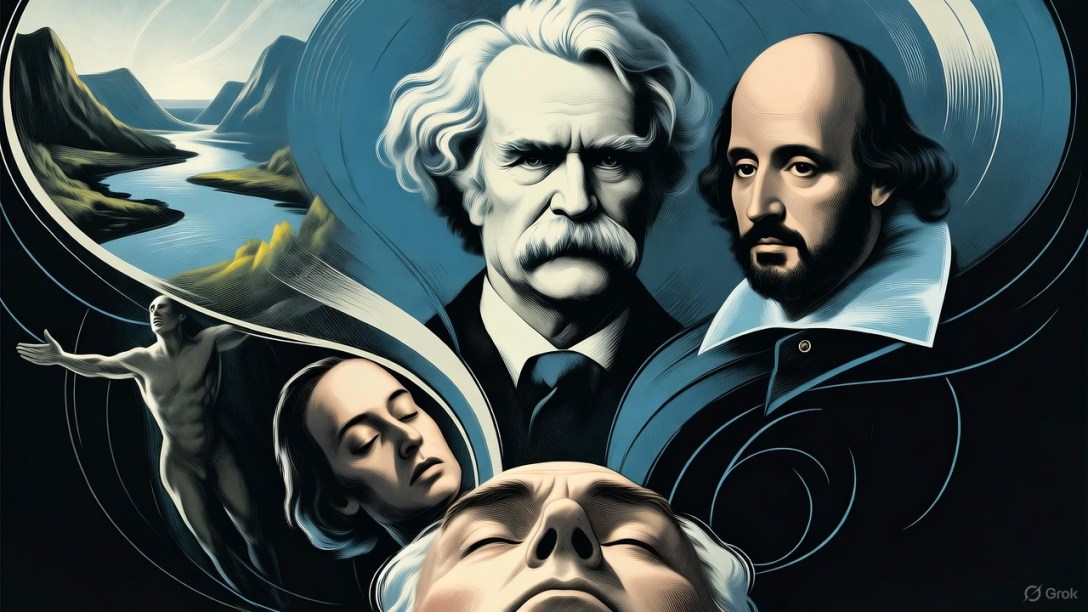
Sleep, death, and the limits of Mark Twain and William Shakespeare

Sleep and death

If only we could sleep as easily as we can die.  I could end my life in an instant, but for reasons that defy explanation, simply putting the mind to rest for a few hours can prove impossible.  If only we could sleep as easily as we can die.  I could, if I chose, end… Continue reading Sleep, death, and the limits of Mark Twain and William Shakespeare

Evolution, two recent discoveries, and how there remain more things in heaven and Earth than are dreamt of in our philosophy

Scientists discover a new cell that lives like a virus and a new rule of life that can best be seen as the opposite of a regular rule, introducing chaos into the operation of a cell at a fundamental level. Scientists like tidy groupings, where you are either in or you’re out.  At least since… Continue reading Evolution, two recent discoveries, and how there remain more things in heaven and Earth than are dreamt of in our philosophy

New Year’s, the mysteries of aging, and whether we’d really want to go back in time to be our younger selves

It’s human nature, but if you value what you have now, what you’ve seen, done, and hopefully learned, why would you want to go back to a point where you had none of it or at least less of it? Aging is a funny thing to say the least.  I suspect almost all of us… Continue reading New Year’s, the mysteries of aging, and whether we’d really want to go back in time to be our younger selves

“We fat all creatures else to fat us, and we fat ourselves for maggots,” how Shakespeare captures both the circle of life and the futility of existence in a single sentence

The entire aside is unnecessary purely in terms of the plot, but Hamlet remains about far more than that.   Perhaps, it is best seen as a vessel for ideas, where they come from, how they evolve, and where they go, and the beings that carry them. The eminent literary critic and scholar Harold Bloom once… Continue reading “We fat all creatures else to fat us, and we fat ourselves for maggots,” how Shakespeare captures both the circle of life and the futility of existence in a single sentence

Lessons on the passing of an aged coonhound

Are we masochists when it would be much, much easier not to have one in the first place, both in terms of mourning their loss and the truth that this animal depends on you for everything?  Or does it represent something far more wonderful and special in human nature, that we voluntarily bring another creature… Continue reading Lessons on the passing of an aged coonhound

Shakespeare’s Sonnet 73, the “Bare ruin’d choirs, where late the sweet birds sang,” and the meaning of love itself

Love can sing to us, sweetly, and we can build an edifice upon it for that special choir, an edifice composed of both the joy we have in our lover and the fears of how it will end, for everything is ultimately “ruin’d” in this world, but in Shakespeare’s, even a single intentionally shortened syllable… Continue reading Shakespeare’s Sonnet 73, the “Bare ruin’d choirs, where late the sweet birds sang,” and the meaning of love itself

I could be bounded in a nutshell, Shakespeare’s genius in three cryptic phrases

In one sense, Hamlet spins out the statement in a play of words, not intended to have any logical meaning, but to confuse his audience, hiding his real thoughts beneath the mask of insanity.  In another, it contains the meaning of the entire play and Macbeth besides. O God, I could be bounded in a… Continue reading I could be bounded in a nutshell, Shakespeare’s genius in three cryptic phrases

“To be or not to be” is the most famous speech in the English language, but what does it really mean?

On the surface, Hamlet ponders life and fear of death, but the subtext veers far beyond that into morality and conscience, reflecting the themes of the play and the broader range of the human condition. Not bad for a speech that seems almost accidentally stuck into the final product, as if Shakespeare wrote it for… Continue reading “To be or not to be” is the most famous speech in the English language, but what does it really mean?